Higher: the electron account of metal–acid reactions
By UK GCSE Chemistry · independent study · myAudience
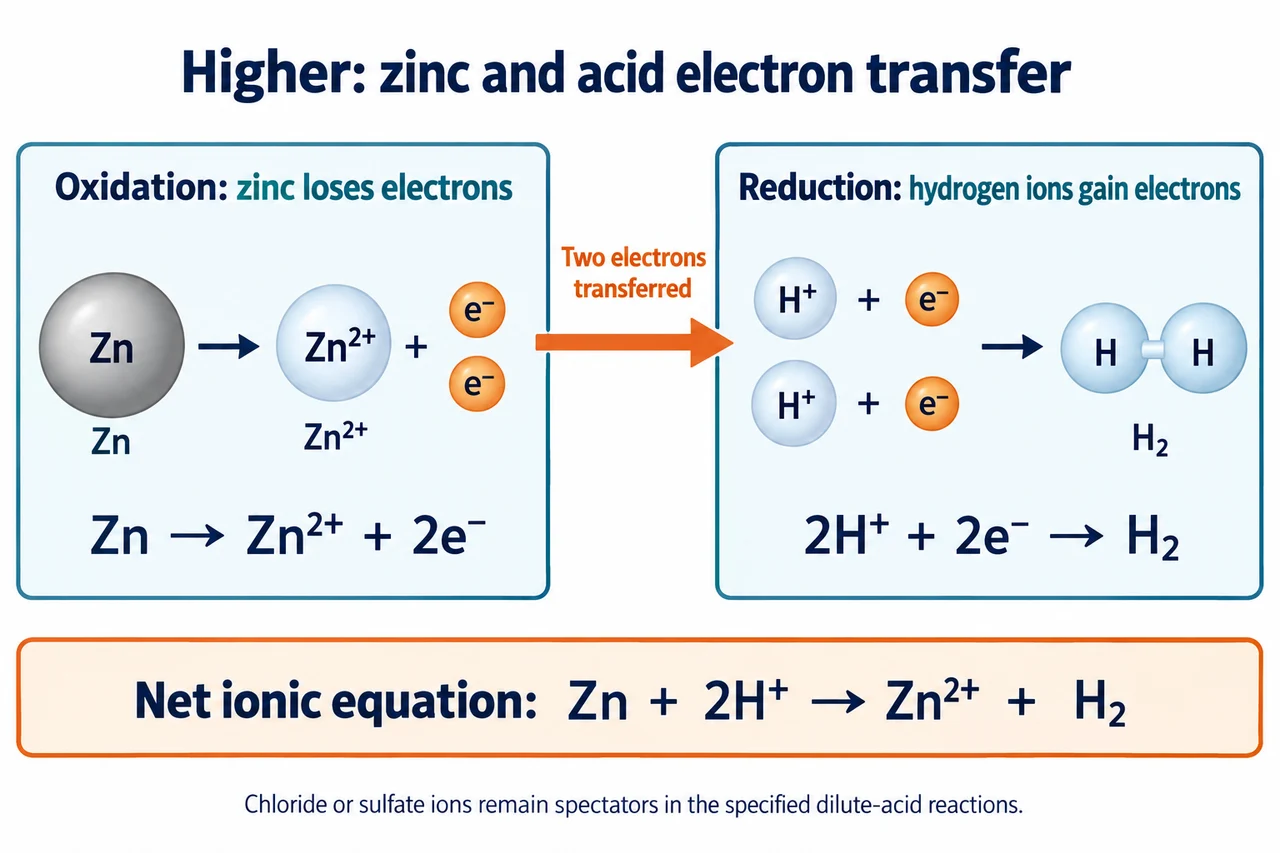
Image: illustration, not a documentary photograph. Original teaching model created for myAudience. · Original generated teaching raster; no exam-board or textbook artwork copied.
Higher: the electron account of metal–acid reactions
This Higher-only companion separates an assessed electron explanation from the common-tier prediction of salt and hydrogen. Magnesium, zinc and iron react with the specified dilute hydrochloric or sulfuric acid at room temperature. To explain why these are redox reactions, track which chemical species lose electrons and which gain them. Do not identify the oxidised species merely by naming the solution in which it appeared: a metal atom and its dissolved positive ion are different species.
For zinc, begin with Zn → Zn^2+ + 2e^-. The left side has zero charge; the right side has +2 from the zinc ion and −2 from the two electrons, so its total is also zero. The zinc atom loses two electrons and is oxidised. At the other half-reaction, 2H^+ + 2e^- → H2, two hydrogen ions gain those same two electrons and are reduced. There are two hydrogen atoms and zero total charge on each side after the electrons are included. Changing H2 to H or changing Zn^2+ to Zn^+ would change the chemistry rather than fix the balance.
Add the two half-equations and cancel the two electrons that appear on opposite sides: Zn + 2H^+ → Zn^2+ + H2. The net ionic equation has total charge +2 on both sides and the same count of zinc and hydrogen atoms. Electrons are transferred; they are not a final gaseous product. Chloride ions in hydrochloric acid remain in solution before and after. With the specified dilute sulfuric acid, sulfate is the spectator. Spectator does not mean absent: those negative ions still balance the positive charge of dissolved metal ions.
Apply this reasoning to iron without importing the wrong oxidation state. Here Fe → Fe^2+ + 2e^- and 2H^+ + 2e^- → H2. Iron(II) chloride or iron(II) sulfate results in the specified dilute-acid examples. A proposed Fe^3+ product requires three electrons per iron and a different ionic account; it is not justified merely because iron has other compounds containing Fe(III). The half-equation must describe the stated reaction, not every oxidation state an element could adopt elsewhere.
Read the new conceptual plate as two accounts of the same transferred electrons. On the left, one zinc atom becomes one Zn2+ ion and releases exactly two electron symbols. On the right, two separate H+ ions acquire those two electrons and form one H2 molecule containing two hydrogen atoms. The central arrow links donor and recipient; it does not establish a literal particle trajectory, measured particle sizes or an experimental apparatus. The bottom equation cancels the electrons and retains the spectator-ion limitation. Compare Zn + Cu^2+ → Zn^2+ + Cu with Zn + 2H^+ → Zn^2+ + H2: zinc is oxidised in both, but the electron recipient and product differ.
A balanced expression need not represent a feasible reaction. Cu + 2H^+ → Cu^2+ + H2 conserves atoms and charge, yet does not predict the specified copper reaction with dilute hydrochloric acid at room temperature: copper lies below hydrogen in the series. Distinguish three checks: the permitted chemical conditions, atom conservation and charge conservation. Likewise, do not extend this account to oxidising nitric acid, where different products and pathways can occur. Reading these equations is not evidence of performing a hydrogen test or handling acids safely.
Transfer challenge: a student writes Zn + H^+ → Zn^2+ + H2, says sulfate is reduced, and predicts that replacing zinc with copper leaves hydrogen production unchanged. Correct the equation, the electron-recipient statement and the copper prediction. Then explain how the same amount of magnesium atoms and iron atoms, each reacting completely with excess specified dilute acid, can produce equal amounts of hydrogen despite different metal masses. State the assumptions rather than presenting a measured result.
Reasoned answer: use Zn + 2H^+ → Zn^2+ + H2. Zinc loses two electrons; two hydrogen ions gain them, while sulfate remains a spectator in the sulfuric-acid example. Copper does not give this hydrogen-displacement reaction under the stated conditions. Each Mg or Fe atom forms a 2+ ion and supplies two electrons, allowing two H^+ to form one H2 molecule; equal numbers of metal atoms therefore give equal numbers of H2 molecules in the complete-reaction model. Different atomic masses make equal metal masses a different comparison. Indicative author criteria require the corrected coefficients, both electron changes, spectators, bounded copper conclusion and justified particle ratio; they are not an exam-board mark scheme or a grade promise.
Worked example: Compare complete reactions of 2.40 g Mg and 5.60 g Fe with excess specified dilute acid, using Mg = 24, Fe = 56 and H = 1. Show electron half-equations and ideal hydrogen masses.
Mg → Mg^2+ + 2e^- and Fe → Fe^2+ + 2e^-. For either, 2H^+ + 2e^- → H2.
2.40/24 = 0.100 mol Mg and 5.60/56 = 0.100 mol Fe. Each produces 0.100 mol H2 under the complete-reaction assumption.
Each ideal H2 mass is 0.100 × 2 = 0.200 g. Each metal amount transfers 0.200 mol electrons.
Answer: Both ideal hydrogen masses are 0.200 g; equal metal amounts, not equal metal masses, explain the equality.
Check your understanding: A student calls sulfate the reduced species because it appears in the salt name. Explain the error and identify the oxidised and reduced species for zinc plus dilute sulfuric acid.
Answer: Zinc atoms are oxidised to Zn^2+; H^+ ions are reduced to H2. Sulfate is unchanged.
Why: Redox identification follows electron loss/gain, not the salt name. The two zinc electrons balance the two acquired by hydrogen ions.