Live, neutral and earth: explaining mains hazards
By UK GCSE Physics · independent study · myAudience
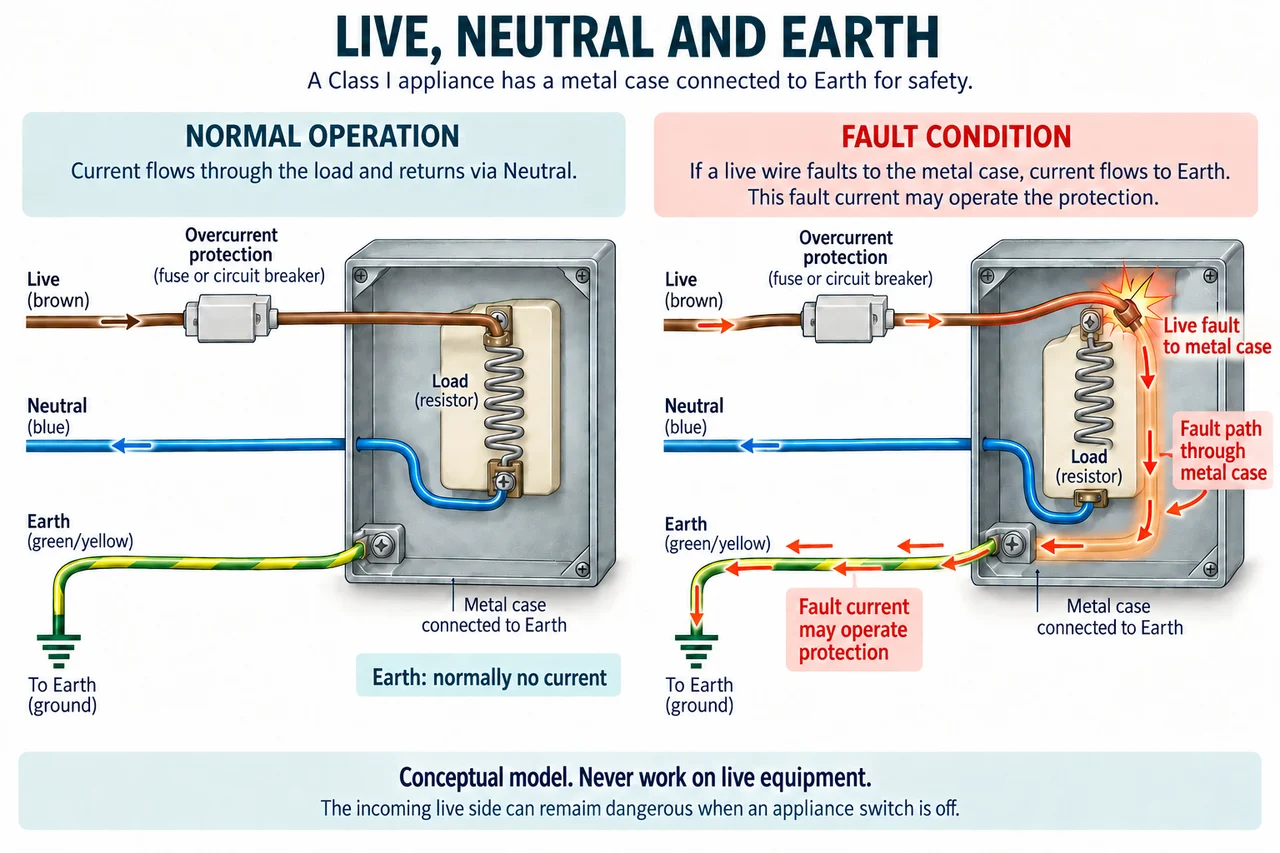
Image: illustration, not a documentary photograph. Original generated teaching illustration for myAudience. · Original AI-generated illustration; editorial scientific review required before publication.
Live, neutral and earth: explaining mains hazards
In the UK three-core cable model, live insulation is brown, neutral is blue, and the protective earth is green-and-yellow striped. The live conductor carries the alternating supply potential difference. Neutral completes the normal current route and is at or close to earth potential. The protective earth normally carries no current; it is connected to exposed metal parts where this safety arrangement is required.
Insulation prevents contact with live conducting parts. If a fault connects live to a metal case, an effective earth connection provides a low-resistance fault route. A large enough fault current causes an appropriate fuse or circuit breaker to disconnect the supply promptly. The earth does not simply absorb electricity, and a fuse does not detect voltage: excessive current heats its element until it melts. This mechanism is explanatory context, not instructions for wiring an appliance.
A live wire can remain dangerous when an appliance’s switch is open. The portion connected to the supply may still be at a large potential difference from Earth. Touching it while connected to Earth can complete a route through the body. Neutral’s usual near-zero potential is part of the model, not permission to touch it: faults, incorrect connections and operating conditions can make conductors dangerous.
Some appliances use double insulation rather than an earth connection to a metal case; do not infer safety from the number of wires alone. Protective devices reduce specified risks but do not make deliberate live contact safe. Use drawings or supplied photographs for this lesson, never dismantle or wire mains equipment as a learning exercise. Damaged equipment should be taken out of use and assessed by a competent person, consistent with HSE guidance.
Vocabulary: live = conductor at supply potential relative to Earth; neutral = normal return route near earth potential; protective earth = safety connection; fuse = overcurrent device that melts; double insulation = two protective insulation measures.
Separate the ordinary operating path from a fault path. In normal Class I operation, live supplies the load and neutral completes the circuit; protective earth connects the accessible metal case to the protective arrangement but does not serve as the normal return through the load. If live contacts the case, a sufficiently low-resistance fault path can produce a large fault current so an appropriate fuse or circuit breaker disconnects the supply. Saying that earth ‘absorbs electricity’ misses both the closed path and the device that interrupts it.
Original paper-only fault comparison: the same 230 V model gives a 5 A fault current for a total loop resistance of 46 Ω and 50 A for 4.6 Ω. This explains why loop resistance matters; it does not prove that either installation is safe. Actual disconnection depends on protective-device characteristics, fault location, supply conditions and verification by competent people. A fuse’s printed rating is not an instantaneous threshold that guarantees a specified time for every current. Do not choose equipment, test wiring or reproduce these faults from this exercise.
Evaluate the claim ‘the appliance is switched off, therefore every internal wire is safe’. An appliance switch may break a path through its load while an incoming live conductor remains connected to the supply. A broken protective earth may leave normal operation apparently unchanged while removing protection against a future case fault. Those two examples show why appearance and ordinary function are poor tests of safety. Stop using damaged equipment and follow competent inspection arrangements; a school explanation is not training to work on mains systems.
Worked example: A paper-only fault model has 230 V between live and earth and a complete fault-loop resistance of 46 Ω. Find the model fault current and explain why the number is not a safety judgement.
Use I = V/R = 230/46.
The model current is 5.0 A.
Disconnection depends on the actual protective device and its time-current behaviour; a current value alone cannot certify safe operation.
Answer: 5.0 A in the model; real safety cannot be concluded from this calculation.
Check your understanding: An appliance stops when its switch opens. Does that prove every conductor inside is safe to touch?
Answer: No. Supply-connected live parts may still be at about 230 V relative to Earth.
Why: No normal operating current does not mean zero potential difference. Contact could create a new dangerous route; the appliance being inactive is not proof of safe isolation.