Electrical power, charge and appliance transfers
By UK GCSE Physics · independent study · myAudience
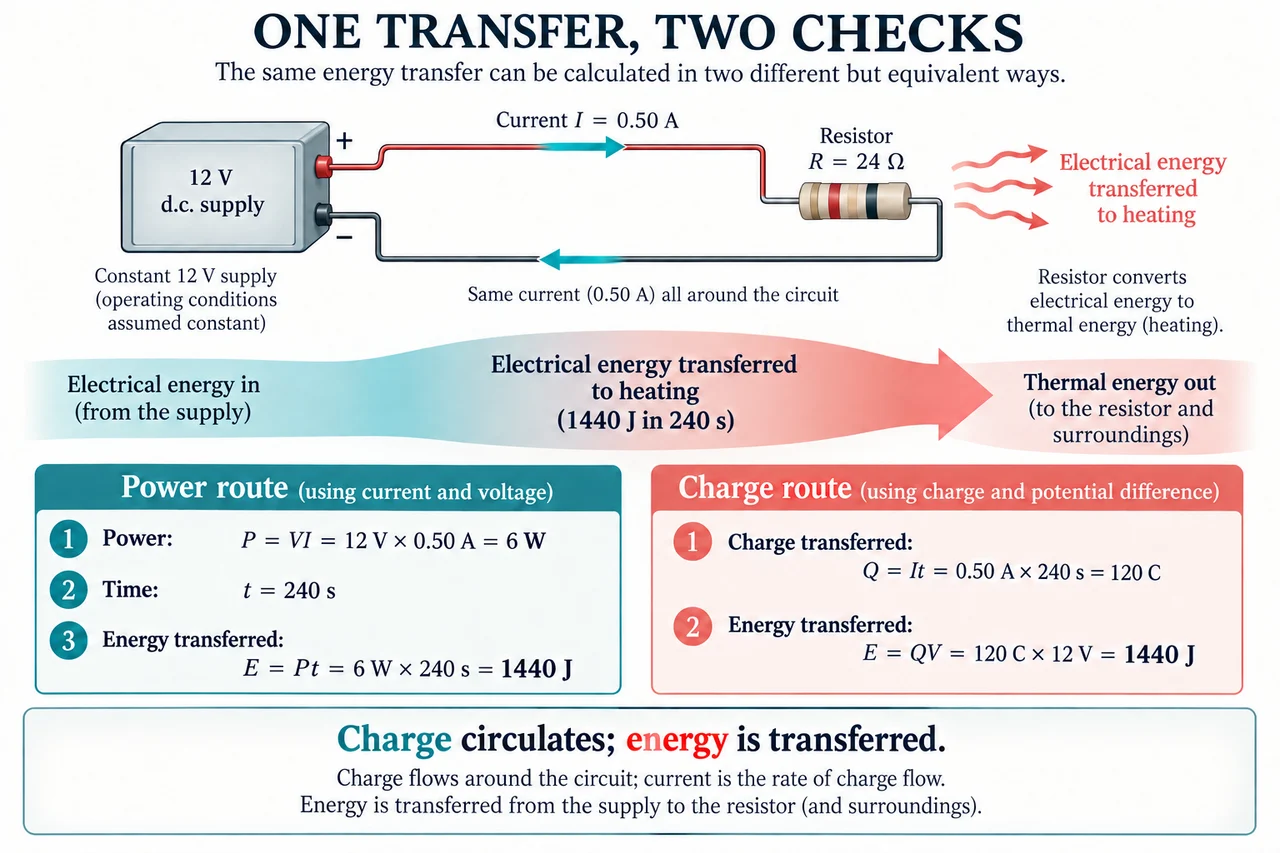
Image: illustration, not a documentary photograph. Original generated teaching illustration for myAudience. · Original AI-generated illustration; editorial scientific review required before publication.
Electrical power, charge and appliance transfers
The Energy module already introduced power as energy per second. Electricity adds a way to obtain it from circuit readings: P = VI, where P is in watts, V in volts and I in amperes. Potential difference tells us joules per coulomb and current tells us coulombs per second, so their product tells us joules per second. A component can transfer much energy per coulomb while carrying a small current; both quantities matter.
For a resistive component, substitute V = IR into P = VI to obtain P = I²R. Square current before multiplying by resistance. At the same resistance, doubling current gives four times the heating power. This equation describes electrical power transfer in the resistor; it does not claim that every appliance’s useful output equals its electrical input. For a heating element, electrical work increases thermal stores; for a motor it can increase kinetic stores and do mechanical work as well as heating surroundings.
Electrical work can also be calculated from E = QV. Every coulomb crossing a potential difference transfers a corresponding amount of energy. Use E in joules, Q in coulombs and V in volts. Combine this with Q = It to connect E = QV with E = VIt = Pt under constant operating conditions. Charge is conserved as it moves around the circuit even while energy is transferred to a device.
An appliance rating indicates power under stated conditions, not a fixed total energy use regardless of time. Compare both running time and power when judging changes in stored energy. The same input energy can produce different useful changes in a heater and motor because their functions and unwanted transfers differ. Calculations here use measured or ideal low-voltage values; the simple dc equations should not be used as a universal rms power rule for every ac appliance.
Keep the existing Energy lesson as the reference for E = Pt instead of repeating its general teaching. Here a check from both charge and power routes tests that the electrical quantities fit together. Convert minutes to seconds and milliamperes to amperes first; include units at every stage. A result described as watts when the question asks for joules confuses a rate with a total.
Use the selected transfer illustration as a check: at 12 V and 0.50 A the input power is 6.0 W. In 240 s, Q = 120 C and E = QV = 1440 J; the equivalent power route gives E = Pt = 6.0 × 240 = 1440 J. These agree because the quantities describe the same steady operating interval. As a separate low-voltage example, at 6.0 V and 0.30 A for 12 s, power is 1.8 W, charge is 3.6 C and both energy routes give 21.6 J. The supply loses energy from its store and the resistor and surroundings gain energy; charge remains in the circuit. The cards do not imply that every appliance’s useful output is 100 percent of input or that a cell lasts indefinitely.
Vocabulary: electrical work = energy transfer associated with charge moving through potential difference; rating = stated operating power; resistive heating = electrical transfer to thermal stores; watt = joule per second.
Equation choice follows what is known. If potential difference and current are constant, multiplying them gives the rate of electrical transfer; multiplying that rate by time gives energy. Alternatively, find the charge that passes during the same interval and multiply by energy transferred per coulomb. Agreement between E = VIt and E = QV is an internal consistency check, not two independent measurements, because Q = It is used in both routes. A mistaken time conversion can make both answers agree and still be wrong.
Original transfer challenge: a 9 V ideal source supplies a constant 0.40 A for 150 s. Determine charge, energy and power, then judge a claim that a device delivering 270 J of useful output has ‘lost charge’. Q = 60 C; E = 540 J; P = 3.6 W. Useful output is half the electrical input, giving 50% efficiency; the other 270 J is transferred in other ways. Charge is not used up to create useful energy. An energy audit needs a specified system boundary and output category, while a charge audit follows circuit flow.
The expression I²R comes from combining P = VI with V = IR for the same component and operating condition. It is not permission to use a cold resistance as though it were the unchanged resistance of a hot filament. Likewise, mixing a current measured at one supply setting with a voltage recorded at another creates a product with no demonstrated physical meaning. Keep units, component identity and measurement interval together. With changing current and voltage, a simple GCSE constant-condition calculation must be bounded rather than pretending a single initial power applies throughout.
Worked example: An ideal 12 V heater has resistance 24 Ω and runs for 4.0 minutes. Calculate current, power, charge flow and electrical energy; check energy by two routes.
I = V/R = 12/24 = 0.50 A; t = 4.0 × 60 = 240 s.
P = VI = 12 × 0.50 = 6.0 W; also I²R = 0.50² × 24 = 6.0 W.
Q = It = 0.50 × 240 = 120 C.
E = Pt = 6.0 × 240 = 1440 J; E = QV = 120 × 12 = 1440 J.
Answer: 0.50 A; 6.0 W; 120 C; 1440 J (about 1.4 kJ to two significant figures).
Check your understanding: A small motor transfers 90 J electrically while 15 C passes through it. What is the potential difference, and has the motor used up 15 C?
Answer: 6.0 V; the charge has passed through and is not used up.
Why: V = E/Q = 90/15 = 6.0 V. The electrical energy may increase motion and thermal stores; charge conservation remains separate from energy transfer.