Why the National Grid uses high potential difference
By UK GCSE Physics · independent study · myAudience
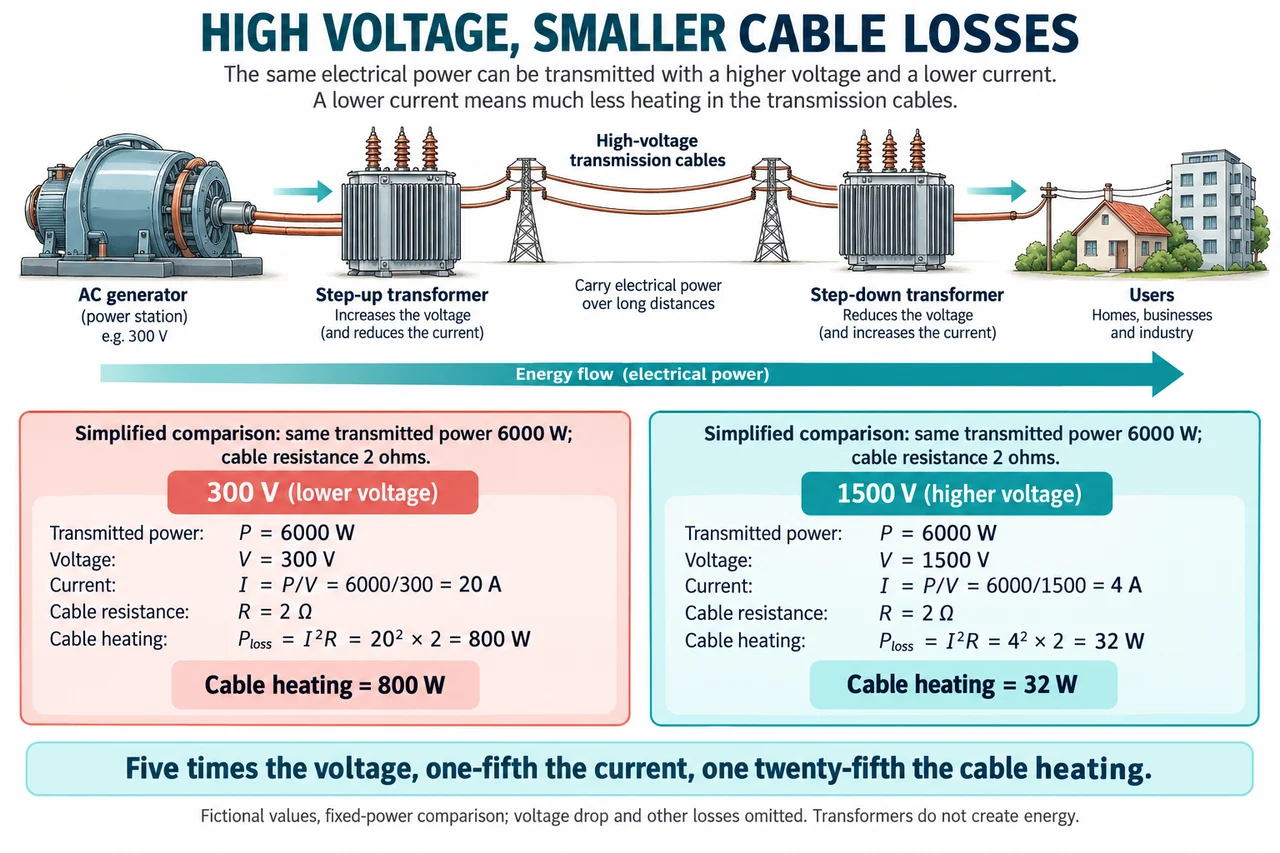
Image: illustration, not a documentary photograph. Original generated teaching illustration for myAudience. · Original AI-generated illustration; editorial scientific review required before publication.
Why the National Grid uses high potential difference
The National Grid links electricity generation with consumers through cables and transformers. A step-up transformer raises potential difference before long-distance transmission. Step-down transformers reduce it for distribution and domestic use. These roles belong to Electricity for both GCSE tiers; transformer construction, induction and turns-ratio calculations belong to the later Higher-only transformer section and are not taught here.
Transmission cables have resistance. Current through them transfers some energy into their thermal stores, warming the cables and surroundings. That power loss can be modelled by P_loss = I²R. For a fixed cable resistance, reducing the current is particularly effective because the current is squared. Calling it lost energy means lost from the useful delivery pathway, not destroyed.
For the same transferred power in the ideal comparison, raising potential difference allows a smaller current because P = VI. Combine the two relationships: smaller current means less cable heating. High potential difference does not make resistance vanish and does not by itself guarantee lower loss if the delivered power changes. State what is being held constant before making the comparison.
Step-down stages provide much lower potential differences appropriate for consumers, while high-voltage transmission requires insulation and separation. No transformer creates energy; real transformers and cables still have losses. The numerical example is a deliberately simplified transmission comparison, not a design for a real grid. It avoids power-station resource comparisons already taught in Energy and avoids unsupported claims about current generation percentages.
Vocabulary: transmission = bulk transfer over a network; step-up = raises potential difference; step-down = lowers it; cable loss = power transferred to cable heating rather than delivered usefully.
Specify which power is being compared. In the simplified fixed-transmitted-power comparison, increasing potential difference reduces current, and cable heating depends on the square of that current. A fivefold voltage increase therefore reduces current fivefold and heating twenty-fivefold when cable resistance is held constant. The energy not dissipated in the cable remains available elsewhere in the system; no transformer creates an additional energy supply. Real networks also have transformer losses, voltage drops and changing loads, so this comparison isolates one causal mechanism.
Original transfer challenge: compare transmission of 12 000 W at 600 V and 2400 V through an illustrative cable with resistance 0.50 Ω. Currents are 20 A and 5 A. Heating rates are 200 W and 12.5 W. The voltage increased fourfold and the loss rate fell sixteenfold, not fourfold. If each condition persists for 60 s, cable heating transfers 12 000 J and 750 J respectively. Those are cable energies, not the whole transmitted energy of 720 000 J. Keep power and energy distinct when comparing the results.
What would weaken the comparison? Changing cable resistance as well as voltage would prevent attributing the whole change to voltage alone. Treating the fictional values as the actual operating voltages of the National Grid would also be unjustified. The diagram explains generation, step-up, transmission and step-down at system level. It does not claim that every modern network link is AC or assess detailed transformer construction; that construction is a separate Higher-tier magnetic-effects topic.
Worked example: In an ideal comparison, transfer 6000 W using either 300 V or 1500 V. A model cable has resistance 2.0 Ω. Find current and cable-heating power in each case.
At 300 V, I = 6000/300 = 20 A; P_loss = 20² × 2.0 = 800 W.
At 1500 V, I = 6000/1500 = 4.0 A; P_loss = 4.0² × 2.0 = 32 W.
Current is one fifth as large and cable heating is one twenty-fifth as large. This calculation neglects voltage-drop feedback and transformer losses.
Answer: 20 A and 800 W versus 4.0 A and 32 W; heating is reduced by a factor of 25 in the simplified model.
Check your understanding: At fixed transferred power and cable resistance, what happens to current and heating loss if transmission potential difference doubles?
Answer: Current halves and cable-heating power becomes one quarter.
Why: P = VI fixes current inversely with potential difference. Substitution into I²R squares the factor of one half; transformers have not removed the cable resistance.