Static charge: electron transfer and forces
By UK GCSE Physics · independent study · myAudience
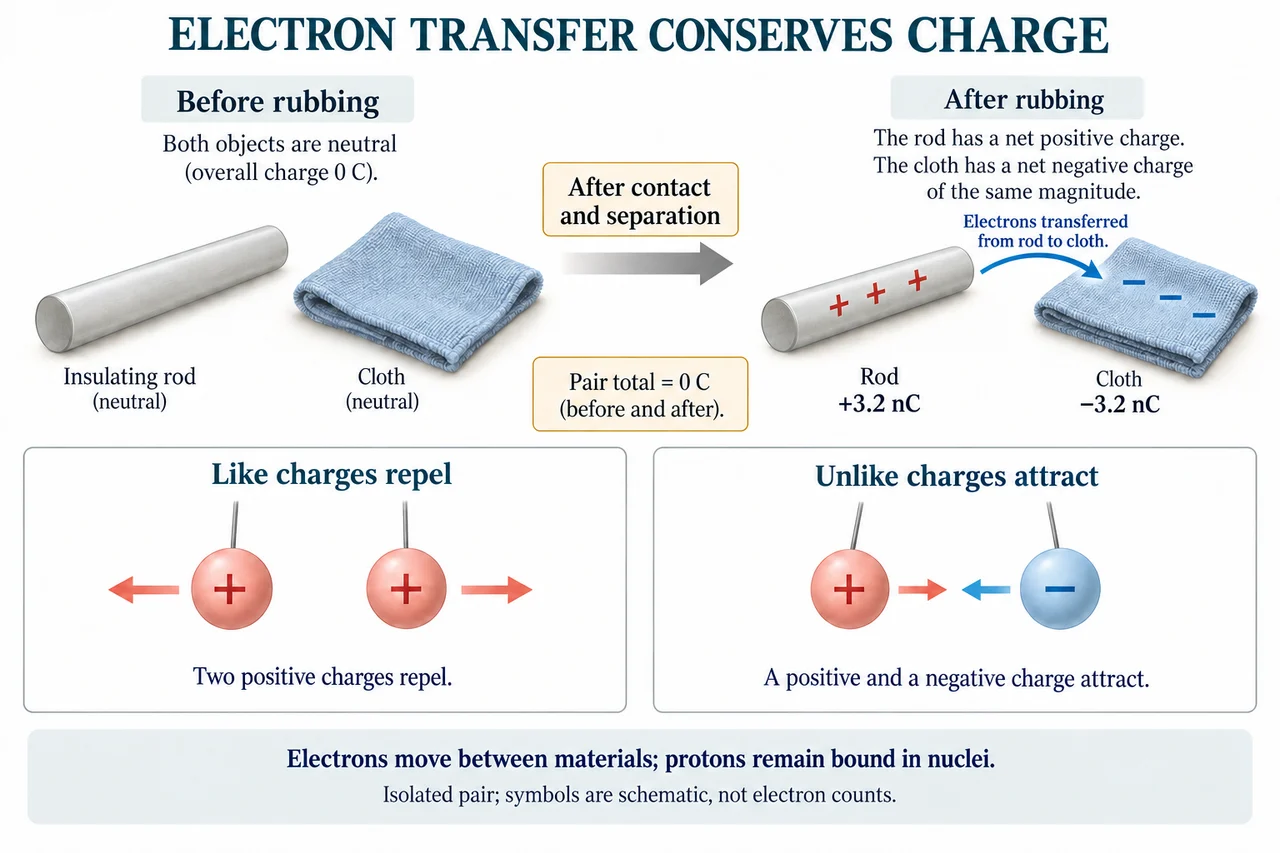
Image: illustration, not a documentary photograph. Original generated teaching illustration for myAudience. · Original AI-generated illustration; editorial scientific review required before publication.
Static charge: electron transfer and forces
Static electricity concerns an imbalance of charge rather than a sustained circuit current. Rubbing suitable insulating materials together can transfer electrons from one surface to another. The object gaining electrons becomes negatively charged; the object losing them becomes positively charged. The protons do not migrate between the rubbed objects. Rubbing separates charge; it does not create positive and negative charge from nothing.
In the simple isolated pair, the negative charge gained by one object has the same magnitude as the positive charge left on the other. Insulating surfaces can retain a local imbalance because charge does not readily flow away. Conductors allow charge to redistribute more easily, and an earth connection can allow an imbalance to discharge. The final charge depends on materials and conditions, so do not guess a sign from an object’s colour.
Two charged objects with the same sign repel; objects with opposite signs attract. These forces can act across a gap and are therefore non-contact forces. In a supervised demonstration, compare behaviour of two identically treated rods with that of rods charged differently. Support the objects so movement can be observed without touching them, and distinguish a reproducible electrical response from draughts or a mechanical push.
Attraction alone does not prove that two objects have opposite net charges. A charged object can attract a neutral object by redistributing its charges; this is useful explanatory context, not an extra required calculation. Repulsion from a known charged object is stronger evidence that the second object carries the same sign. Sparking is a rapid discharge through air; the field explanation follows in the next lesson. Do not attempt spark demonstrations near flammable materials.
Vocabulary: static = retained charge imbalance; electron transfer = movement of negative charge between materials; net charge = overall charge after positive and negative contributions; non-contact force = force without touching.
Choose a system boundary before invoking conservation. For an initially neutral, isolated rod-and-cloth pair, transferring electrons from one to the other produces equal and opposite net charges. That equality need not hold if charge can also pass to a hand, ground or another object outside the pair. The simple illustration deliberately excludes those paths. Plus and minus symbols identify signs schematically; their number is not a calibrated count of the enormous number of electrons corresponding to nanocoulombs.
Original transfer challenge: an isolated pair begins neutral. After contact and separation, object A has +6 nC. A learner claims B has +6 nC because ‘rubbing makes charge’. B must instead have −6 nC if no charge crossed the pair’s boundary. The pair still has zero total net charge. The observation does not tell us the sign without evidence about the transferred electrons; positive net charge means an electron deficit, not that protons have been dragged between these solids. Contact and separation redistribute existing charge.
Use force evidence cautiously. Repulsion between charged objects supports the conclusion that their net charges have the same sign in the simple model, but does not identify which sign. Attraction is less decisive: opposite net charges attract, while a charged object can also polarise a neutral object so the nearer induced charge gives a net attraction. Therefore ‘it attracts a neutral paper scrap, so the paper must have the opposite net charge’ is an overclaim. No demonstrations involving flammable vapour or hazardous charging equipment are implied.
Worked example: In a supplied charge-accounting model, a rod loses negative charge with magnitude 3.2 nC to a cloth. The pair was initially neutral and is isolated. State each final charge and their total.
Losing electrons leaves the rod with +3.2 nC.
The cloth gains those electrons and has −3.2 nC.
Add signed charges: +3.2 + (−3.2) = 0 nC.
Answer: Rod +3.2 nC; cloth −3.2 nC; total 0 nC.
Check your understanding: Two suspended rods repel after being rubbed. What can be concluded about their charge signs?
Answer: They carry the same sign of charge; this alone does not tell us whether both are positive or both negative.
Why: Like charges repel. Inferring a specific sign requires a comparison with a known sign or other evidence.