Electric fields and why air can spark
By UK GCSE Physics · independent study · myAudience
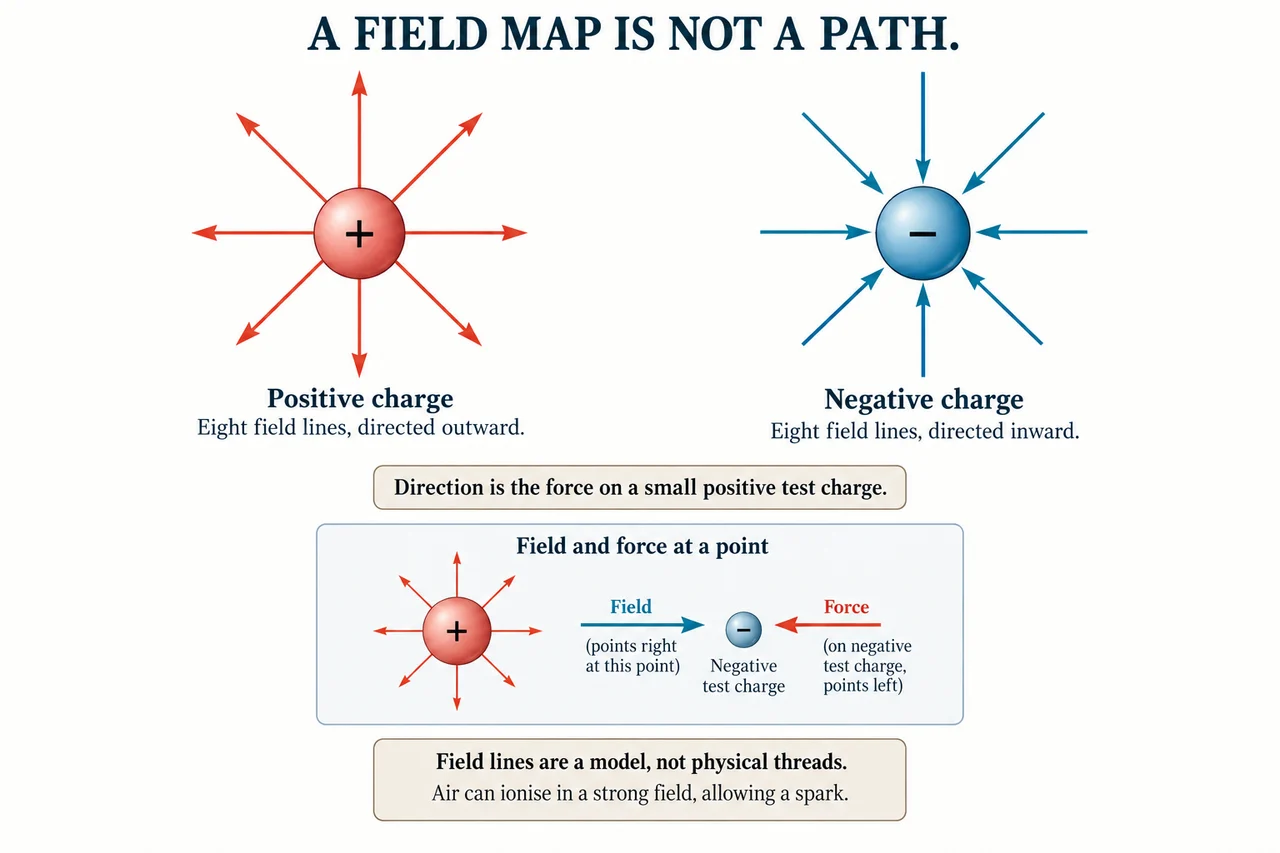
Image: illustration, not a documentary photograph. Original generated teaching illustration for myAudience. · Original AI-generated illustration; editorial scientific review required before publication.
Electric fields and why air can spark
An electric field describes how a charged object can exert a force on another charged object placed nearby. The second object does not need to touch the first. A field is a model for the interaction in the surrounding space, not a visible substance. Its direction is defined as the direction of force on a small positive test charge.
For an isolated positively charged sphere, draw radial field lines with arrows away from the sphere. For an isolated negatively charged sphere, draw radial lines with arrows towards it. A negative test charge experiences force opposite to the arrows. The drawn lines are representative guides rather than actual threads, and the signs and arrows must communicate the model without relying on colour.
Around an isolated charged sphere, the field becomes weaker farther away. The lines spread apart as distance increases; closer spacing represents a stronger field. Bringing two charged objects closer increases the force magnitude for the simple comparison of unchanged charges. No inverse-square calculation or field-strength formula is required by this GCSE Electricity section. Keep the model separate from more complex arrangements where surrounding conductors change the pattern.
Air usually acts as an insulator. If a local electric field becomes sufficiently strong, it can ionise the air, making a conducting path for a rapid discharge: a spark. A smaller gap can make a strong field more likely for the same potential difference, but geometry and conditions also matter. A spark transfers charge and energy; it does not mean charge travelled safely. Use images or supplied demonstrations rather than creating sparks independently, and keep electrostatic demonstrations away from flammable vapours.
Vocabulary: electric field = model of force on charge in surrounding space; test charge = small charge used to define a field; radial = along directions from a centre; ionisation = creation of charged particles from neutral atoms or molecules.
A field-line arrow is defined by the force direction on a small positive test charge. Around an isolated positive spherical charge, the arrows point away; around an isolated negative one, they point towards it. Replacing the test charge with a negative charge reverses its force direction at the same position without reversing the source’s field. This definition avoids the misleading idea that a drawn arrow is necessarily the path of any particle placed there.
Original transfer challenge: a map around one positive sphere has eight radial lines, five of which point inward. Identify the error and explain how a negative test charge would behave on the sphere’s right-hand side. All field arrows should point outward, so the five inward arrows require reversal. At that position the field points right but the negative test charge feels a force left, towards the sphere. The chosen eight lines are drawing conventions, not eight separate physical channels or a measurement of charge.
More widely spaced lines away from an isolated sphere represent a weakening field in a qualitative map. They are not threads moving through air. Under suitable conditions a sufficiently strong electric field can ionise air, producing charged particles that allow charge to flow across a gap as a spark. The drawing does not specify a universal sparking threshold: gap shape, gas conditions and other factors matter. The explanation establishes a causal distinction between an insulating gas and a conducting ionised path, without giving a spark-production procedure.
Worked example: A diagram of an isolated positive sphere has eight radial guides. A student draws three arrowheads outwards and five inwards. Decide which must change and explain the force on a negative test charge.
For a positive source sphere all representative field arrows point outwards.
The five inward arrowheads must be reversed.
A negative test charge feels a force opposite to the field direction, towards the sphere.
Answer: Reverse five arrows; the negative test charge is attracted towards the sphere. The eight guides do not quantify the sphere’s charge.
Check your understanding: If an isolated negative sphere is drawn with arrows inwards, does a positive test charge move away from it?
Answer: No. Its force is inwards, towards the sphere.
Why: Field direction is defined for a positive test charge. Unlike charges attract; a negative test charge would instead experience force opposite to those arrows.