Auditing electrical transfers when operating conditions change
By UK GCSE Physics · independent study · myAudience
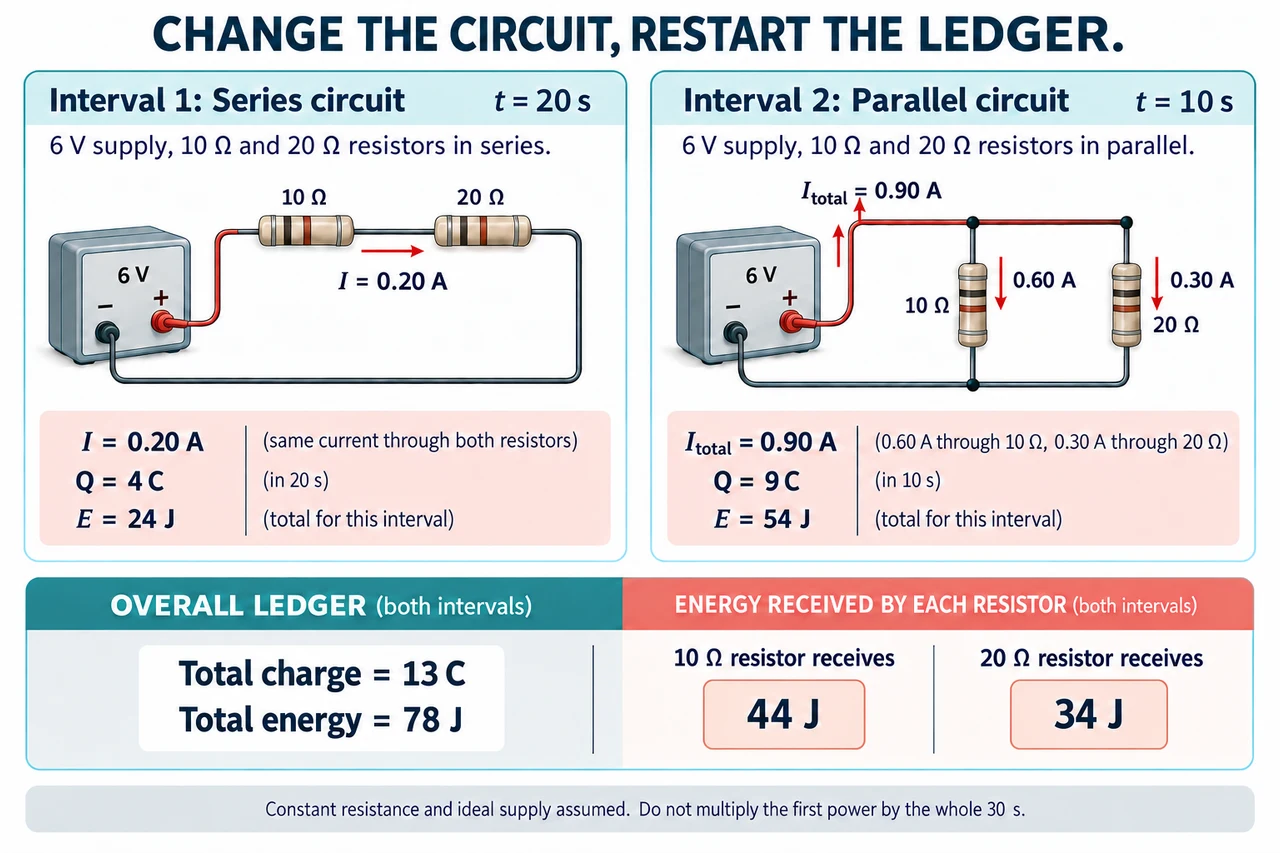
Image: illustration, not a documentary photograph. Original generated teaching illustration for myAudience. · Original AI-generated illustration; editorial scientific review required before publication.
Auditing electrical transfers when operating conditions change
Begin a multi-stage problem with a model ledger: identify the circuit routes, the maintained supply potential difference, the time spent in each configuration, and whether resistance is assumed constant. P = VI gives input power at a specified operating point. If the arrangement changes, calculate each interval separately rather than multiplying one power reading by the whole duration. This separates a total transfer in joules from an instantaneous rate in watts.
Plate 01 locates the point where Q is counted; plate 03 locates the resistor receiving electrical work. Combine them only when current, potential difference and time describe the same interval. At a junction charge flow splits; in a series chain each resistor carries the same charge flow but can transfer a different energy per coulomb. Plate 02 therefore predicts different energy totals when the same resistors are reconnected. Its ideal supply maintains terminal potential difference in both configurations.
Audit using independent routes. First calculate E = Pt from circuit power and duration. Then calculate Q = It and E = QV across the same terminals. In a series circuit also add the component transfers. If totals disagree, check conversions, whether a voltage is across one component or the whole supply, and whether a current is a branch or total current. Agreement checks internal arithmetic; it does not demonstrate that the ideal assumptions describe a real source.
An appliance rating belongs to stated operating conditions. A fixed resistor model permits calculating new power from new supply values, but a filament warms and changes resistance. Useful output needs an efficiency or a measured useful transfer; electrical input alone cannot tell how much light or mechanical work was produced. The worked scenario assumes ideal wires, fixed resistances, a maintained low-voltage source and no energy storage during transitions; it is invented data, not a laboratory result.
For a demanding answer, report the result, units, model assumptions and a reasoned check. At fixed V, adding a conducting parallel branch raises total current. At fixed R, reducing current reduces heating by its square. Those statements hold different quantities fixed: do not apply them to a changing lamp or infer an exact grid loss without specifying the model. Numerical precision beyond the supplied values should be kept only for checking, then rounded appropriately.
Vocabulary: operating point = matched current and potential difference; input transfer = electrical work received; model ledger = explicit assumptions and intervals; audit = consistency check by another route.
Split the timeline at every change that invalidates a constant-condition model. Reconfiguring the resistors changes the current drawn from the same ideal source, so it requires two interval calculations. Charge passing through the source is the sum of interval charges, and electrical energy delivered is the sum of interval energies. Component totals provide a second bookkeeping boundary: each interval’s component energies should add to that interval’s source energy under the ideal-wire model.
Original transfer challenge: an ideal 8 V source supplies 8 Ω and 24 Ω resistors in series for 16 s, then in parallel for 8 s. Series current is 8/32 = 0.25 A, giving Q = 4 C, P = 2 W and E = 32 J. Parallel currents are 1 A and one-third ampere, total four-thirds ampere; Q = 32/3 C, P = 32/3 W and E = 256/3 J. Total Q = 44/3 C and E = 352/3 J, about 117.3 J. E = VQ checks the total because the source voltage stayed unchanged.
Audit the individual resistors as well. In series, I²Rt gives 8 J in the 8 Ω resistor and 24 J in the 24 Ω resistor. In parallel, V²t/R gives 64 J and 64/3 J. Combined component totals are 72 J and 136/3 J, summing to 352/3 J. Multiplying the initial 2 W by the whole 24 s would give only 48 J because it ignores the later larger current. Rounding one-third too early may also spoil the equality; retain fractions until the final reported result.
A successful numerical audit does not establish that the physical apparatus obeyed the assumptions. Real resistors may heat, a source may have internal resistance and connections can add resistance. Decide which departures would change the model before treating disagreement as a calculation mistake. Conversely, a perfectly matching fictional ledger is evidence of arithmetic consistency only; it is not measured proof that a practical was performed. The illustration’s original 6 V example and this 8 V transfer question are distinct scenarios.
Worked example: An ideal 6.0 V source powers 10 Ω and 20 Ω fixed resistors in series for 20 s, then in parallel for 10 s. Find total charge supplied and electrical energy. How much energy enters each resistor? Explain why multiplying the initial power by 30 s fails.
Series: R = 30 Ω, I = 0.20 A. Q = 4.0 C and P = 1.2 W, so E = 24 J. Drops are 2.0 V and 4.0 V; transfers are 8.0 J and 16 J.
Parallel: each branch has 6.0 V. Currents are 0.60 A and 0.30 A; total is 0.90 A. Q = 9.0 C; P = 5.4 W; E = 54 J. Branch transfers are 36 J and 18 J.
Totals: Q = 13 C; E = 78 J. Resistors receive 44 J and 34 J. Check QV = 13 × 6.0 = 78 J and 44 + 34 = 78 J.
The initial 1.2 W lasted only 20 s. Using it for 30 s gives 36 J, ignoring the larger parallel power. The ideal reconnection is conceptual; isolate power before changing a real circuit.
Answer: 13 C and 78 J total; 44 J into the 10 Ω resistor and 34 J into the 20 Ω resistor.
Check your understanding: A 6.0 V motor receives 78 J electrically while 13 C passes. Its useful mechanical output is 31.2 J. Find efficiency and explain whether the 46.8 J difference or the 13 C is destroyed.
Answer: Efficiency = 0.40 = 40%; 46.8 J is transferred elsewhere or retained in other stores, and 13 C is conserved.
Why: 31.2/78 = 0.40. A statement about useful mechanical transfer is separate from charge flow. Account for the other energy pathways rather than claiming that wasted energy ceases to exist.