Read the language of a diagram
By UK GCSE Mathematics · independent study · myAudience
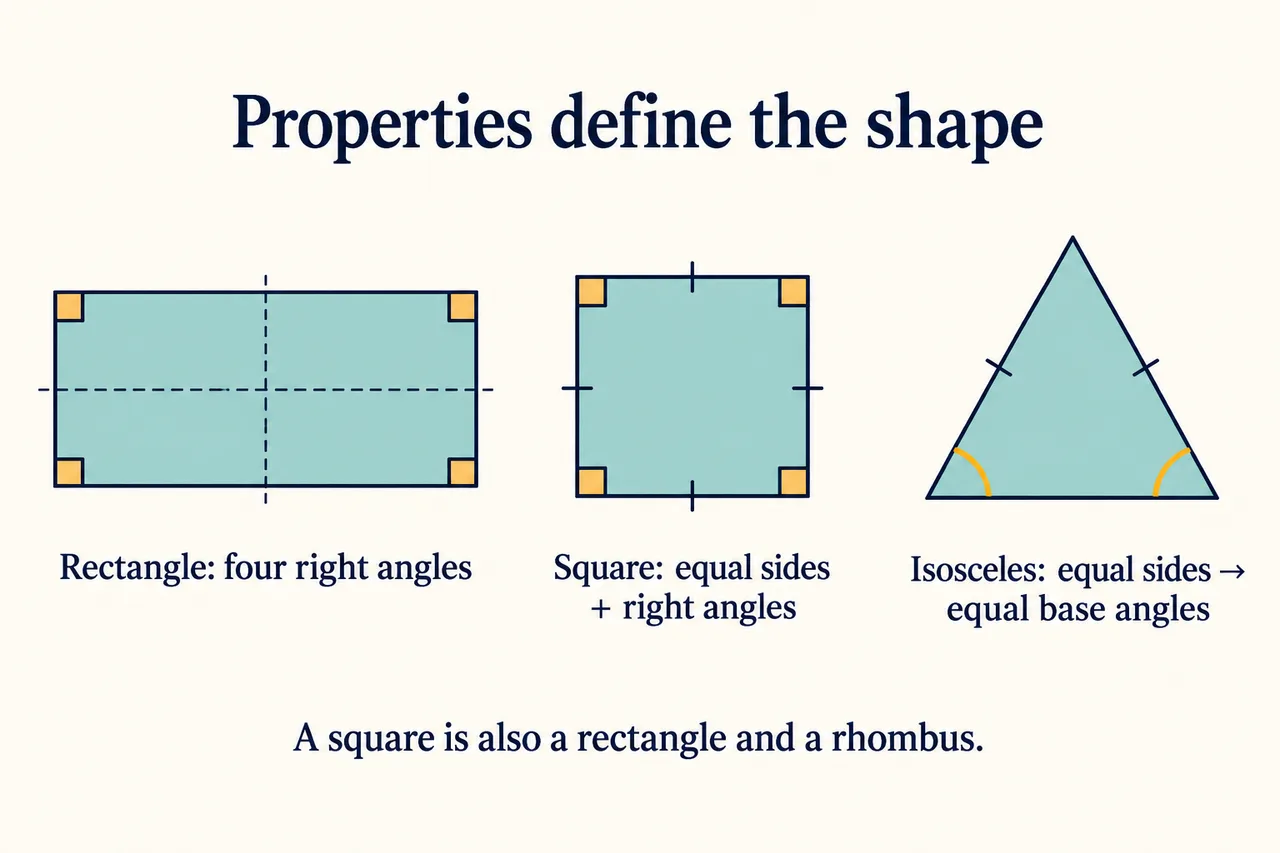
Original myAudience AI-generated mathematics teaching illustration; geometry and labels checked by the authoring agent. Independent integration review pending. · Original project artwork; no exam-board figures or textbook illustrations reused.
Read the language of a diagram
A point records a position and is usually named with a capital letter. A line continues in both directions; a line segment has two endpoints. The segment AB joins A to B. An angle such as ABC has its vertex at B: the middle letter tells you where the turn is measured. A plane is a flat surface extending in two dimensions; an edge is where faces meet in a solid.
Parallel lines lie in the same plane and never meet. Perpendicular lines meet at a right angle, 90°. Matching arrow marks indicate parallel lines, matching short ticks indicate equal lengths, and a small square indicates a right angle. These marks are mathematical information. A diagram that merely looks symmetrical is not evidence that lengths or angles are equal.
When translating words into a diagram, record the stated relationships before trying to calculate. For a triangle ABC with AB perpendicular to BC, place the right-angle mark at B. If AB and BC are equal, mark those two sides with the same tick. Sketches need not be accurate scale drawings, but their labels and relationships must be consistent.
Precision prevents hidden assumptions. Saying AB = CD compares lengths, not positions: the segments could point in different directions or lie in different parts of the plane. Saying AB is parallel to CD compares directions but does not make their lengths equal. Equal-length marks and parallel marks therefore carry different information. A right-angle square establishes a particular perpendicular intersection; it does not prove every angle in a nearby figure is right. Build a table of what is given, what follows by a theorem, and what is only suggested by appearance before beginning a proof.
An angle names two rays from one vertex. Angle ABC is formed by BA and BC, whereas angle BAC is formed by AB and AC. Reversing the endpoints around the same middle letter, from ABC to CBA, names the same non-reflex angle under the usual convention. Changing the middle letter changes the vertex. If several angles meet at B, a single letter B can be ambiguous; use three letters or a labelled angle. A reflex angle needs explicit identification because two rays determine both a smaller turn and its complementary turn to 360°.
Translate a compound description in stages. For a quadrilateral ABCD listed around its boundary, AB parallel to CD concerns opposite sides; AB = BC concerns adjacent sides. The vertices must follow the stated order, or an intended edge may become a diagonal. A diagonal joins non-adjacent vertices; AC and BD are the diagonals here. A point M on AC adds a location condition, while AM = MC adds a midpoint condition. Neither condition alone supplies the other. This is why a construction or calculation should not silently move a named point to a more convenient place.
Geometry can also expose an impossible description. Suppose triangle ABC has AB = BC, a right angle at A, and three distinct non-collinear vertices. The equal sides would force angles at A and C to be equal, so both would be 90°. There is then no positive angle left at B. Do not rescue the statement by drawing a flattened triangle: that would violate the non-collinear hypothesis. A good response identifies the contradictory relationships and the theorem connecting them instead of merely saying the sketch looks wrong.
Image: illustration, not a documentary photograph. The selected plate demonstrates equal-side and right-angle marks, with reflection axes on the non-square rectangle. It is not a diagram of every named configuration in this lesson. Use stated relationships rather than measuring its pixels. Reading these examples develops notation and reasoning; accurate independent drawing from a fresh description remains a separate exercise to practise and check. For an unfamiliar diagram, write each given statement beside the two or three named points it concerns. Then draw a separate conclusion column: collinearity licenses a straight-angle sum, equal sides license equal opposite angles, and a midpoint licenses both location and equal halves. A conclusion requiring two premises must not be promoted when only one is present. This small proof ledger is useful even when the eventual calculation is short.
Worked example: An ordinary triangle ABC has AB = BC, and D lies on the extension of AB beyond B. The exterior angle DBC is 110°. Locate every angle, determine the three interior angles, and explain why calling A the right-angle vertex would contradict the data.
A, B and D are collinear in that order, so BA and BD point in opposite directions. The interior angle ABC and exterior DBC fill a straight angle.
Angle ABC = 180° − 110° = 70°. This uses the extension condition, not the apparent slope of the drawing.
AB = BC makes B the shared vertex of the equal sides; the opposite angles at A and C are equal.
The remaining interior total is 180° − 70° = 110°, so BAC = BCA = 55°.
A cannot be a right-angle vertex: the deduced angle is 55°, and an assumed 90° at A would force 90° at C, leaving an invalid negative or zero remainder.
Checks: 55° + 70° + 55° = 180°, and 70° + 110° = 180°. Each equality addresses a different geometric region.
Answer: Interior angles at A, B and C are 55°, 70° and 55°. The exterior angle is at B, not A. The proposed right-angle claim is inconsistent.
Check your understanding: A student reads AM = MC as meaning M is automatically the midpoint of AC, even when M is not stated to lie on AC. Give a concrete counterexample. Then explain exactly which additional location statement makes the midpoint conclusion valid, and why measuring a diagram is insufficient.
Answer: Take A = (−2, 0), C = (2, 0), and M = (0, 3). The distances AM and MC are both √13, but M is not on segment AC and therefore is not its midpoint. The actual midpoint is (0, 0). To conclude that M is the midpoint from equal lengths, also establish that M lies on segment AC; on that segment equal distances to its endpoints select the halfway point. A drawing can suggest collinearity but must not replace a given condition or a justified construction. Coordinate values are a counterexample, not a necessary formula for every midpoint argument.
Why: Credit the specified counterexample, equality of its distances, the missing collinearity/location condition and a justified midpoint conclusion. A named theorem without its hypotheses is incomplete.