Separate reflection from rotation
By UK GCSE Mathematics · independent study · myAudience
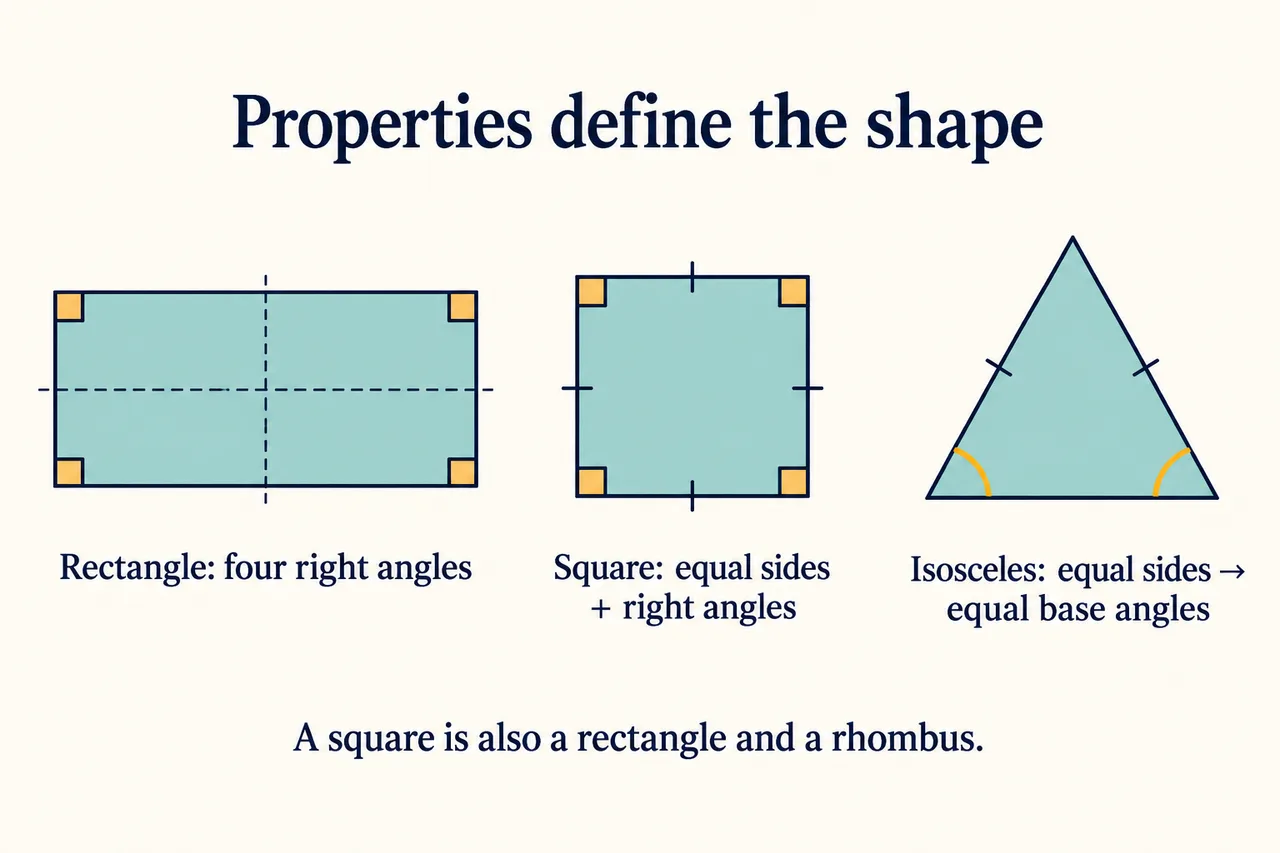
Original myAudience AI-generated mathematics teaching illustration; geometry and labels checked by the authoring agent. Independent integration review pending. · Original project artwork; no exam-board figures or textbook illustrations reused.
Separate reflection from rotation
A line of reflection symmetry divides a shape into halves that match when folded onto each other. A rotational symmetry maps the shape onto itself after a turn about a centre. Its order counts matching positions during one full turn, including the completed 360° turn. A shape with no smaller matching turn has rotational order 1.
A regular polygon has all its sides equal and all its interior angles equal. For a regular n-sided polygon, rotational order is n and the smallest positive matching turn is 360°/n. It also has n lines of reflection symmetry. Equal sides alone do not make every polygon regular: a non-square rhombus has unequal angles.
A non-square rectangle has two reflection lines and rotational order 2. Its diagonals are not reflection lines. A square has four reflection lines and order 4. Name the exact shape and use its properties rather than counting symmetry from a distorted sketch.
Test a proposed reflection line by following a point and its image. For a rectangle of width w and height h with w ≠ h, a diagonal reflection would interchange adjacent directions and require a side of length w to match one of length h. That contradicts w ≠ h. The horizontal and vertical centre lines instead pair points at equal perpendicular distances and preserve the boundary. This argument explains the two axes rather than simply counting lines in a familiar icon.
A matching rotation must preserve distances and the entire shape, not just put one vertex on another. A non-square rectangle matches after 180° because opposite vertices exchange and opposite sides align; a 90° turn interchanges unequal dimensions and fails. Its order is therefore 2. For a square, a 90° turn works and the matching positions in one revolution are 90°, 180°, 270° and 360°, giving order 4. The unturned 0° position and the final 360° position represent the same orientation and must not be counted twice.
A regular polygon has equally spaced vertices on a circle, so moving every vertex forward by one position gives a matching rotation of 360°/n. A smaller nonzero rotation cannot send a vertex to the next available vertex. This justifies the smallest-angle rule. A reflection axis either passes through a vertex and the opposite midpoint for odd n, or passes through opposite vertices or opposite side midpoints for even n. Both parity cases still give n axes in total; the shapes of the axes need not look identical.
Properties do not always imply symmetry of a decorated object. An equilateral triangle outline has three reflection axes and rotational order 3, but placing a different letter at each vertex can remove every nontrivial symmetry of the labelled object. State whether a problem concerns the outline, its colours, or all its markings. Conversely, equal side lengths alone do not establish a regular quadrilateral: a non-square rhombus has equal sides but two different angle sizes. The definition of regularity needs both side and angle equality.
Image: illustration, not a documentary photograph. The plate shows the two centre axes of a non-square rectangle and property marks on a square and an isosceles triangle; it does not depict a regular hexagon or every square axis. Draw and justify the missing examples rather than inferring unmarked axes from the image. A symmetry explanation should identify the transformation, its centre or line, and how the whole object is preserved. A useful scaffold is to list an outline, its proposed transformation and one witness point that would fail if the claim were false. To reject diagonal reflection of a 6-by-4 rectangle, follow the endpoint of a 6-unit side: it would have to match an endpoint 6 units along a direction whose rectangle side is only 4 units. To reject a quarter-turn, compare the horizontal span before and after the turn. To establish a symmetry, however, one matching point is insufficient; you must account for the whole boundary or use a property that determines it. This distinguishes the logic of a counterexample from the logic of a proof. An irregular drawing can approximate a regular shape without inheriting its exact symmetries; screen rendering is not a premise.
Worked example: A regular decagon outline is drawn with one vertex coloured red and the other nine black. Find the rotational order of the outline and of the coloured object. Explain whether the coloured object has a reflection axis through the red vertex.
The undecorated regular decagon has ten equivalent vertex positions, so its smallest matching rotation is 360°/10 = 36° and its order is 10.
For the coloured object, any matching rotation must send the unique red vertex back to itself. No rotation of 36°, 72°,…, 324° does that.
Only the completed 360° turn matches the full colouring, so the coloured object has rotational order 1.
A regular decagon has a reflection axis through each pair of opposite vertices. The axis through the red vertex and the opposite vertex fixes the red vertex and pairs the other black vertices.
Other reflection axes send the red vertex to a different vertex and fail to preserve the colours. The coloured object thus has one reflection axis.
Answer: Outline: order 10, smallest turn 36°. Coloured object: order 1 and one reflection axis through the red and opposite vertices.
Check your understanding: A polygon is reported to have rotational order 8 and to be regular. A student says its smallest turn is 45° and therefore each interior angle is 45°. Evaluate both claims. Then explain whether a shape with rotational order 2 must be a rectangle.
Answer: The smallest positive matching rotation is 360°/8 = 45°, so the first claim is correct. For a regular octagon the exterior turn is 45°, and the interior angle is 180° − 45° = 135°, not 45°. A non-square parallelogram also maps onto itself after 180° and has rotational order 2; it need not have four right angles. Thus rotational order alone does not determine the full shape family. A justification must distinguish a rotation angle from an interior angle and provide a counterexample to the claimed converse.
Why: Credit separate angle meanings, the 135° interior result and a valid nonrectangular order 2 counterexample. Do not infer a rectangle from one symmetry invariant.