Construct an equal-distance boundary
By UK GCSE Mathematics · independent study · myAudience
Original myAudience AI-generated mathematics teaching illustration; geometry and labels checked by the authoring agent. Independent integration review pending. · Original project artwork; no exam-board figures or textbook illustrations reused.
Construct an equal-distance boundary
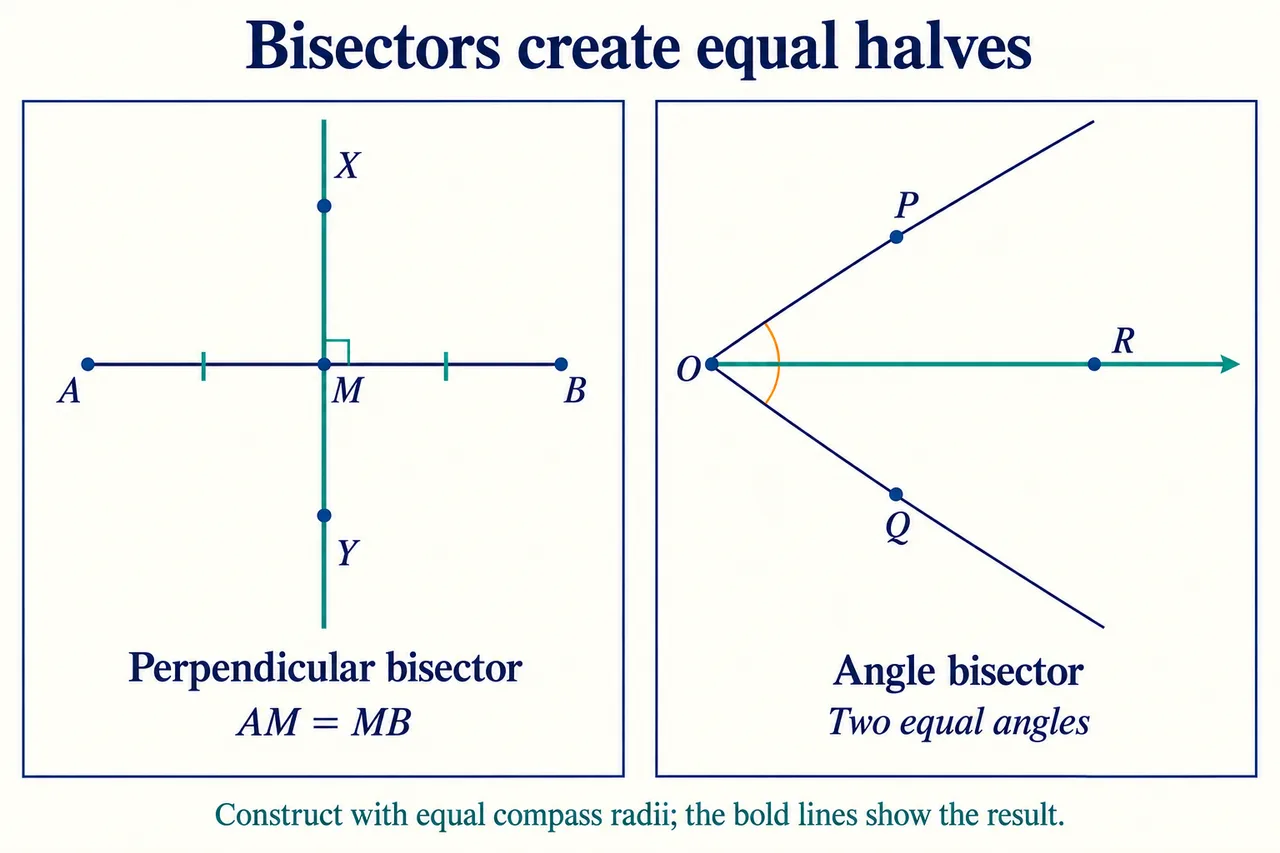
The perpendicular bisector of a segment passes through its midpoint at 90°. Every point on this line is equally distant from the two endpoints. Conversely, a point equally distant from those endpoints lies on this line. That two-way statement explains why the construction solves an equal-distance problem.
Place a compass at A and draw arcs above and below AB using a radius greater than half AB. Without changing the opening, repeat from B. Join the two arc intersections using a straightedge. Equal-radius arcs give two points equally distant from A and B; their joining line is the perpendicular bisector. Keep the construction arcs visible as evidence.
This is not a request to guess a midpoint with a ruler and draw a line by eye. The compass fixes equal distances, and the geometric argument fixes the perpendicular direction. If the radius is too small, the arcs do not meet; increase it equally for both centres.
The radius condition has a geometric purpose. Two circles of the same radius r with centres A and B meet in two distinct points when AB < 2 r. When AB = 2 r the y only touch at the midpoint, giving one point and no second point to define the required line. When AB > 2 r the y do not meet. Choosing r greater than half AB therefore produces the two intersections needed by the construction; simply drawing any convenient arcs does not establish that condition.
Prove the construction rather than relying on its appearance. Name the arc intersections X and Y, on opposite sides of AB. Triangles AXY and BXY have AX = BX, AY = BY and common XY, so SSS gives congruence. Their angles at X are equal. If M is where XY crosses AB, triangles AXM and BXM then have equal AX and BX, common XM and equal included angles at X; SAS gives AM = BM and equal angles AMX and BMX. Those two angles fill a straight angle, so each is 90°. This establishes both midpoint and perpendicularity without ruler measurement.
To construct a perpendicular at a given point P on a line, first mark A and B on that line at the same distance from P, using a compass centred at P. Construct the perpendicular bisector of AB with equal-radius arcs; because P is its midpoint, that bisector passes through P. Keep all the original arcs visible. Merely putting a set square against the line may produce a perpendicular, but it does not demonstrate the requested ruler-and-compass construction when that is the specified method.
To drop a perpendicular from a point P outside a line, draw a circle centred at P large enough to cut the line at two points A and B. Then PA = PB. Construct the perpendicular bisector of AB. The equal-distance property means that P lies on this bisector, which meets the original line at a right angle. Use two distinct crossing points: a tangent circle supplies only one and is insufficient. The foot of the perpendicular is not generally at a preselected point on the original line.
Image: illustration, not a documentary photograph. The accepted plate shows the resulting line through midpoint M and the right-angle/equal-length facts; it deliberately does not show the construction arcs. The text supplies those missing steps and their justification. Reading or correctly naming the finished picture is not evidence that a learner has executed an accurate construction; independent compass work with retained arcs and checking remains required. A valid construction report separates method, proof and practical accuracy. The method says which centres and radii are used and which two intersections are joined. The proof explains why the equality marks come from circle radii and why the equal adjacent angles are right angles. Accuracy must be checked on the actual drawing: preserve the arcs, ensure the pencil has not changed the compass opening and check that the joined intersections are distinct. These checks are described here but have not been observed. For a mathematical counterexample, choosing radius exactly half the segment illustrates why a single touching point cannot determine a unique line: infinitely many lines pass through it. The missing second point is a logical failure as well as a practical obstacle.
Worked example: A and B are 6 cm apart. Explain what happens with equal compass radii 2 cm, 3 cm and 4 cm. For 4 cm, prove that joining the two arc intersections produces the perpendicular bisector, identifying the congruence criteria used.
At r=2 cm, 2 r=4 cm<6 cm, so the circles do not intersect. At r=3 cm, 2 r=6 cm, so the y touch at one point. Neither choice supplies two intersections.
At r=4 cm, 2 r=8 cm>6 cm, so there are two intersections X and Y on opposite sides of AB.
AX = BX =4 cm and AY = BY =4 cm, while XY is common. Thus AXY and BXY are congruent by SSS.
Let M = AB∩XY. Congruence makes AXM and BXM have equal included angles at X; AX=BX and XM is common, so the y are congruent by SAS.
Hence AM=BM=3 cm. Angles AMX and BMX are equal and supplementary, so both are 90°. The line is both a bisector and perpendicular.
Answer: Only 4 cm gives the two-point construction. SSS followed by SAS establishes midpoint and right angle; measuring a tidy-looking picture is not the proof.
Check your understanding: Two settlements A=(0, 0) and B=(8, 0) require a depot equally distant from each. The depot must also lie on the road y=3 and be at most 5 distance units from A. Find it and justify the boundary case. Would a road x=3 provide any qualifying equal-distance location?
Answer: The perpendicular bisector is x=4 because the settlements are 8 units apart along a horizontal segment. Its intersection with y=3 is (4, 3), at distance √(4²+3²)=5 from A and also 5 from B. “At most 5” includes equality, so this point qualifies; “less than 5” would exclude it. The road x=3 is parallel to and distinct from the locus x=4, so there is no intersection and no equal-distance depot on that road. Naming a road point without checking all conditions is insufficient.
Why: Credit the equal-distance locus, unique intersection, both distance/boundary checks and the no-intersection argument. These are chosen mathematical coordinates, not a real planning recommendation.