Bisect an angle and interpret a locus
By UK GCSE Mathematics · independent study · myAudience
Original myAudience AI-generated mathematics teaching illustration; geometry and labels checked by the authoring agent. Independent integration review pending. · Original project artwork; no exam-board figures or textbook illustrations reused.
Bisect an angle and interpret a locus
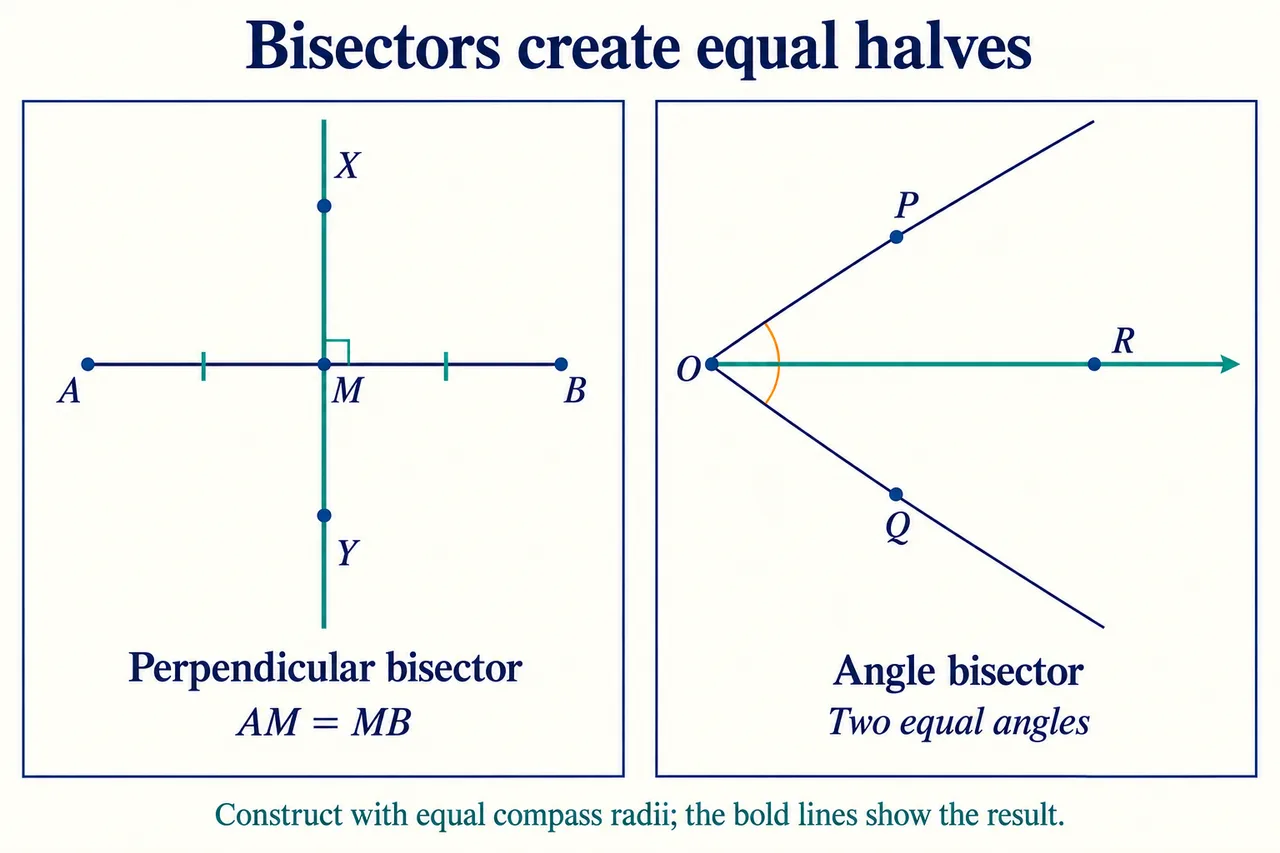
To bisect an angle, first draw one compass arc centred at its vertex to meet both arms. From those two crossing points, use the same compass radius to draw intersecting arcs inside the angle. Join their intersection to the vertex. The resulting ray splits the angle into two equal parts, supported by congruent triangles.
A locus is the set of all points satisfying a stated condition. Points at a fixed distance r from one point form a circle, not its interior. Points within distance r form the disc including or excluding its boundary according to whether the condition says at most or less than. The perpendicular distance to a line is the shortest distance to it.
For two intersecting straight lines, points equally distant from the lines lie on their two angle-bisector lines. In a problem restricted to the inside of one specified angle, use its internal bisector. Combine conditions by intersecting loci; also apply any boundaries or region restrictions.
Justify the angle-bisector construction with correspondence. Let an initial circle centred at O meet the arms at P and Q, so OP = OQ. Equal-radius arcs centred at P and Q meet at R inside the angle, so PR = QR. Triangles OPR and OQR also share OR. The y are congruent by SSS, giving equal angles POR and ROQ. A ray drawn from O through R therefore bisects the specified angle. Using unequal radii for the second pair of arcs removes PR = QR and invalidates this proof, even if the finished ray looks central.
An angle bisector also gives an equal-distance locus, but distance to an arm means perpendicular distance, not distance along a sloping segment to a chosen endpoint. Drop perpendiculars from an interior point R to the two arms. The resulting right triangles share hypotenuse OR and have equal angles at O, so their perpendicular sides are equal. Reversing the argument shows that an interior point with equal perpendicular distances lies on the internal bisector. Outside that chosen region, the second angle-bisector line must also be considered; a restriction to one angle is part of the problem, not a universal deletion of the other branch. To see why the perpendicular distance is shortest, name its foot D on the line and another point E on that line. Triangle PDE is right-angled at D, so PE is its hypotenuse and is longer than PD whenever E differs from D. In squared lengths, PE² = PD² + DE²; the positive extra term prevents any sloping path to another point from being shorter.
Boundary words change a locus. Exactly 3 cm from O is a circle; at most 3 cm gives its closed disc; less than 3 cm gives its open interior. At least 3 cm gives the exterior together with the circle. In a sketch, use a solid boundary when equality is admitted and a dashed boundary when it is excluded, and state the convention. A line of equidistant points can pass through a permitted region while portions of the line outside that region must still be discarded.
Combine conditions as an intersection, not a union. “Equally distant from A and B and at most r from O” means points on the perpendicular bisector that also lie in the disc. It does not mean every point on either locus separately. A finite segment could remain, one point could remain in a tangent case, or nothing could remain. A circle meeting a line produces at most two isolated points, but a disc meeting that line can produce infinitely many points in a segment. Distinguish an exact-distance condition from an inequality before counting answers.
Image: illustration, not a documentary photograph. The right-hand panel shows the internal angle bisector and its two equal angle regions; the left-hand panel shows a perpendicular bisector. Neither panel depicts every circle–line intersection or retained compass arc in the tasks. Sketch the additional loci and label the admitted boundaries. Written reasoning does not certify accurate practical construction, and field restrictions cannot be inferred from a decorative map. To scaffold a compound locus, first solve each condition separately and label it A or B. Test a point lying only in A and a point lying only in B: each should fail the original sentence containing 'and'. Then test a point in the intersection and check every stated inequality. This is a simple way to catch a union/intersection error before completing the sketch. A tangent line to a closed disc retains its one contact point, while the same line has no point in the corresponding open disc. Thus changing 'at most' to 'less than' can change one solution to none; the difference is not just how the boundary is drawn.
Worked example: A=(-4, 0), B=(4, 0) and O=(0, 0). Describe all points equally distant from A and B that are at most 3 units from O. Then replace at most with exactly and finally less than. Explain how the number and kind of solutions change.
Equal distance from A and B gives their perpendicular bisector x=0, the vertical axis.
At most 3 from O means x²+y²≤9. On x=0 this is y²≤9, so −3≤y≤3.
The qualifying locus is the closed segment from (0,−3) to(0, 3), with infinitely many points. It is not the whole disc.
Exactly 3 gives y²=9, so only (0,−3) and(0, 3).
Less than 3 gives −3<y<3: an open segment with infinitely many points but neither endpoint.
Equality signs decide whether boundary points survive; changing the wording changes the answer even though the same centre and radius appear.
Answer: At most: closed segment on x=0,−3≤y≤3. Exactly: two endpoints. Less than: open segment,−3<y<3.
Check your understanding: Two straight lines meet at 90°. A point inside one chosen right-angle region must have equal perpendicular distances to both lines and be exactly 4 units from their intersection. Explain why there is one solution in that region but four if all four angle regions are allowed. What error results from measuring distance only to convenient labelled endpoints on the lines?
Answer: Use perpendicular axes through the intersection. Equal distances give |x|=|y|, the two bisector lines y=x and y=−x. The radius condition x²+y²=16 then gives |x|=|y|=2√2. All four sign combinations occur on the two lines, yielding four points. Inside one specified quadrant only its matching sign combination is admitted, so there is one solution. Distance to a line is its shortest perpendicular distance; distances to selected endpoints depend on where those endpoints were placed and need not match the locus condition. A sketch alone cannot replace that distinction.
Why: Credit both bisectors, the circle intersection argument, the region restriction and correct perpendicular-distance interpretation. Do not accept four points when the specified region allows only one.