Use angle facts rather than appearances
By UK GCSE Mathematics · independent study · myAudience
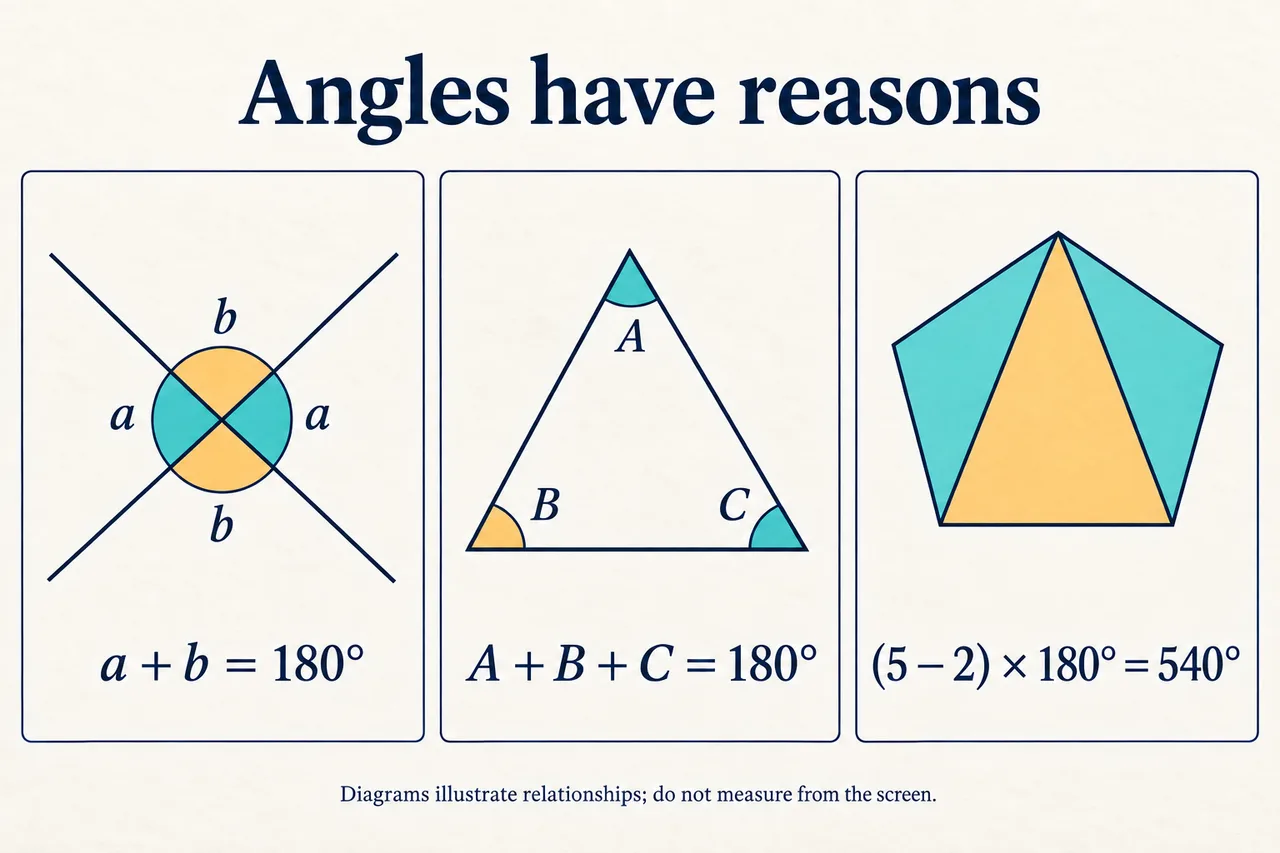
Original myAudience AI-generated mathematics teaching illustration; geometry and labels checked by the authoring agent. Independent integration review pending. · Original project artwork; no exam-board figures or textbook illustrations reused.
Use angle facts rather than appearances
Angles around a point total 360°, one complete turn. Angles at a point on one side of a straight line total 180°, a half turn. These totals concern adjacent non-overlapping angles that fill the specified region. Do not add angles that overlap or leave a missing sector.
When two straight lines cross, vertically opposite angles are equal. Adjacent angles on the straight line add to 180°, so each opposite pair has the same value. The word opposite describes positions across the vertex, not merely angles drawn far apart.
Write a reason with each step. A sketch drawn imperfectly can still encode exact relationships. If a crossing gives one angle 68°, the opposite angle is 68° and each adjacent angle is 112°. Measuring an illustration is weaker than deriving the values from the stated angle.
Explain why vertically opposite angles are equal using only straight-angle facts. Label successive sectors around a crossing a, b, c, d. Because a+b=180° and b+c=180°, subtracting gives a=c. Similarly b=d. This argument needs two complete straight lines; it cannot be applied to four arbitrary rays merely because some sectors look opposite. It also does not say adjacent sectors are equal: that special case would force them all to 90°.
An algebraic angle expression is an unknown measure constrained by geometry, not a licence to accept every algebraic solution. If adjacent sectors forming a straight angle are 3 x+10 and 2 x+20 degrees, their sum is 180, giving 5 x+30=180 and x=30. The angles are 100° and 80°, both positive and correctly supplementary. Substitute into the original expressions after solving. A negative sector or an angle too large for its specified region reveals an inconsistent interpretation or impossible data.
Angles around a point require a complete non-overlapping partition of one revolution. Three rays may determine three sectors, but measuring a reflex angle between two rays can include two of those sectors. Adding that reflex angle again to each constituent sector would double-count part of the turn. Use a small diagram with sector labels to decide what fills 360° before writing an equation. The same care applies when a straight line forms part of a larger crossing or when one angle is given outside a polygon.
The exterior-angle theorem of a triangle follows from two familiar totals. If interior angle at C is c and the other interiors are a and b, then a+b+c=180°. The adjacent exterior e satisfies e+c=180°. Subtracting gives e=a+b. Thus an exterior is equal to the sum of the two non-adjacent interiors, not generally equal to either one individually. Naming the non-adjacent vertices prevents a common error of including the interior angle next to the exterior.
Image: illustration, not a documentary photograph. The crossing panel marks equal opposite sectors and one adjacent-pair sum; the triangle panel shows a separate 180° relation. The shared letters are schematic labels, not a single equation linking unrelated panels. An unfamiliar problem should be solved by identifying which sectors belong together, writing one reason per equation, and checking the result against the original region. A reliable scaffold is to label the smallest non-overlapping sectors first. Suppose three sectors around a point are 2x, 3x and 4x degrees. Their sum is 9x = 360, giving x = 40 and sectors 80°, 120° and 160°. The reflex angle formed by the first two sectors is 200°; adding it as a fourth independent sector would double-count those 200°. If a question gives the reflex angle instead, replace it by its constituent sum or by 360° minus the complementary sector before solving. This makes the equation match a region rather than a list of visible numbers. In a triangle, the exterior theorem can also identify an impossible claim immediately: an exterior angle must be larger than either positive non-adjacent interior angle because it equals their sum. An exterior of 40° with a non-adjacent interior of 50° is inconsistent before any unknown is solved. Neither statement concerns a concave polygon vertex; specify which triangle extension supplies the exterior. A finished answer should attach a theorem to each equation, substitute the unknown back into every original expression and check both positivity and the correct total. These checks diagnose an interpretation error that a neatly rearranged equation can otherwise hide.
Worked example: Two complete straight lines cross. Opposite angles are labelled 3 x+8 and 5 x−30 degrees. Find x and every sector angle, then justify your result using opposite and adjacent rules.
Opposite angles are equal, so 3 x+8=5 x−30. Move terms to obtain 38=2 x and x=19.
Substitution gives 3×19+8=65° and 5×19−30=65°, confirming the opposite pair.
Each adjacent sector is 180°−65°=115°. The other opposite pair is therefore 115° and 115°.
The four sectors total 65+115+65+115=360°. Both straight-angle checks also give 180°.
All sector angles are positive and below 180°, consistent with two intersecting nonparallel straight lines.
Answer: x=19; opposite sectors 65° each, remaining sectors 115° each.
Check your understanding: A triangle has two interior angles x+15 and 2 x+5 degrees. Its exterior angle at the third vertex is 4 x−10 degrees. Solve for x and all three interior angles. A student instead adds all three given expressions to 180°. Explain exactly why that equation uses the wrong region.
Answer: The exterior equals the two non-adjacent interiors: 4 x−10=(x+15)+(2 x+5)=3 x+20, giving x=30. The two stated interiors are 45° and 65°, the exterior is 110°, and its adjacent interior is 70°. The interior check 45+65+70=180° holds, while 70+110=180° checks the straight line at the third vertex. Adding 45+65+110 counts an exterior where the triangle requires 70°, so it does not describe the triangle interior. The issue is geometric interpretation, not a different choice of algebraic manipulation.
Why: Credit the exterior-angle reason, solved x, all interior values, independent checks and identification of the replaced sector. Correct arithmetic on an unjustified equation is insufficient.