Recognise angles on parallel lines
By UK GCSE Mathematics · independent study · myAudience
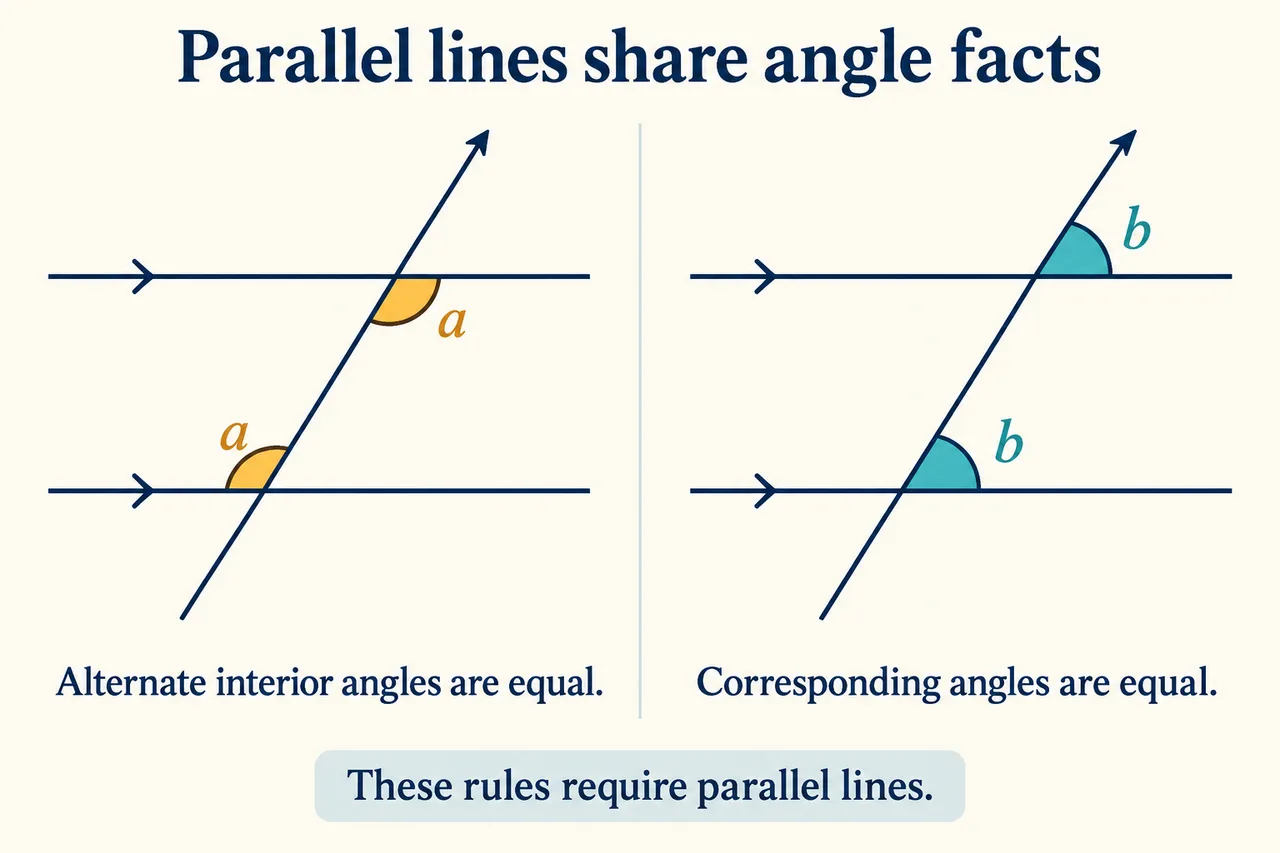
Original myAudience AI-generated mathematics teaching illustration; geometry and labels checked by the authoring agent. Independent integration review pending. · Original project artwork; no exam-board figures or textbook illustrations reused.
Recognise angles on parallel lines
A transversal crosses two or more lines. If the crossed lines are parallel, corresponding angles in matching positions are equal, and alternate interior angles are equal. Interior angles on the same side of the transversal add to 180°. The parallel condition is essential: these rules do not follow merely because two lines look nearly parallel.
Identify positions before selecting a rule. Corresponding angles occupy the same relative corner at the two intersections. Alternate interior angles lie between the parallel lines on opposite sides of the transversal. Same-side interior angles lie between the lines on the same side.
You can reverse the reasoning to establish parallelism when the relevant angle relationship is known. State which relationship applies, rather than writing a letter-shape shortcut as the whole explanation. Combine a parallel-line rule with a straight-line or vertically-opposite rule when the requested angle is in a different position.
The equality of corresponding angles can be understood by translating the first intersection to the second by the vector joining them along the transversal. This translation maps the first parallel line onto the second and the transversal onto itself, preserving the matching corner angle. Combining this with vertically opposite equality gives alternate interior equality. Combining it with a straight angle gives same-side interior supplementation. These are linked deductions, not three unrelated letter-shape tricks; a reasoned solution can move between them when the requested sector is elsewhere.
Converses must identify the appropriate angle pair. If corresponding sectors made by a transversal are equal, the crossed straight lines are parallel; equal alternate interior angles likewise establish parallelism. If same-side interiors sum to 180°, their lines are parallel. Equal angles at arbitrary locations do not establish any of these hypotheses. Mark the transversal and name the corners before applying a converse, and distinguish a given parallel symbol from a conclusion you are trying to prove.
In a multistep problem, first transport an angle using a justified parallel rule, then use local angle sums. Suppose an upper corresponding angle is 3 x+12 and its lower matching angle is 5 x−24. Parallelism yields x=18, giving 66°. The lower adjacent sector is 114°, not another 66°. Writing the requested angle as x confuses a parameter with an angle expression. The known equality, equation solution and final sector value are three separate steps that all need to appear.
When lines are not known parallel, angle data can either establish or disprove that property. Corresponding angles 64° and 68° rule it out in ordinary Euclidean geometry. However, adjacent angles 64° and 116° at the same intersection only establish a straight-angle sum already true there; the y give no information about the second line. A converse compares relationships across the two intersections. Ruler appearance or near-horizontal screen pixels cannot bridge a missing condition.
Image: illustration, not a documentary photograph. The dedicated parallel plate now correctly accompanies this lesson: its left highlighted pair lies between the marked parallel lines on opposite sides of the transversal, and its right pair occupies matching corners. The equality labels are symbolic and no precise numerical slope is supplied. Use the marks and sector positions, not pixel measurement, to choose the rule. For a scaffolded proof, name the two intersections U and V and label the transversal segments. First identify whether an angle sits inside or outside the strip between the lines. Next identify whether the pair is on the same or opposite sides of the transversal. Then use the actual corresponding corners, or use a local opposite-angle equality to convert to them. This procedure works when the figure is tilted and the usual letter-shaped mnemonics no longer look familiar. A chain of reasons might read 'given upper angle; alternate interior equality because the lines are parallel; straight-line subtraction at V; triangle sum in the new triangle'. Each link carries its own premise. A final numerical answer cannot retrospectively prove that the initial lines were parallel.
Worked example: Lines l and m are crossed by one transversal. Corresponding angles are 3 x+12 and 5 x−24 degrees, and l∥m is given. Find x and the two same-side interior angles associated with the lower intersection. Explain how the argument changes if parallelism is not given.
With l∥m, corresponding sectors are equal: 3 x+12=5 x−24, so 36=2 x and x=18.
Each stated corresponding angle is 66°. The adjacent sector on its straight line is 114°.
The relevant same-side interior pair therefore consists of 66° and 114° in the chosen configuration, and their sum is 180°.
If parallelism is not given, the equation cannot be assumed from a drawing. If equality of those corresponding angles is independently supplied or proved, its converse can establish parallelism.
If the two angle expressions alone are supplied with no relationship or value of x, the y do not determine x or prove that the lines are parallel.
Answer: Given parallelism: x=18 and the same-side interiors are 66° and 114°. Without a justified cross-intersection relationship, the same algebra is not licensed.
Check your understanding: A designer marks two same-side interior angles as 2 y+40 and 3 y+15 degrees and claims the lines are parallel. For what y would that claim follow from the converse? If y=24 is measured instead, explain what conclusion is supported. Why are two supplementary adjacent angles at one intersection insufficient?
Answer: The parallel converse needs (2 y+40)+(3 y+15)=180°, so 5 y+55=180 and y=25. The values are 90° and 90°, a valid special case. At y=24 the values are 88° and 87°, totalling 175°, so the claimed parallelism is inconsistent with the exact stated angle data; a measured value would also require an uncertainty statement before treating it as exact. Adjacent sectors at one straight-line intersection are supplementary regardless of the orientation of another line, so that local fact alone supplies no cross-line evidence.
Why: Credit the correct pair classification, converse equation and 25 result, the 175° inconsistency and distinction between exact data and measurements. A diagram alone cannot establish parallelism.