Build polygon angle sums from triangles
By UK GCSE Mathematics · independent study · myAudience
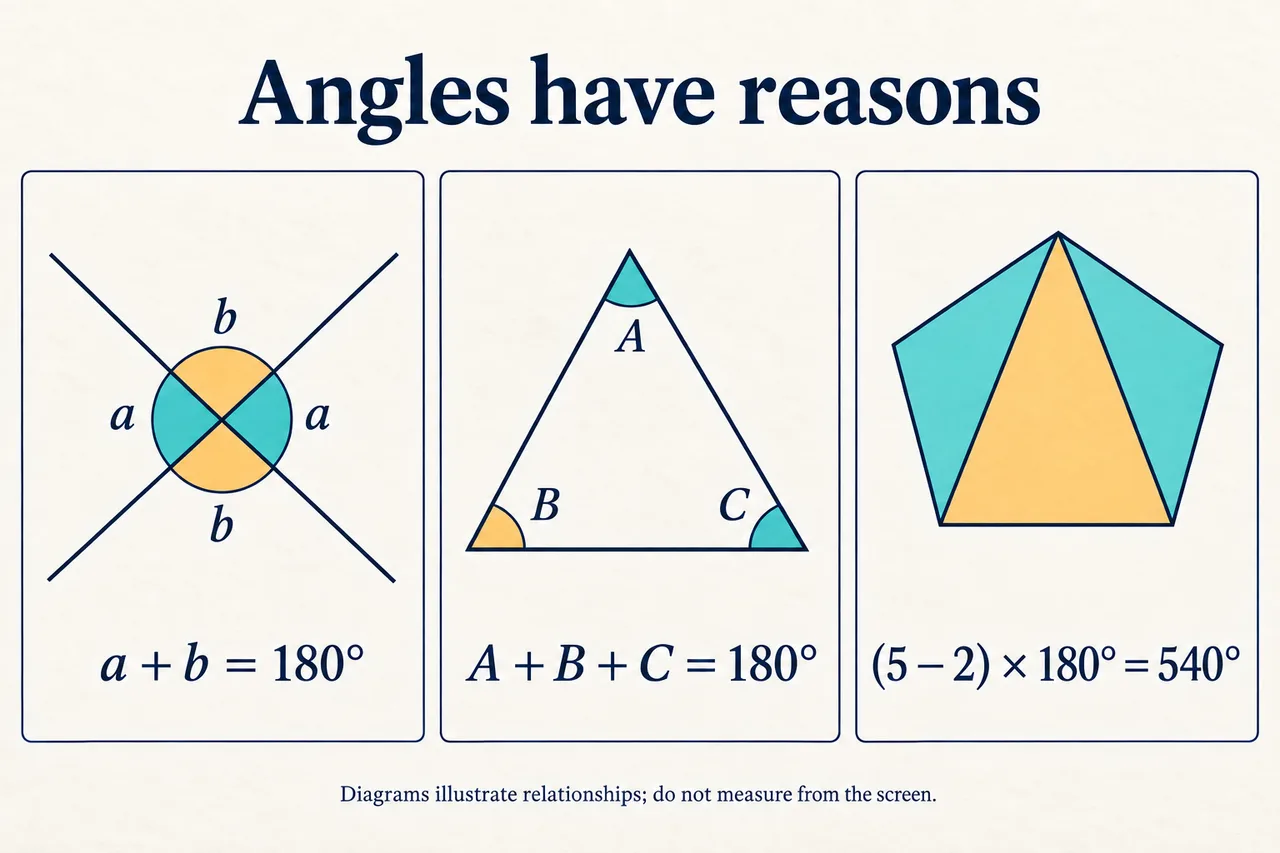
Original myAudience AI-generated mathematics teaching illustration; geometry and labels checked by the authoring agent. Independent integration review pending. · Original project artwork; no exam-board figures or textbook illustrations reused.
Build polygon angle sums from triangles
The interior angles of a triangle add to 180° in plane Euclidean geometry. A proof draws a line through one vertex parallel to the opposite side: alternate angles reproduce the other two vertex angles along a straight angle. This connects the triangle rule to parallel-line reasoning.
A simple convex n-sided polygon can be divided into n − 2 non-overlapping triangles by drawing diagonals from one vertex. Its interior angle sum is therefore (n − 2) × 180°. A pentagon gives three triangles and 540°. The formula also holds for simple concave polygons, though a triangulation may need different diagonals; self-crossing figures need separate care.
For a regular polygon, divide the sum by n to obtain each interior angle. Each exterior turning angle is 360°/n. For the usual consistent traversal of a convex polygon, one exterior angle at every vertex adds to 360°. A regular polygon must have an integer number of sides; an algebraic answer that is not a whole number cannot describe one.
A polygon angle formula needs a reason, not just a substitution. In a convex polygon, choose one vertex and draw diagonals to every non-adjacent vertex. The diagonals divide the interior into n − 2 triangles without gaps or overlaps. Adding their angle sums gives (n − 2) × 180°. Each internal diagonal is counted as a boundary between two triangles, but the angles together still fill the original polygon angles exactly. The triangle starting point can itself be derived: draw through a vertex C a line parallel to AB. Alternate angles copy the angles at A and B onto the two sides of angle ACB at C. These three adjacent sectors fill a straight angle of 180°, so the original triangle angles sum to 180°. This avoids assuming the polygon formula to prove its own starting case.
Convex means that every interior angle is less than 180°. A concave simple polygon has an inward corner. It can still be triangulated into n − 2 triangles, but a fan from an arbitrarily chosen vertex may leave the polygon or overlap. A self-crossing star is a different object: applying the simple-polygon formula to the apparent outer tips without defining its interior is not justified. State the shape assumptions before claiming that a diagram proves a formula.
For a convex polygon, extend each side in the direction of a walk around its boundary. The turning angle at a vertex is supplementary to its interior angle. The complete walk makes one full turn, so the exterior turns sum to 360°. This also follows algebraically: n × 180° − (n − 2) × 180° = 360°. For concave boundaries, a turn in the opposite direction must be treated with a sign; adding every visible acute angle as positive does not describe the walk.
Regular means both equal sides and equal interior angles. Only after establishing regularity may you divide the interior sum by n or use n = 360° ÷ exterior angle. The result for n must be a whole number of at least three. An apparently plausible decimal is a warning that an exact claimed angle cannot belong to a regular polygon. A non-regular polygon can have the same total interior sum while its individual angles differ.
The illustration is a concept hook for labelled shapes, not a scale instrument or a drawing of every polygon in this lesson. Sketch a convex pentagon and draw the three non-overlapping triangles yourself on paper. Explain which vertices each triangle uses. This written explanation supports the logic, but it does not record an observed construction or replace practice drawing and checking the partition. A useful scaffold is to begin with n = 3, 4 and 5: the fan contains one, two and three triangles respectively. The count increases by one when another vertex is inserted, which makes the n − 2 rule plausible; the non-overlapping fan gives its general justification. Drawing every possible diagonal instead is unsuitable because their crossings generate additional regions that are not the chosen triangulation. For an irregular hexagon, knowing the 720° total does not determine any one angle until five others or other relationships are supplied. If one interior is reflex in a simple concave polygon, include its full angle above 180° in the total rather than substituting the smaller outside turn. A claimed set of five convex-pentagon interior angles 90°, 90°, 90°, 90° and 180° has the right sum but is not a convex pentagon: the 180° corner is degenerate. The sum is necessary, not a complete existence test. This counterexample prevents a formula check from being mistaken for a full geometric proof.
Worked example: A regular polygon has interior angle 150°. Find its number of sides. Then find the missing interior angle of a simple pentagon whose other angles are 100°, 110°, 120° and 130°. Explain why a claimed regular polygon with exact interior angle 158° is impossible.
The exterior turn corresponding to 150° is 180° − 150° = 30°.
Regularity permits n = 360° ÷ 30° = 12, a valid integer.
A simple pentagon has interior sum (5 − 2) × 180° = 540°.
The four known angles sum to 460°, so the fifth is 80°. The y need not all be equal.
An exact interior angle of 158° gives an exterior turn of 22°, so n = 360 ÷ 22 = 180/11, not an integer.
Answer: Twelve sides; the missing pentagon angle is 80°; no regular polygon has exact interior angle 158°.
Check your understanding: A student says a convex hexagon contains five triangles because five diagonals can be drawn somewhere inside it. Critique the reasoning. A second student says a regular polygon has interior angle six times its exterior turn: determine n and check both angle sums.
Answer: A triangulation needs non-overlapping triangles that cover the interior, not a count of arbitrary diagonals. A convex hexagon can be partitioned into four triangles, giving 720°. If exterior turn is e and interior angle is 6 e, then 7 e = 180°, so e = 180/7 degrees and n = 360 ÷ (180/7) = 14. The interior angle is 1080/7 degrees. Fourteen exterior turns total 360° and fourteen interiors total 2160° = (14 − 2) × 180°. Fractional angles are allowed even though the number of sides must be integral.
Why: Credit a valid partition argument, the distinction between diagonal counts and triangle counts, the supplementary-angle equation and two independent sum checks. Do not reject a polygon merely because its angle measure is fractional.