Classify quadrilaterals by their properties
By UK GCSE Mathematics · independent study · myAudience
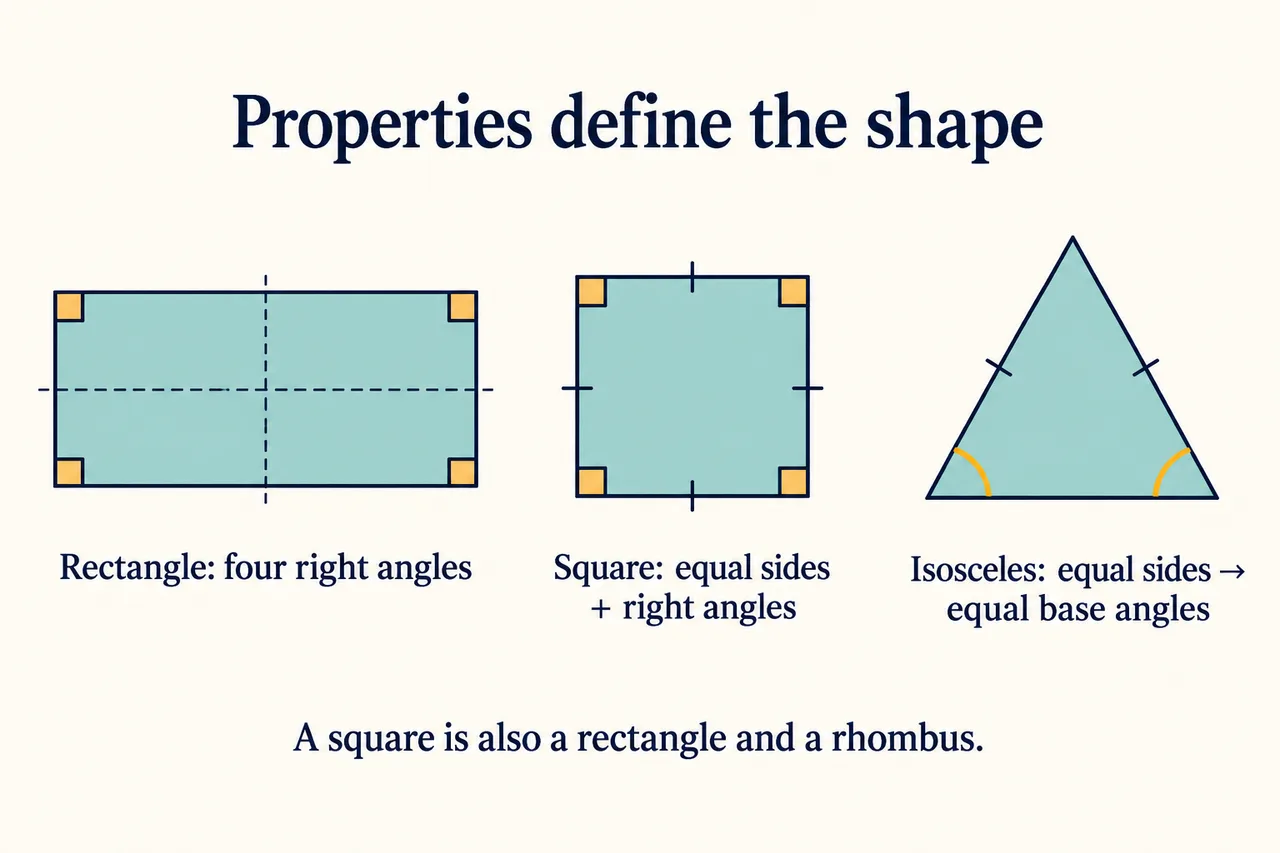
Original myAudience AI-generated mathematics teaching illustration; geometry and labels checked by the authoring agent. Independent integration review pending. · Original project artwork; no exam-board figures or textbook illustrations reused.
Classify quadrilaterals by their properties
A parallelogram has two pairs of parallel opposite sides. Its opposite sides and opposite angles are equal; adjacent interior angles add to 180°. A rectangle is a parallelogram with four right angles. A rhombus is a parallelogram with four equal sides. A square satisfies both descriptions, so it is also a rectangle and a rhombus.
Diagonals help distinguish the families. All parallelogram diagonals bisect one another. Rectangle diagonals are equal in length, while rhombus diagonals meet at right angles. A square has both properties. These implications have hypotheses: perpendicular diagonals alone do not establish a rhombus, because a kite can also have them.
A kite has two pairs of equal adjacent sides. A trapezium is commonly taught in UK GCSE work as having one pair of parallel sides; state the convention when using an inclusive definition that permits more. Do not transfer every parallelogram property to these other quadrilaterals. Tick and parallel marks are evidence; the drawing is only a guide.
A quadrilateral classification is a set of implications. A parallelogram has both pairs of opposite sides parallel; a rectangle is a parallelogram with right angles; a rhombus is a parallelogram with four equal sides; a square satisfies both the rectangle and rhombus conditions. Thus every square is both a rectangle and a rhombus, but neither converse holds. Here a trapezium uses the usual UK school convention of exactly one pair of parallel sides; some sources use an inclusive definition, so a classification question must state its convention.
A parallelogram diagonal splits it into two triangles. Alternate angles from the parallel sides agree, and the diagonal is common, so ASA establishes congruence. This proves opposite sides are equal. For the intersection of the two diagonals, alternate angles and an equal opposite-side pair establish another ASA comparison, proving that each diagonal bisects the other. Opposite angles are equal and adjacent angles supplementary by the parallel-line facts; these are consequences with reasons, not additional arbitrary marks.
In a rectangle, triangles formed by a diagonal have matching side pairs and an included right angle. SAS proves that the diagonals are equal. In a rhombus, use the already-established diagonal bisection and two equal sides to compare the two triangles on either side of one diagonal by SSS. Their equal adjacent angles at the intersection sum to 180°, so both are 90°. The diagonals are perpendicular. A square has both sets of consequences.
Converse statements need their hypotheses. Equal diagonals alone do not prove a rectangle, and perpendicular diagonals alone do not prove a rhombus. Within a parallelogram, equal diagonals do establish a rectangle, and perpendicular diagonals establish a rhombus; without that starting condition, an isosceles trapezium or a non-rhombus kite supplies a counterexample. A kite has two pairs of adjacent equal sides; under an inclusive definition a rhombus is a special kite. A typical non-rhombus kite has one symmetry axis, perpendicular diagonals, and only one diagonal bisected by the other.
The plate shows named shapes and selected markings. It does not show the diagonal proofs just described. Draw the diagonals and name the triangle vertices before matching corresponding sides. If your proof depends on a fact that has not been given or proved, mark that gap rather than assuming a familiar shape has every property you need. A concise proof can be short while still stating the criterion and the relationships that justify it. To scaffold a classification, organise properties into defining conditions, proved consequences and insufficient evidence. Four equal sides gives a rhombus for an ordinary simple quadrilateral, but equal opposite sides alone gives only a parallelogram. Equal opposite angles alone do not force right angles: a parallelogram with angles 70°, 110°, 70°, 110° is a counterexample to the rectangle conclusion. Conversely, a parallelogram with one right angle has adjacent supplementary angles, so both adjacent angles are 90°, and its opposite angle is also 90°. This establishes the rectangle condition from one right angle plus parallelism. An ordinary trapezium need not have equal non-parallel sides; that extra condition selects the isosceles case, with equal base-angle pairs and equal diagonals. Avoid exporting those extra consequences to every trapezium. A properties table is useful only when its assumptions travel with each row.
Worked example: A parallelogram ABCD has diagonals meeting at O. AO = 2 x + 1 and OC = 5 x − 8. BO = 3 y − 2 and OD = y + 6. Find both whole diagonal lengths. Can these data describe a rectangle? Do the y prove a rhombus?
A parallelogram’s diagonals bisect each other, so 2 x + 1 = 5 x − 8 gives x = 3.
AO = OC = 7, so AC = 14.
Likewise 3 y − 2 = y + 6 gives y = 4; BO = OD = 10, so BD = 20.
A rectangle must have equal diagonals. Since 14 ≠ 20, this is not a rectangle.
Unequal diagonal lengths are compatible with a non-square rhombus, but do not prove one. No equal-side or perpendicular-diagonal condition has been supplied.
Answer: AC = 14 and BD = 20 in the stated length units. The parallelogram is not a rectangle; rhombus status remains undetermined.
Check your understanding: Consider A(0, 3), B(2, 0), C(0,−1), D(−2, 0), joined in that order. Show that this is a kite with equal perpendicular diagonals but is neither a rectangle nor a rhombus. Which hypothesis is missing from the tempting converse?
Answer: AB = AD = √13 and BC = CD = √5, so there are two adjacent equal-side pairs but not four equal sides. AC is vertical of length 4 and BD horizontal of length 4, so the diagonals are equal and perpendicular. Their intersection (0, 0) bisects BD, but does not bisect AC: the two parts have lengths 3 and 1. It is not a parallelogram, so the converse results restricted to parallelograms cannot be used. The unequal adjacent lengths exclude a rhombus and rectangle membership is also excluded by the failed parallelogram condition.
Why: Credit both length pairs, both diagonal claims, the unequal halves of AC and explicit identification of the missing parallelogram hypothesis. “It looks like a kite” is insufficient evidence.