Use equal sides to deduce angles
By UK GCSE Mathematics · independent study · myAudience
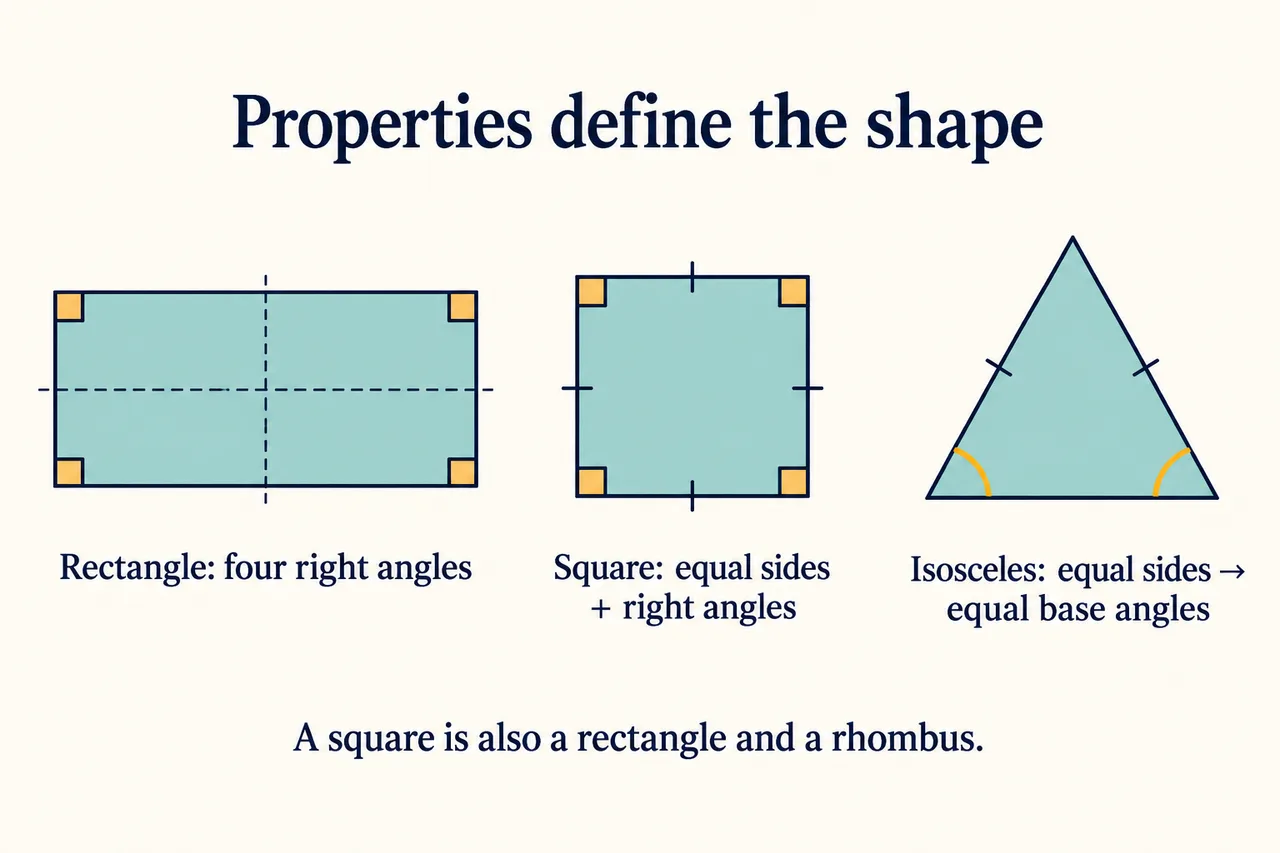
Original myAudience AI-generated mathematics teaching illustration; geometry and labels checked by the authoring agent. Independent integration review pending. · Original project artwork; no exam-board figures or textbook illustrations reused.
Use equal sides to deduce angles
An isosceles triangle has at least two equal sides. The angles opposite those equal sides are equal. An equilateral triangle has three equal sides and three equal angles, each 60°. Under this inclusive definition it is also isosceles. A scalene triangle has no equal sides; a right-angled triangle has one 90° angle.
A triangle may belong to more than one category. For example, a triangle can be both right-angled and isosceles. Its two remaining angles then add to 90° and are equal, so each is 45°. An equilateral triangle cannot be right-angled because every one of its angles is 60°.
The equal angles are opposite the equal sides, not automatically adjacent to whichever vertex was named first. Mark the equal sides, identify their opposite vertices and then apply the 180° triangle sum. If side AB equals AC, the base is BC and angles ABC and BCA are equal.
Triangle labels describe two independent classifications. By sides, a triangle is scalene, isosceles or equilateral; by angles it is acute, right-angled or obtuse. An isosceles triangle can belong to any of the three angle classes. An equilateral triangle has three 60° angles and is acute. In the inclusive convention used here, an equilateral triangle is a special isosceles triangle because it has at least two equal sides; a question using exactly two must say so.
The equal angles in an isosceles triangle are opposite the equal sides. If AB = AC, the apex is A and the equal base angles are at B and C. Drawing a line from A that bisects its angle gives two triangles with AB = AC, the common dividing segment and equal included angles. SAS establishes congruence, so the base angles agree. Naming the apex incorrectly moves the equality to the wrong angles, even if the arithmetic looks plausible.
The converse also has a reason. If the base angles at B and C agree, draw the angle bisector from A to BC. The two resulting triangles have equal apex angles, equal base angles and a common corresponding side, so AAS, derived from ASA using the triangle angle sum, gives congruence. Hence AB = AC. The step from equal angles to equal opposite sides is justified; it is not a guess based on an apparently symmetrical sketch.
Check that proposed data describe a possible non-degenerate triangle. All three interior angles must be positive and sum to 180°. Any side must be shorter than the sum of the other two. Lengths 2, 3 and 6 cannot form a triangle because 2 + 3 < 6; lengths 2, 3 and 5 would be collinear, not a triangle with an interior. An algebraic answer that produces a zero or negative angle is similarly evidence that the stated conditions are inconsistent.
The isosceles example on the plate illustrates matched side and base-angle markings. It does not make every triangle in an accompanying question isosceles. Read which sides actually carry the same mark, identify the opposite angles, and show both the angle-sum check and a valid classification. This transfers a familiar image into a justified argument rather than copying its appearance. A scaffolded side-and-angle classification should begin with the actual equality marks, not the orientation. If two equal sides meet at the bottom of a rotated sketch, that is still the apex and the equal angles are at the remaining two vertices. Next use the 180° sum and check whether the largest angle is below, equal to or above 90°. For an isosceles triangle with apex angle a, each base angle is (180° − a)/2. With a = 100°, the bases are 40° and the triangle is obtuse; with a = 90°, the bases are 45° and it is right-angled; with a = 40°, the bases are 70° and it is acute. This gives concrete counterexamples to the claim that all isosceles triangles are acute. Notice that an isosceles triangle cannot have two obtuse base angles because their sum would already exceed 180°. Two right angles are likewise impossible in a non-degenerate triangle. An equilateral conclusion needs three equal sides or an equivalent justified condition; merely observing two 60° angles is enough only after the third is obtained from the angle sum and equal opposite sides are justified. If a problem lists proposed side lengths as well, test the longest against the sum of the two shorter lengths before trying to classify angles. For lengths 2, 3 and 4, the inequality passes and a triangle is possible; that alone does not establish a right angle. The squared-length check 2² + 3² = 13 ≠ 16 rules out a right angle opposite the longest side, but it is a separate Pythagorean argument, not the triangle-inequality test. Organising these checks prevents an existence result from being confused with a shape property.
Worked example: AB = AC. The apex angle A is 3 x + 10 degrees and each base angle is 2 x + 15 degrees. Find x, all three angles and both side and angle classifications.
The equal sides meet at A, so the equal base angles are B and C.
(3 x + 10) + 2(2 x + 15) = 180, giving 7 x + 40 = 180 and x = 20.
A = 70° and B = C = 55°; all are positive and 70 + 55 + 55 = 180.
Two equal sides justify isosceles, and all three angles below 90° justify acute. No three-equal-side claim is supported.
Answer: x = 20; angles 70°, 55°, 55°; an acute isosceles triangle.
Check your understanding: AB = AC, and the exterior angle at B formed by extending CB beyond B is 134°. Find all interior angles. A second sketch instead states AB = BC but retains these angle values at the same vertices: explain whether it is consistent.
Answer: The interior angle at B is 180° − 134° = 46°. Since AB = AC, angle C is also 46°, leaving angle A = 88°. If AB = BC instead, the equal angles must be opposite those sides, at C and A. The retained 46° and 88° values are unequal, so the second set of claims is inconsistent. The vertex names and side pairing matter; the phrase “isosceles” alone cannot select the equal angles.
Why: Credit the straight-line subtraction, the correct equal base angles, angle-sum check and explicit opposite-side contradiction in the second sketch.