Prove triangles have the same size and shape
By UK GCSE Mathematics · independent study · myAudience
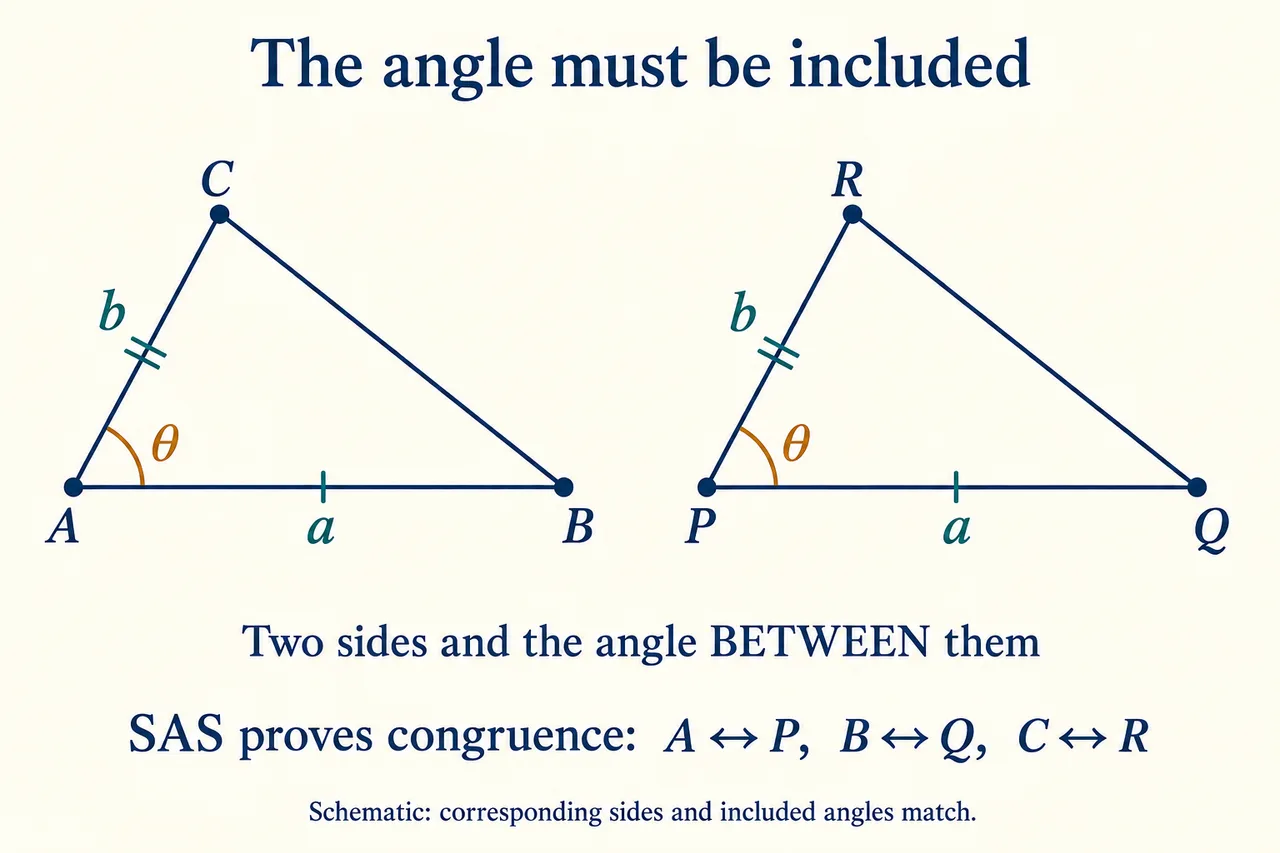
Original myAudience AI-generated mathematics teaching illustration; geometry and labels checked by the authoring agent. Independent integration review pending. · Original project artwork; no exam-board figures or textbook illustrations reused.
Prove triangles have the same size and shape
Congruent shapes match exactly after a translation, rotation or reflection. Similar shapes may have different sizes; congruent shapes have corresponding sides and angles equal. Always match vertices in a consistent order when stating a congruence, because that order defines which sides and angles correspond.
For triangles, SSS specifies three corresponding sides. SAS specifies two corresponding sides and the angle between them. ASA specifies two corresponding angles and the included side; two angles also determine the third, so equivalent angle-side information can establish the same triangle. RHS uses a right angle, equal hypotenuses and one other corresponding side.
Three equal angles alone establish similarity, not congruence. Two sides and a non-included angle are not a general congruence test: more than one triangle can fit. After proving a valid criterion, you may deduce other corresponding lengths or angles. Clearly identify the included angle for SAS and the hypotenuse for RHS.
Congruence means that one triangle can be moved by translations, rotations or reflections to coincide with the other. It preserves all corresponding lengths and angles; it does not require the triangles to face the same direction on the page. Name a correspondence consistently. In triangle ABC corresponding to PQR, A pairs with P, B with Q and C with R. A correct numerical equality paired with the wrong vertices is not a valid congruence argument.
SSS supplies three corresponding side lengths. SAS supplies two corresponding sides and the angle included between them. ASA supplies two corresponding angles and their included corresponding side; if a different corresponding side is supplied, first use the 180° angle sum to obtain the missing angle and reduce AAS to ASA. RHS applies only after both triangles are established as right-angled, and requires a matching hypotenuse and one other corresponding side. The hypotenuse is opposite the right angle, not whichever segment looks longest in an unscaled sketch. For a valid RHS example, let PQR and STU be right-angled at Q and T, with hypotenuses PR = SU = 9 and legs PQ = ST = 4. The right angles, hypotenuse equality and leg equality are all given before the proof. RHS establishes PQR congruent to STU, hence QR = TU and angle PRQ equals SUT. No unproved hypotenuse equality has been smuggled into the criterion.
The included-angle condition in SAS prevents ambiguity. If one side is laid down, a fixed angle at its endpoint sets a ray for the second fixed side; their endpoints determine the third side. A non-included angle and two sides can leave two possible endpoints: a circle of the fixed side length around the far endpoint can intersect the angle ray twice. Those intersections give two different triangles with the same stated side-side-angle data. SSA is therefore not a universal congruence criterion, even though some particular data have only one solution.
AAA also fails as a congruence criterion. A triangle with side lengths 3, 4, 5 and a triangle with lengths 6, 8, 10 have the same angles because one is an enlargement of the other, but their lengths differ. The y are similar, not congruent. A counterexample needs only one valid failure to disprove a universal claim; examples where AAA happens to describe the same triangle do not repair the criterion.
A proof should separate givens from derived facts and finish with the required consequence. The congruence plate illustrates a valid matching-side/included-angle comparison for SAS. The separate SSA discussion above supplies the warning about a non-included angle; that counterexample is not depicted in the plate. It is not evidence that a learner has performed a construction or measured the triangles. State the matching sides, the included-angle or other criterion, and the resulting correspondence in words before extracting an angle or side equality. A useful proof scaffold is a three-row correspondence table. List one pair of sides, a second pair, and the angle between them for SAS; list the three pairs of sides for SSS; or identify the two right angles, matching hypotenuses and matching other sides for RHS. Mark each item as given, common or previously proved. If an entry depends on the result being proved, the argument is circular. After congruence, name the corresponding vertices before using an equal side or angle consequence. For example, the correspondence ABC ↔ CDA sends AB to CD, not to DA. Reversed triangle naming is harmless only when the entire pairing is kept consistent. This bookkeeping is especially valuable with overlapping triangles sharing a diagonal, where a visually obvious match can conceal a misordered side.
Worked example: ABCD is a parallelogram. Prove triangles ABC and CDA congruent using diagonal AC, then deduce AB = CD and BC = AD. Explain why saying only “AC is common” is incomplete.
Because AB is parallel to CD, angle BAC equals angle DCA by alternate angles.
Because BC is parallel to AD, angle BCA equals angle DAC by alternate angles.
AC is the common side included between those angle pairs.
ASA proves triangle ABC congruent to triangle CDA, with A corresponding to C, B to D and C to A.
Corresponding sides therefore give AB = CD and BC = AD. One common side alone permits many different triangles and cannot establish congruence.
Answer: The two alternate-angle pairs and common included side establish ASA; the corresponding opposite sides are equal.
Check your understanding: P lies on the perpendicular bisector of AB, whose midpoint is M. A student proposes proving PA = PB using RHS. Evaluate that instruction and provide a valid proof. If instead P is only said to be equidistant from A and B, prove PM is perpendicular to AB when P is not on AB. Identify why the second direction uses a different criterion.
Answer: In the first direction, PM is common, AM = BM by the midpoint condition, and both angles at M are right angles. SAS (equal included right angles) proves the triangles congruent; their hypotenuses PA and PB are then equal. It would be circular to use RHS before the hypotenuse equality is established. In the converse, PA = PB is given, AM = BM and PM is common, so SSS proves triangles PAM and PBM congruent. The two angles at M are equal and supplementary, hence each is 90°. The prompt’s suggestion of RHS in the first direction must be rejected: RHS would require the very hypotenuse equality we are trying to prove.
Why: Credit identifying the misleading instruction, using SAS without assuming PA = PB, using SSS for the converse and combining equality with the straight angle. Correcting an invalid proposed proof is part of the task, not an error in a learner’s response.