Units make a physical calculation meaningful
By UK A Level Physics · independent study · myAudience
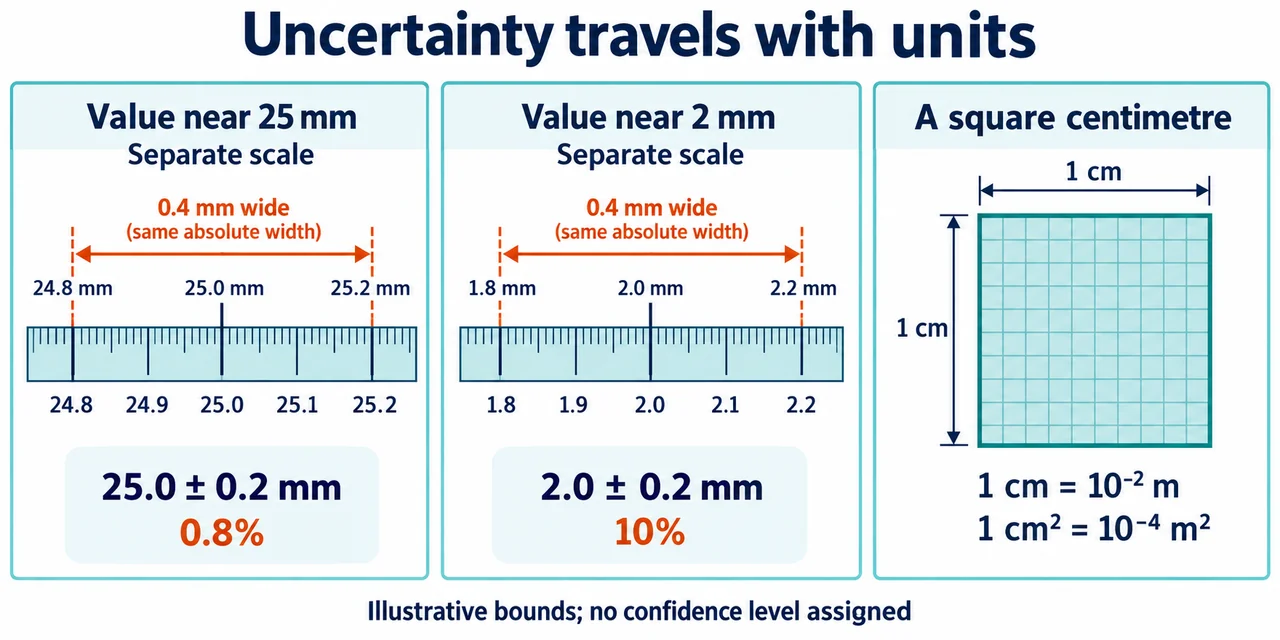
Image: illustration, not a documentary photograph. Original teaching model created for myAudience. · Original generated teaching illustration; no board endorsement or source textbook artwork reproduced.
Units make a physical calculation meaningful
Before calculating, distinguish a quantity from its unit: length is a quantity, while metre is a unit used to express it. This lesson assumes GCSE arithmetic with powers of ten. Vocabulary to retain includes base unit, derived unit, prefix and standard form. The six base quantity–unit pairs required here are mass–kilogram (kg), length–metre (m), time–second (s), amount of substance–mole (mol), thermodynamic temperature–kelvin (K), and electric current–ampere (A). excludes the candela from this section and does not require memorised definitions of the base quantities.
Derived units express relationships between quantities. Speed measured as distance divided by time has unit m s⁻¹. Force has unit kg m s⁻², named the newton (N), and energy has unit N m, named the joule (J). This is practical bookkeeping rather than a demand for formal dimensional analysis. A number such as 8.0 is incomplete as a physical answer until its unit and context tell us what was measured or calculated.
Prefixes change scale, not the underlying quantity. Learn T = 10¹², G = 10⁹, M = 10⁶, k = 10³, c = 10⁻², m = 10⁻³, μ = 10⁻⁶, n = 10⁻⁹, p = 10⁻¹² and f = 10⁻¹⁵. Prefixes are case-sensitive: m means milli when attached to a unit, whereas M means mega. Write 4.7 × 10⁻³ A for 4.7 mA. In standard form the leading positive coefficient lies between 1 and 10; moving its decimal point must be compensated by changing the exponent.
Apply a conversion to the entire unit. One cm is 10⁻² m, so one cm² is 10⁻⁴ m² and one cm³ is 10⁻⁶ m³. A kilowatt-hour is energy, because power multiplied by time gives energy: 1 kW h = 1000 × 3600 J = 3.6 × 10⁶ J. It is not a unit of power. An electronvolt is also energy: 1 eV = 1.602176634 × 10⁻¹⁹ J. Multiplying by that conversion factor takes eV to J; dividing takes J to eV.
A reliable method is to write the conversion as an equality, convert every input, substitute, and attach the final unit. Keep guard digits until the end; conversion does not create more measurement precision. These habits will later prevent errors when nuclear distances use femtometres and photon energies use MeV. SI uses a space between number and unit, as in 5.0 s; ordinary prose should state what the number describes rather than letting an isolated equation carry the explanation.
Read the two rulers separately. The endpoints are 24.8 and 25.2 mm in the first panel and 1.8 and 2.2 mm in the second. In each case the full interval is 0.4 mm wide, whereas the absolute uncertainty is its half-width, 0.2 mm. The percentages compare that half-width with the central value: 100(0.2/25.0) = 0.8% and 100(0.2/2.0) = 10%. The larger percentage does not mean the second interval is physically wider. It means the stipulated bound is large relative to the quantity being reported. Separate scales prevent the drawings from implying that the two objects themselves have equal length.
The area panel requires two length conversions, one for each side. A square with sides 1 cm and 1 cm has area (0.01 m)(0.01 m) = 0.0001 m². The grid is schematic, not a calibrated photograph. A prefix acts on the unit before the unit is squared: cm² means (cm)². Converting a stated uncertainty to another unit requires the same factor as the central value. Thus 25.0 ± 0.2 mm becomes 0.0250 ± 0.0002 m; its percentage uncertainty stays 0.8%. A change of units cannot improve precision.
**Worked subtraction and addition.** Two independently bounded position readings are x₁ = 12.4 ± 0.3 cm and x₂ = 28.6 ± 0.4 cm. Find the displacement and its conservative bound. The centre is 16.2 cm. The lowest difference is 28.2 − 12.7 = 15.5 cm; the highest is 29.0 − 12.1 = 16.9 cm. Therefore report 16.2 ± 0.7 cm. Adding the positions instead gives 41.0 ± 0.7 cm. For sums and differences the absolute contributions add under this worst-case bound convention; subtracting the central values does not subtract their uncertainties.
**Worked multiplication with exact endpoint check.** Let a = 20.0 ± 0.2 mm and b = 10.0 ± 0.1 mm be independently bounded positive lengths. The central area is 200 mm². First-order fractional propagation gives 0.2/20 + 0.1/10 = 0.02, hence approximately 200 ± 4 mm². Exact endpoint products are 19.8×9.9 = 196.02 and 20.2×10.1 = 204.02 mm². The asymmetry exposes the discarded product of small errors; it does not invalidate the useful first-order approximation. An exact enclosing interval is [196.02, 204.02] mm². In SI the first-order report is 0.000200 ± 0.000004 m², not 0.0200 m². This is a bound calculation, not a standard deviation or a 95% interval.
**Transfer check.** A zero offset z is common to both readings, so x₁ = r₁ − z and x₂ = r₂ − z. Does the uncertainty in z contribute twice to x₂ − x₁? Explain algebraically before calculating. Answer: (r₂ − z) − (r₁ − z) = r₂ − r₁, so this exactly shared additive offset cancels. Treating it as two independent contributions would discard known correlation. Scale-factor errors do not generally cancel from a difference. School propagation rules need an explicit measurement model; they are not universal statistical rules.
**All-prefix independent practice.** Convert to SI and normalised standard form: 2.4 THz; 3.6 GHz; 7.2 MJ; 5.0 kV; 8.1 cm; 4.3 mm; 6.2 μA; 9.4 nm; 1.7 pF; 2.8 fs. Answers in order: 2.4×10¹² Hz, 3.6×10⁹ Hz, 7.2×10⁶ J, 5.0×10³ V, 8.1×10⁻² m, 4.3×10⁻³ m, 6.2×10⁻⁶ A, 9.4×10⁻⁹ m, 1.7×10⁻¹² F, 2.8×10⁻¹⁵ s. These are the ten prefixed symbols T, G, M, k, c, m, μ, n, p and f required here. A separate unprefixed case is 0.0065 s = 6.5×10⁻³ s. Convert 3.0 mm³ too: 3.0×10⁻⁹ m³. Confusing milli with mega changes a value by a factor of 10⁹.
Worked example: A model lamp transfers 0.75 kW h of energy. Express this in J; also convert 3.2 eV to J.
Use 1 kW h = 3.6 × 10⁶ J.
0.75 × 3.6 × 10⁶ = 2.7 × 10⁶ J.
3.2 × 1.602176634 × 10⁻¹⁹ = 5.1269652288 × 10⁻¹⁹ J.
Answer: 2.7 × 10⁶ J and 5.1 × 10⁻¹⁹ J to two significant figures.
Check your understanding: Convert 2.5 cm² to m².
Answer: 2.5 × 10⁻⁴ m².
Why: The length conversion must be squared; multiplying the area by only 10⁻² loses a factor of 100.