Order-of-magnitude reasoning makes assumptions visible
By UK A Level Physics · independent study · myAudience
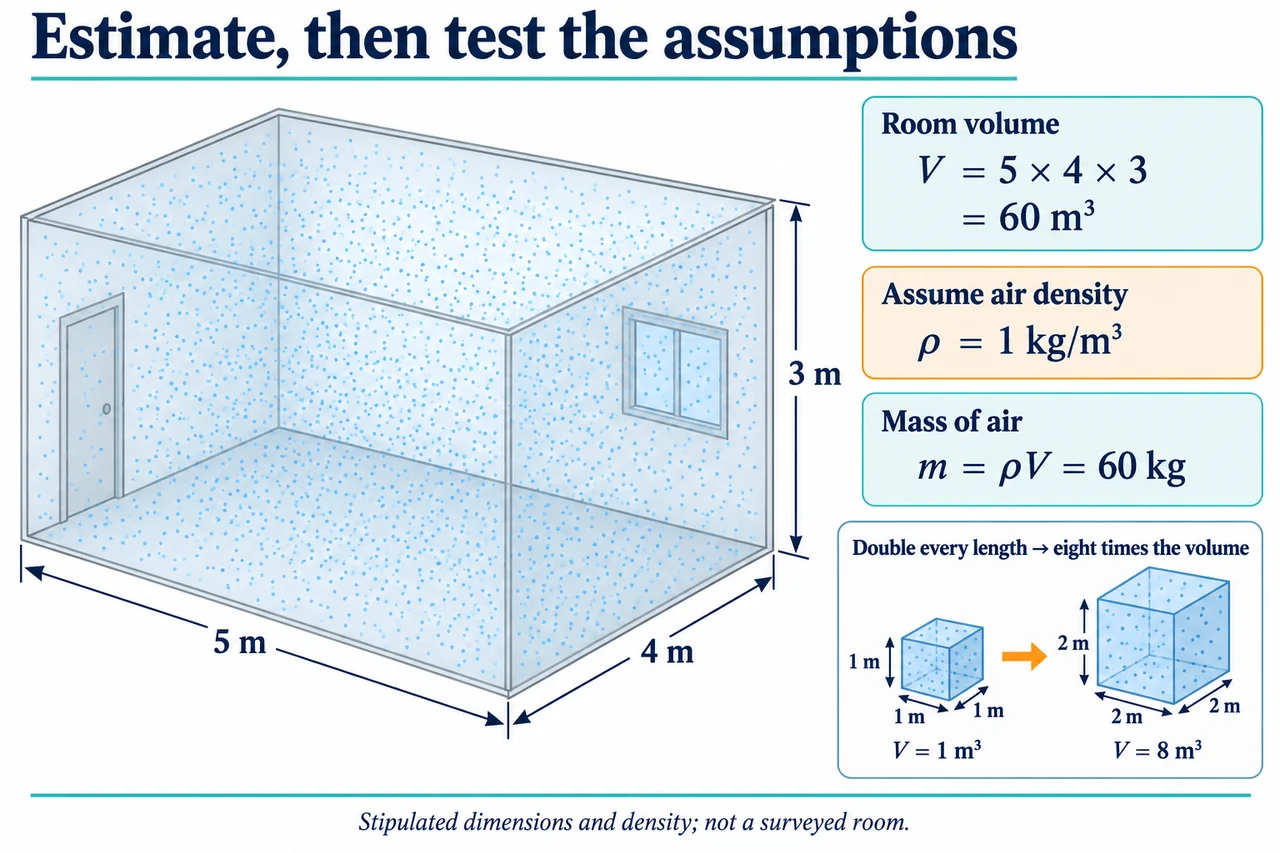
Image: illustration, not a documentary photograph. Original teaching model created for myAudience. · Original generated teaching illustration; no board endorsement or source textbook artwork reproduced.
Order-of-magnitude reasoning makes assumptions visible
An estimate is a reasoned approximation used when exact data are unavailable or unnecessary. This lesson assumes standard form, derived units and simple multiplication. An order of magnitude expresses a scale as a power of ten. The purpose is to test plausibility and identify the dominant factors, not to hide ignorance behind a confident-looking number. State what is being estimated and what assumptions provide the scale.
For nearest-power-of-ten rounding, compare on a logarithmic scale: the boundary between 10ⁿ and 10ⁿ⁺¹ is √10 × 10ⁿ, about 3.16 × 10ⁿ. Thus 2 × 10³ rounds to 10³, while 6 × 10³ rounds to 10⁴ under this explicit convention. Some informal uses simply mean the exponent in standard form, so say which meaning you use. Avoid claiming more significant figures than the assumptions support.
Build derived estimates from physical relationships. For a hypothetical room 5 m long, 4 m wide and 3 m high, its volume is about 60 m³. Assuming air density about 1 kg m⁻³ gives air mass about 60 kg, nearest order 10² kg. The dimensions and density are stipulated estimates, not measurements or universal room properties. The units cancel correctly, and the result explains why a roomful of air can have substantial mass despite low density.
Ask how robust the estimate is. Doubling the assumed density doubles the mass; it does not multiply it by a thousand. By contrast, estimating a sphere's radius wrongly by a factor of ten changes its volume by a factor of a thousand. Separate arithmetic from uncertainty in the assumptions. A result can have correct arithmetic yet be physically implausible because the wrong characteristic length or model was used.
Estimates can guide apparatus choice and help catch conversion mistakes. A wire diameter of order 10⁻⁴ m belongs to a small-distance measurement, while 10⁴ m clearly does not. Before using a calculator, predict the sign, scale and unit of the answer. After calculating, compare against the estimate and explain any large difference. This habit will be reused when femtometre nuclear separations and nanometre electron wavelengths enter the same course.
The pictured room uses stipulated 5 m, 4 m and 3 m dimensions, giving 60 m³. Its dots stand for an air volume, not counted molecules. The assumed density 1 kg/m³ is deliberately rounded for estimation; it is not a current measured density for every room. The cube comparison shows why doubling three independent lengths multiplies volume by eight. Perspective is schematic and cannot be measured to recover the dimensions.
Original transfer challenge: a hall is approximately 20 m long, 10 m wide and 5 m high. Suppose its air density lies between 1.0 and 1.3 kg/m³. Estimate the air mass interval, explain how excluding a 100 m³ solid stage changes it, and judge a proposed 10⁶ kg estimate. Model answer: gross volume is 1000 m³, giving 1000–1300 kg under the stipulated density bounds. Removing the stage leaves 900 m³ and 900–1170 kg, not 100 kg less regardless of density. A million kilograms would require about 1000 kg/m³ at that volume and conflicts with the supplied air-density model. Geometry uncertainty and changing temperature or pressure could matter, but their effects must not be assigned invented numerical bounds. A nearest-power-of-ten estimate is 10³ kg for either interval. Explain the product, the excluded volume and the plausibility test; a correct order of magnitude alone is insufficient.
Worked example: Estimate the mass of air in a hypothetical 5 m × 4 m × 3 m room, using 1 kg m⁻³.
Volume ≈ 5 × 4 × 3 = 60 m³.
Mass ≈ density × volume = 60 kg.
60 kg is 6 × 10¹ kg; logarithmic nearest-power rounding gives 10² kg.
Answer: About 60 kg; order 10² kg under the stated convention.
Check your understanding: If every room dimension doubles but density is unchanged, how does mass change?
Answer: It increases by a factor of 8.
Why: Three independent lengths multiply, giving 2 × 2 × 2. This is a change in model scale, not extra precision.