Atoms, isotopes and specific charge
By UK A Level Physics · independent study · myAudience
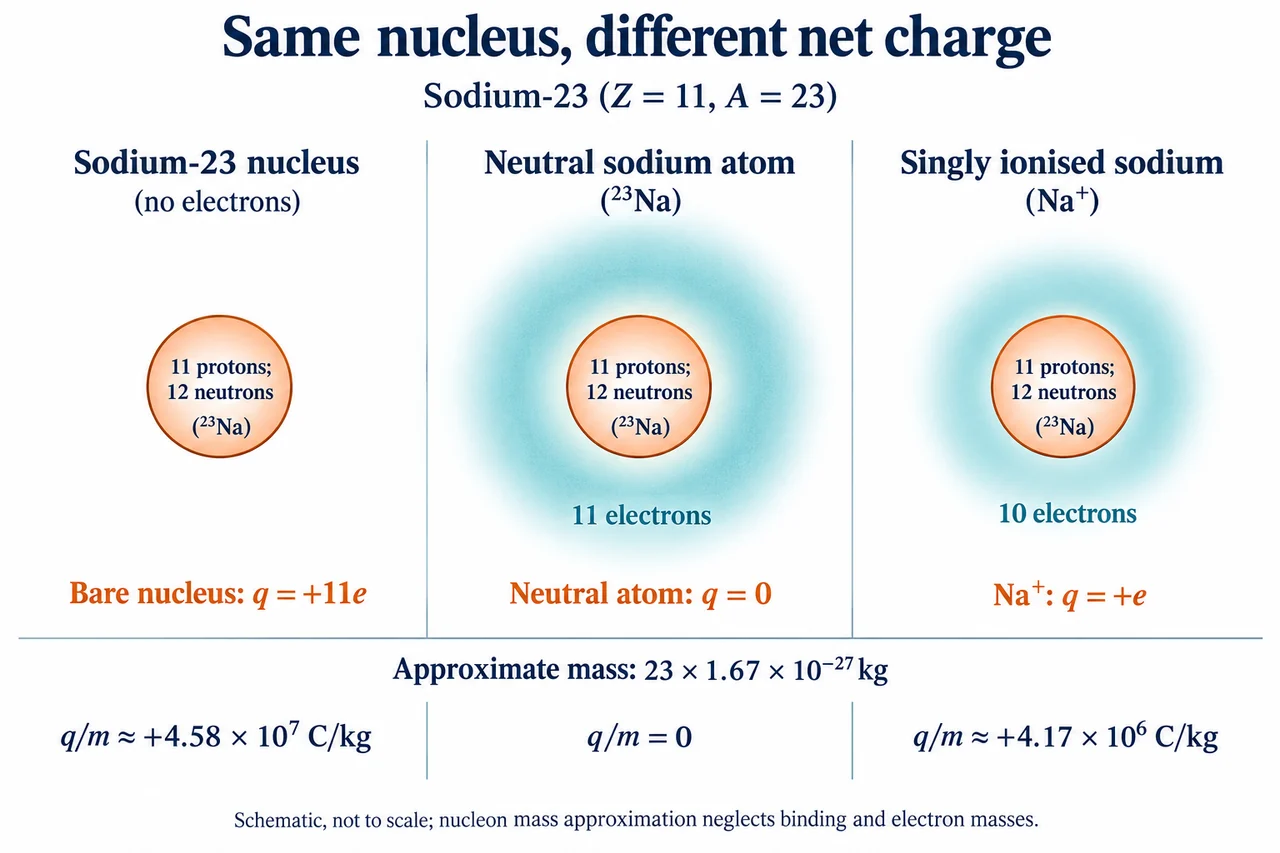
Image: illustration, not a documentary photograph. Original teaching model created for myAudience. · Original generated teaching illustration; no board endorsement or source textbook artwork reproduced.
Atoms, isotopes and specific charge
The simple atomic model places protons and neutrons in a small nucleus with electrons outside it. This lesson assumes signed numbers and division in SI units. Proton charge is +e, neutron charge is zero, and electron charge is −e, where e ≈ 1.60 × 10⁻¹⁹ C. Approximate SI masses are 1.67 × 10⁻²⁷ kg for a proton, 1.67 × 10⁻²⁷ kg for a neutron and 9.11 × 10⁻³¹ kg for an electron. Relative to a proton mass of about 1, a neutron is about 1 and an electron about 1/1836.
Nuclide notation places nucleon number A above proton number Z to the left of the chemical symbol. A counts protons plus neutrons; Z counts protons and determines the element. For ²³₁₁Na, there are 11 protons and 23 − 11 = 12 neutrons. A neutral atom has 11 electrons; a Na⁺ ion has lost one and has 10. Ion formation changes the electron count, whereas nuclear decay can change the element.
Isotopes have the same Z but different neutron counts and therefore different A. They are not ions merely because their masses differ. Isotopic data can identify neutron numbers or the abundance of each isotope in a sample. For a deliberately simplified sample with 75% mass-number-20 atoms and 25% mass-number-22 atoms, the abundance-weighted mass-number proxy is 0.75 × 20 + 0.25 × 22 = 20.5. It is not a claim about a real sample or an exact isotopic mass; precision mass-unit work belongs later in A Level nuclear physics.
Specific charge is charge divided by mass, q/m, with unit C kg⁻¹. Its sign matters. A proton has about +9.58 × 10⁷ C kg⁻¹, and an electron about −1.76 × 10¹¹ C kg⁻¹. The much larger magnitude for an electron comes from its much smaller mass, not from a larger charge. For a nucleus, use +Ze and a stated approximate nuclear mass; for an ion, first count the net charge after electrons are included.
Using A times a nucleon mass is a useful approximation for this foundation exercise. It ignores the proton–neutron mass difference and binding effects, and often neglects electron masses for an atomic ion. State those assumptions rather than treating the approximate mass as exact. the related topic requires specific charge of nuclei and ions as well as elementary particles, so learning only a table of proton and electron values leaves a reasoning gap.
The sodium plate holds nuclear identity fixed while changing electron count. Its cloudy halos are schematic, not planetary electron orbits. The bare nucleus and singly positive ion have charge ratio 11 under the same approximate mass; a neutral atom has zero net specific charge.
As a cross-topic nuclear-decay comparison, the following nuclide equations keep A unchanged because beta processes change a neutron into a proton or vice versa. The mass number counts nucleons, not the sum of masses of all emitted particles. For carbon-14 beta-minus the daughter has Z = 7, balanced by the emitted electron's charge −1. The antineutrino supplies electron-family lepton number −1 to cancel the electron's +1. It is an electron antineutrino, not an electron neutrino. Sodium-22 beta-plus produces a positron and electron neutrino and reduces Z to 10. Capture consumes an electron and reduces beryllium's Z from 4 to 3. The nuclide notation in these equations represents nuclear identity; whole-atom electronic rearrangement is a further account, not a reason to alter A.
**Worked correction task.** Diagnose ¹⁴₆C → ¹⁴₇N + e⁻ + νₑ. A and charge balance, but the final electron-family number is +2 instead of zero. Replacing νₑ with anti-νₑ corrects that account. In ²²₁₁Na → ²²₁₀Ne + e⁺ + anti-νₑ, the same family number is −2; replace the antineutrino with νₑ. Bookkeeping alone still cannot prove an energetically possible decay. A free proton cannot beta-plus decay to a heavier neutron and positron; a suitable nucleus can because total initial and final nuclear energies differ.
**Original synthetic energy-sharing exercise.** Stipulate a beta-minus transition with available kinetic energy Q = 0.800 MeV and one event with electron kinetic energy 0.250 MeV, daughter recoil 0.002 MeV and negligible neutrino rest energy. The antineutrino carries 0.548 MeV. If another event has electron energy 0.700 MeV and the same stipulated recoil, the antineutrino carries 0.098 MeV. This changing sharing illustrates why the electron spectrum can be continuous. A two-body final state with fixed initial rest energy would impose a fixed electron energy in the parent's rest frame. Energy sharing does not by itself complete the vector momentum account; directions and recoil must also be consistent. The recoil values here are hypothetical inputs, not measured or claimed solutions to the full kinematics.
**Standalone bare nucleus.** For a bare ²³₁₁Na nucleus, use e = 1.60×10⁻¹⁹ C and approximate nucleon mass 1.67×10⁻²⁷ kg, neglect binding and proton/neutron mass differences. Charge is 11e = 1.76×10⁻¹⁸ C, approximate mass 23×1.67×10⁻²⁷ = 3.841×10⁻²⁶ kg, and q/m = 4.582×10⁷ C/kg. A singly ionised Na⁺ atom has charge +e and nearly the same mass at this approximation, giving 4.166×10⁶ C/kg. Their ratio is 11, not 23. A neutral atom has zero specific charge. The calculation distinguishes missing electrons from changed nucleus identity; electron removal does not change the isotope.
Worked example: Estimate q/m for a singly positive ²³₁₁Na⁺ ion using mass ≈ 23 × 1.67 × 10⁻²⁷ kg and e = 1.60 × 10⁻¹⁹ C.
The ion has 11 protons and 10 electrons, so net q = +e, not +11e.
Approximate mass = 3.841 × 10⁻²⁶ kg.
q/m = 1.60 × 10⁻¹⁹ / 3.841 × 10⁻²⁶ = 4.16558… × 10⁶ C kg⁻¹.
Answer: Approximately +4.17 × 10⁶ C kg⁻¹. The bare nucleus would have eleven times this charge-to-mass ratio under the same mass approximation.
Check your understanding: How many neutrons and electrons are in neutral ²⁵₁₂Mg?
Answer: 13 neutrons and 12 electrons.
Why: A − Z counts neutrons; neutrality requires one electron per proton.