Nuclear stability and balanced decay equations
By UK A Level Physics · independent study · myAudience
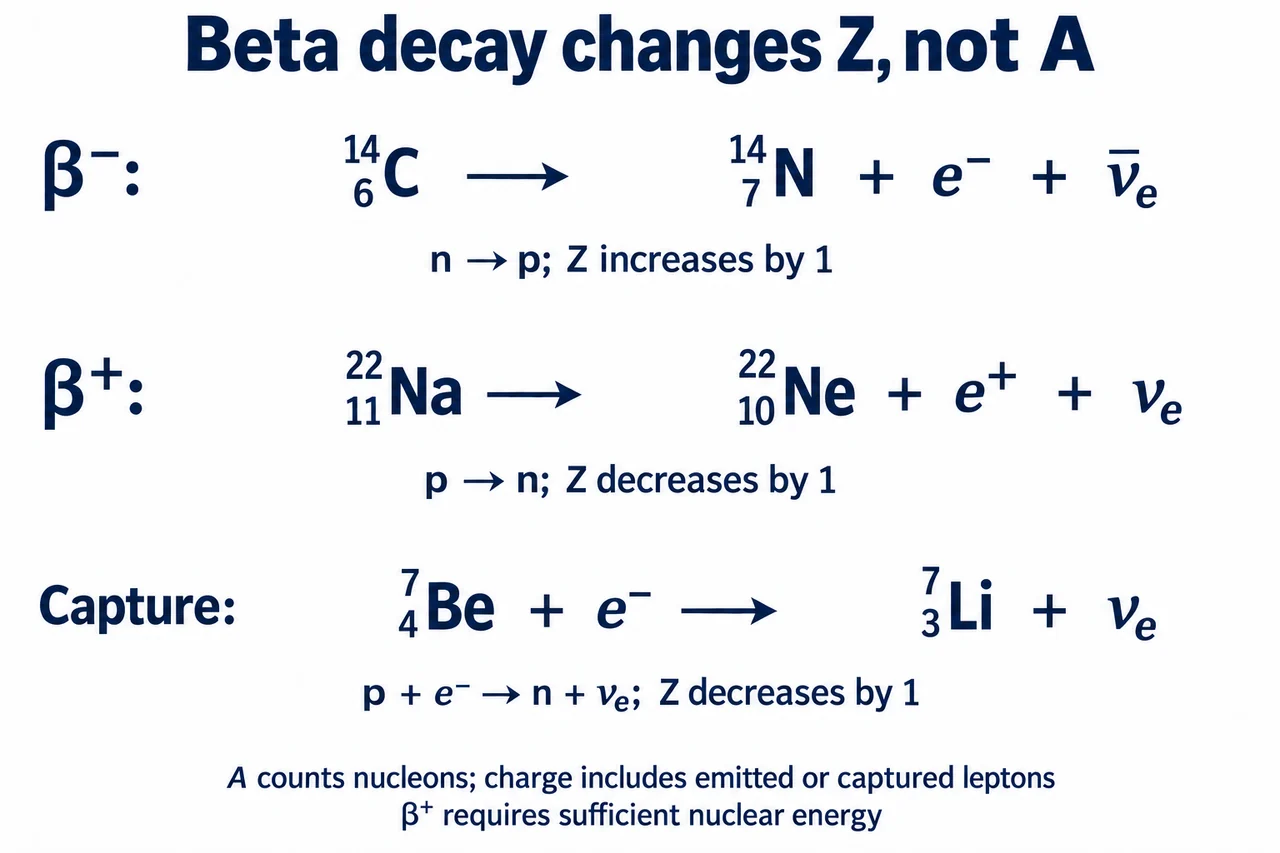
Image: illustration, not a documentary photograph. Original teaching model created for myAudience. · Original generated teaching illustration; no board endorsement or source textbook artwork reproduced.
Nuclear stability and balanced decay equations
Protons repel electrically, so electrical attraction cannot explain why a nucleus containing many protons holds together. This lesson assumes nuclide notation. The residual strong nuclear force between nucleons supplies short-range attraction over separations up to roughly 3 fm, with strong repulsion below roughly 0.5 fm in this school model. A femtometre is 10⁻¹⁵ m. The very-short-range repulsion helps prevent the nucleus collapsing into one point; the attractive range is not a hard universal boundary.
An unstable nucleus can change into a lower-energy arrangement and emit particles. In alpha decay it emits a helium nucleus, ⁴₂He, containing two protons and two neutrons. The daughter therefore has A reduced by four and Z reduced by two. A model equation is ²¹²₈₄Po → ²⁰⁸₈₂Pb + ⁴₂He. Balance both nucleon count and charge; do not treat the alpha particle as a neutral helium atom with its electrons attached.
In beta-minus decay, a neutron changes into a proton, an electron and an electron antineutrino: n → p + e⁻ + ν̄ₑ. Inside a nucleus, A stays the same and Z increases by one. The emitted electron is created in the weak transformation; it is not an orbital electron knocked out of the atom. Nuclide bookkeeping may write it as ⁰₋₁e, but the zero denotes no nucleons, not zero mass or zero energy.
A two-body picture with only a daughter and electron could not account for the observed spread of electron energies while conserving energy and momentum in each decay. The neutrino hypothesis supplied another particle to share the available energy and momentum. For beta-minus the required species is specifically an antineutrino; the board's general wording about a neutrino must not cause the sign and lepton type to be lost. Conservation reasoning will later make this distinction testable.
A cloud chamber or detector can provide evidence of radiation range, but a track is not a picture of a nucleus or a record of every emitted neutral particle. A teacher-led range comparison should control geometry, use a background reading and compare counts over equal times; detector efficiency and random counting variation affect the inference. This is reasoning about an illustrative opportunity, not the practical study or instructions to handle a source independently. Full decay kinetics, radiation hazards and binding-energy calculations remain later 3.8 work.
The nuclide rows keep A unchanged because beta processes change a neutron into a proton or vice versa. The mass number counts nucleons, not the sum of masses of all emitted particles. For carbon-14 beta-minus the daughter has Z = 7, balanced by the emitted electron's charge −1. The antineutrino supplies electron-family lepton number −1 to cancel the electron's +1. It is an electron antineutrino, not an electron neutrino. Sodium-22 beta-plus produces a positron and electron neutrino and reduces Z to 10. Capture consumes an electron and reduces beryllium's Z from 4 to 3. The nuclide notation in the plate represents nuclear identity; whole-atom electronic rearrangement is a further account, not a reason to alter A.
**Worked correction task.** Diagnose ¹⁴₆C → ¹⁴₇N + e⁻ + νₑ. A and charge balance, but the final electron-family number is +2 instead of zero. Replacing νₑ with anti-νₑ corrects that account. In ²²₁₁Na → ²²₁₀Ne + e⁺ + anti-νₑ, the same family number is −2; replace the antineutrino with νₑ. Bookkeeping alone still cannot prove an energetically possible decay. A free proton cannot beta-plus decay to a heavier neutron and positron; a suitable nucleus can because total initial and final nuclear energies differ.
**Original synthetic energy-sharing exercise.** Stipulate a beta-minus transition with available kinetic energy Q = 0.800 MeV and one event with electron kinetic energy 0.250 MeV, daughter recoil 0.002 MeV and negligible neutrino rest energy. The antineutrino carries 0.548 MeV. If another event has electron energy 0.700 MeV and the same stipulated recoil, the antineutrino carries 0.098 MeV. This changing sharing illustrates why the electron spectrum can be continuous. A two-body final state with fixed initial rest energy would impose a fixed electron energy in the parent's rest frame. Energy sharing does not by itself complete the vector momentum account; directions and recoil must also be consistent. The recoil values here are hypothetical inputs, not measured or claimed solutions to the full kinematics.
**Standalone bare nucleus.** For a bare ²³₁₁Na nucleus, use e = 1.60×10⁻¹⁹ C and approximate nucleon mass 1.67×10⁻²⁷ kg, neglect binding and proton/neutron mass differences. Charge is 11e = 1.76×10⁻¹⁸ C, approximate mass 23×1.67×10⁻²⁷ = 3.841×10⁻²⁶ kg, and q/m = 4.582×10⁷ C/kg. A singly ionised Na⁺ atom has charge +e and nearly the same mass at this approximation, giving 4.166×10⁶ C/kg. Their ratio is 11, not 23. A neutral atom has zero specific charge. The calculation distinguishes missing electrons from changed nucleus identity; electron removal does not change the isotope.
Worked example: Complete ¹⁴₆C → ? + ⁰₋₁e + ν̄ₑ and explain the missing particle.
Nucleon number remains 14 because the beta particles have no nucleons.
Charge balance requires 6 = Z − 1, so daughter Z = 7.
The daughter is ¹⁴₇N; the antineutrino carries energy, momentum and electron lepton number −1.
Answer: ¹⁴₆C → ¹⁴₇N + ⁰₋₁e + ν̄ₑ.
Check your understanding: In alpha decay, can A decrease by four while Z remains fixed?
Answer: No, not for emission of a ⁴₂He nucleus alone.
Why: The alpha takes away two units of positive charge as well as four nucleons; both totals must balance.