Antiparticles, photons and energy thresholds
By UK A Level Physics · independent study · myAudience
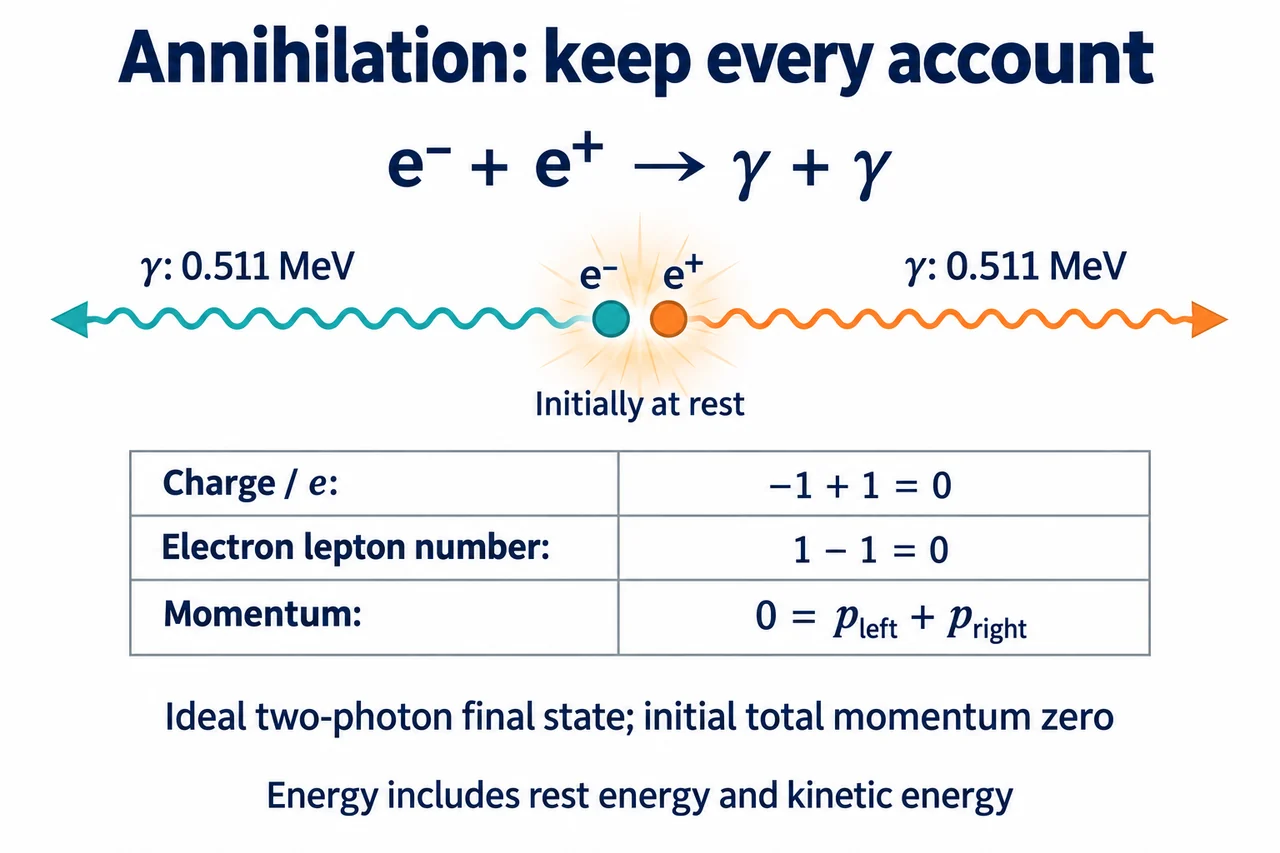
Image: illustration, not a documentary photograph. Original teaching model created for myAudience. · Original generated teaching illustration; no board endorsement or source textbook artwork reproduced.
Antiparticles, photons and energy thresholds
An antiparticle has the same mass and rest energy as its corresponding particle, with opposite additive quantum numbers. This lesson assumes energy-unit conversion and signed charge. The electron's antiparticle is the positron; the proton's is the antiproton; the neutron's is the antineutron; and a neutrino has a corresponding antineutrino. An antineutron is electrically neutral, so opposite electric charge alone cannot distinguish it from a neutron: baryon number is another distinguishing property. Some particles, such as photons, are their own antiparticles.
A photon is a quantum of electromagnetic radiation with energy E = hf = hc/λ in vacuum. Here h is the Planck constant, approximately 6.63 × 10⁻³⁴ J s, f is frequency in Hz, c ≈ 3.00 × 10⁸ m s⁻¹, and λ is vacuum wavelength in metres. Higher frequency means higher energy per photon. Greater beam intensity at fixed frequency means more photons arriving per second per unit area, rather than more energy in each photon.
When an electron and positron annihilate, their rest energy and any kinetic energy can become photon energy. For a pair with negligible initial kinetic energy and total momentum near zero, the simple two-photon model gives opposite photon directions and equal energies of about 0.511 MeV each. A single photon would carry nonzero momentum and cannot account for this isolated initial state. Real systems can have different initial motion and other allowed final states; the simple model states its conditions.
Pair production converts photon energy into a particle–antiparticle pair. Creating an electron and positron requires at least their combined rest energy, about 1.022 MeV; any available energy above the threshold can become kinetic energy. A nearby nucleus can take recoil momentum. A lone photon cannot produce an isolated electron–positron pair in empty space while satisfying energy and momentum conservation. The threshold estimate neglects the small extra recoil energy needed for a finite-mass nucleus. This section uses given rest energies; calculations using E = mc² are not required here.
Two gamma detections in coincidence provide the physical basis for locating annihilation events in PET, though a detector pair does not itself determine a unique point along the connecting line. Timing, many events and reconstruction supply further information. A count includes background and detection limitations, so an image is an inference rather than direct vision inside tissue. This is a source-backed conceptual application, not A Level Medical Physics option coverage or a demonstration that the learner has detected gamma radiation.
The two opposing photon arrows depict a special initial state: negligible total kinetic energy and zero total momentum, followed by exactly two photons. Each photon carries 0.511 MeV, so the total final energy is 1.022 MeV. Opposite arrows alone are insufficient: their momentum magnitudes must also be equal. For a real photon p = E/c, so equal energies make the two momentum vectors cancel. The electron contributes electron-family lepton number +1 and the positron −1; the photons contribute zero. Their charges also sum to zero. An antiparticle is not negative mass or negative energy. A neutral antineutron still differs in baryon number from a neutron.
**Worked energy and direction test.** A hypothetical detector report gives two photons of 0.400 and 0.622 MeV in opposite directions from an isolated pair initially at rest. The energy sum is 1.022 MeV, but momentum is not conserved: the remaining magnitude is (0.622−0.400) MeV/c = 0.222 MeV/c. The report cannot describe the stipulated isolated two-photon event. It could motivate investigating recoil, initial motion, missed particles or detector calibration; none may be assumed without evidence. Using the rounded exercise conversion 1 eV = 1.60×10⁻¹⁹ J and c = 3.00×10⁸ m/s, the imbalance is 1.184×10⁻²² kg m/s.
**Transfer.** Keep two photons, each 0.511 MeV, but let their angle be 170°. Their total momentum magnitude is 2(E/c)cos(85°), approximately 0.08907 MeV/c, rather than zero. Explain why a correct energy total does not repair the vector failure. Conversely, if an initial electron and positron have equal opposite momenta and total kinetic energy 0.200 MeV, the same two-photon centre-of-momentum model gives 0.611 MeV per photon. Initial motion with nonzero total momentum generally removes equal photon energies in the laboratory frame.
**Threshold check.** A 1.50 MeV photon converts near a heavy nucleus to an electron–positron pair. In the recoil-neglected approximation the combined kinetic energy is at most 1.50−1.022 = 0.478 MeV. This is not automatically 0.239 MeV for each particle: the sharing depends on momentum and recoil. A free lone photon cannot make the pair in vacuum. A nucleus supplies a momentum account, not missing rest energy; a finite-mass recoil slightly raises the true threshold. Intensity cannot rescue a single 0.90 MeV photon under the stipulated single-photon process.
Worked example: Find the frequency and wavelength of a 0.511 MeV annihilation photon using e = 1.60 × 10⁻¹⁹ C, h = 6.63 × 10⁻³⁴ J s and c = 3.00 × 10⁸ m s⁻¹.
E = 0.511 × 10⁶ × 1.60 × 10⁻¹⁹ = 8.176 × 10⁻¹⁴ J.
f = E/h = 1.23318… × 10²⁰ Hz.
λ = c/f = 2.43273… × 10⁻¹² m.
Answer: f ≈ 1.23 × 10²⁰ Hz; λ ≈ 2.43 pm.
Check your understanding: Can a 0.90 MeV photon make an electron–positron pair near a nucleus?
Answer: No.
Why: Its energy is below the approximately 1.022 MeV rest-energy requirement, regardless of beam intensity.