Exchange particles and weak transformations
By UK A Level Physics · independent study · myAudience
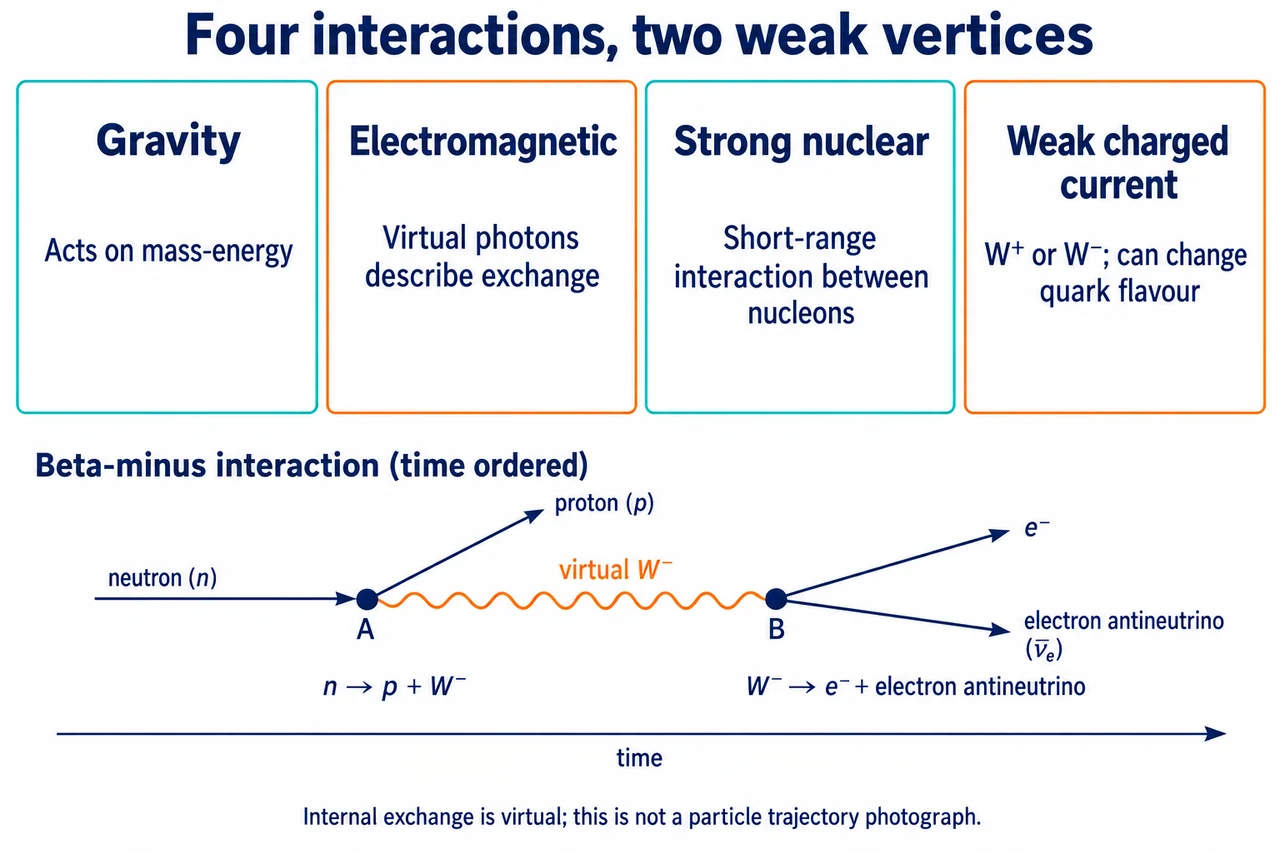
Image: illustration, not a documentary photograph. Original teaching model created for myAudience. · Original generated teaching illustration; no board endorsement or source textbook artwork reproduced.
Exchange particles and weak transformations
Four fundamental interactions organise the ways particles affect one another: gravity, electromagnetism, strong and weak interactions. This lesson assumes charge conservation and beta-minus decay. Gravity is relevant to mass-energy, electromagnetism to electric charge, the strong interaction to quarks and hadrons, and the weak interaction to processes such as beta decay. Being electrically neutral does not mean having no interactions; a neutrino can interact weakly and a neutron participates in nuclear forces.
Exchange-particle language represents an interaction as connected particle processes. Electromagnetic interactions are represented with virtual photons. A virtual exchange is an internal element of the model, not necessarily an observable photon flying between two particles, and it must not be treated as a real detected light ray. Throwing a ball between two people can illustrate momentum transfer and recoil, but that analogy cannot explain every quantum force or attraction. does not test knowledge of gluons, Z⁰ or the graviton in this section.
Weak charged-current processes use W⁻ or W⁺. At nucleon level, beta-minus is n → p + e⁻ + ν̄ₑ, represented by n → p + W⁻ followed by W⁻ → e⁻ + ν̄ₑ. Beta-plus is p → n + e⁺ + νₑ in an energetically suitable nucleus, with W⁺ → e⁺ + νₑ. These intermediate expressions represent virtual exchanges; they are not claims that a free neutron has enough energy to emit a real W boson.
Electron capture is p + e⁻ → n + νₑ within a suitable atom and nucleus. An energetic electron–proton collision can have the same net particle transformation when energy and momentum permit. One representation is p → n + W⁺, then e⁻ + W⁺ → νₑ; another reverses the virtual exchange direction and uses W⁻. Check charge at both vertices rather than memorising an arrow without its participants. Capture consumes an electron, whereas beta-plus creates a positron.
A simple interaction diagram should name incoming and outgoing particles, connect the two vertices with the correctly charged exchange and show a consistent time direction. It is a bookkeeping model, not a literal trajectory photograph. The words and vertex equations here explain the selected conceptual diagram; they do not establish performed practical skills. Charge balance is necessary but not sufficient for a process: available energy, momentum and other quantum numbers also matter. In particular, an isolated proton cannot simply decay by beta-plus merely because the written charges balance.
The reviewed plate uses external arrows as left-to-right time directions, not formal reversed antiparticle fermion-flow arrows. The internal W connector has no arrowhead; named vertex equations define its sign. The two-vertex picture is not an on-shell W emitted by a free neutron.
The four cards identify interactions without ranking their strengths at every distance or claiming every particle feels each in the same way. Neutral particles can participate in strong or weak interactions. A neutron's nuclear attraction is not electromagnetic attraction of a net charge. At nucleon level the strong nuclear interaction is short range: the source describes attraction to roughly 3 fm and repulsion below roughly 0.5 fm. Those approximate scales are not universal sharp cutoffs. The assessed exchange-particle description uses a virtual photon for electromagnetic interactions and charged W bosons for the stated weak processes. Gluons, Z⁰ and a graviton are outside the named knowledge requirement here. Gravity is not included in the Standard Model's three-interaction quantum account.
Read the beta-minus drawing from left to right in time. A neutron enters vertex A; a proton and an internal W⁻ leave. The W⁻ connects to B, where an electron and electron antineutrino leave. Charge balances at A: 0 = +1−1, and at B: −1 = −1+0. Cancelling the internal W gives n → p + e⁻ + anti-νₑ. The motion/time arrows are explanatory conventions, not the reversed fermion-flow convention of a formal Feynman diagram. A virtual W is an internal exchange in the description; the neutron does not emit a real on-shell W. Local accounts should not be read as a classical intermediate-state energy measurement.
**Drawing task before viewing the answer.** Draw electron capture with time increasing to the right and two vertices connected by a virtual W⁺. Label every external particle and the internal exchange, write charge balances and derive the net equation. Then draw beta-plus and explain the changed incoming/outgoing electron-family account. Mark independently with this analytic rubric: one point for coherent time and external directions; one for capture p → n + W⁺; one for e⁻ + W⁺ → νₑ; one for internal connection and virtual label; one for charges +1 = 0+1 and −1+1 = 0; one for net p+e⁻ → n+νₑ; one for beta-plus W⁺ → e⁺+νₑ with both leptons outgoing; one for the energy condition and distinction from free proton decay. Maximum eight; these are author-created review marks, not a board mark scheme.
**Model answer.** At A the incoming proton becomes the outgoing neutron and emits the internal W⁺ toward B. At B an incoming electron absorbs that exchange and the outgoing electron neutrino leaves. The captured electron's family number +1 becomes the neutrino's +1. For beta-plus there is no incoming electron at B; the positron and electron neutrino are both outgoing and their family numbers sum −1+1 = 0. A wrong W sign cannot be fixed by relabelling a neutrino, because neutrinos carry no electric charge. Time directions and vertex equations must agree.
**Force transfer check.** Why can a neutron be held in a nucleus despite zero net charge, and why is a ball-exchange analogy insufficient to explain nuclear attraction? Answer: the strong nuclear interaction acts on nucleons and provides attraction at relevant separations; zero net electric charge does not remove it. Throwing a real ball models recoil and momentum transfer, but does not establish how a virtual exchange produces attraction or quantum amplitudes. Identify the model's useful account and its limit instead of converting the analogy into a literal mechanism.
Worked example: Represent electron capture with a W⁺ exchange and verify charge at each vertex.
Vertex 1: p → n + W⁺ has charge +1 = 0 + 1 in units of e.
Vertex 2: e⁻ + W⁺ → νₑ has charge −1 + 1 = 0.
Cancel the internal exchange in the net expression: p + e⁻ → n + νₑ.
Answer: The W⁺ representation conserves charge at both vertices; the net reaction needs an energetically suitable initial system.
Check your understanding: Which exchange particle represents the electromagnetic interaction in this syllabus?
Answer: A virtual photon.
Why: A real photon may be emitted or detected, but the exchange in an electromagnetic interaction diagram is virtual.