Hadrons, leptons and strange-particle evidence
By UK A Level Physics · independent study · myAudience
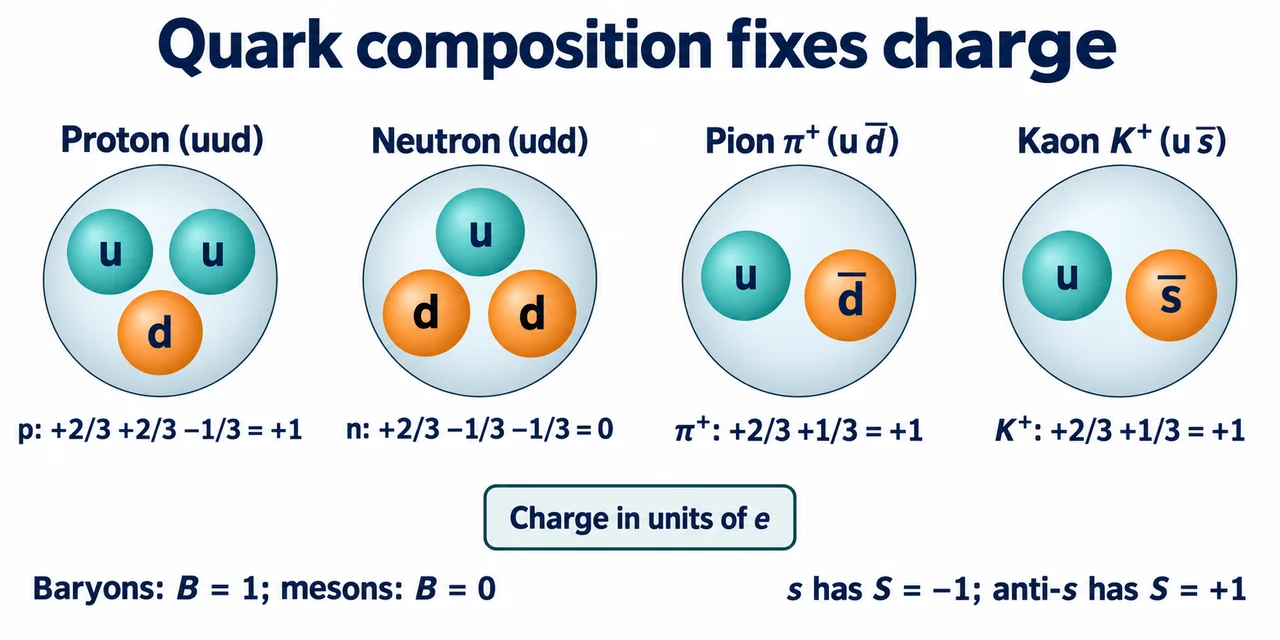
Image: illustration, not a documentary photograph. Original teaching model created for myAudience. · Original generated teaching illustration; no board endorsement or source textbook artwork reproduced.
Hadrons, leptons and strange-particle evidence
Particle families classify behaviour rather than just mass or charge. This lesson assumes elementary charges and the distinction between particles and antiparticles. Hadrons participate in the strong interaction and include baryons, antibaryons and mesons. In the simple quark model, a baryon contains three quarks and has baryon number B = +1; an antibaryon has B = −1; a meson contains a quark and antiquark and has B = 0. Proton and neutron are the required baryon examples, and pion and kaon the meson examples.
The proton is treated as stable in this syllabus; a free neutron is unstable. Other baryons can decay through routes that ultimately leave stable baryons while conserving total B. Mesons are hadrons even though their B is zero, so B = 0 does not mean 'lepton'. At the level of the residual nuclear-force model, pions can represent exchange between nucleons. This should be distinguished from the more fundamental strong interaction between quarks, whose detailed carrier theory is outside this assessed section.
Leptons do not participate in the strong interaction. The required types are the electron, muon, electron neutrino and muon neutrino, with their antiparticles. Use two lepton-number accounts: an electron or electron neutrino has Lₑ = +1, their antiparticles −1; a muon or muon neutrino has Lμ = +1, their antiparticles −1. Each has zero for the other family's number. This separate bookkeeping is more informative than merely checking a single total lepton number.
Muon decay illustrates why the invisible particles matter: μ⁻ → e⁻ + ν̄ₑ + νμ. Charge is −1 on both sides. Electron lepton number is 0 before and +1 − 1 = 0 after; muon lepton number is +1 before and +1 after. A neutrino does not need an electric charge to carry a lepton number. These family conservation rules are the syllabus model for these reactions; neutrino oscillations and their more advanced interpretation are not being taught by this account.
Strange hadrons can be produced in strong processes and decay weakly; a kaon can decay to pions. Strangeness is an additive quantum number, conventionally S in this guide while prints s. A zero-strangeness initial state requires balancing positive and negative strangeness in strong production, commonly seen as associated production or particle pairs. In weak processes the syllabus permits changes of 0 or ±1. Collaborative detector design, calibration and independent analysis make these assignments testable. A cloud-chamber track or simulation alone cannot identify every neutral species or establish a discovery. For example, K⁺ → π⁺ + π⁰ balances charge and B while S changes from +1 to 0, consistent with a weak strangeness-changing decay. In a zero-strangeness strong initial state, production of K⁺ and K⁻ gives +1 − 1 = 0, provided other conservation and energy conditions are satisfied.
The constituent plate shows baryon and meson examples, not every lepton family. Its coloured disks are schematic valence bookkeeping, not static particles observed inside hadrons. Use the separate muon-family worked example to test invisible lepton accounts.
The disks group constituents without depicting literal orbits. For uud, the charge sum is 2/3+2/3−1/3 = +1; for udd it is 2/3−1/3−1/3 = 0. Both contain three quarks with B = 1/3 each, giving B = 1. A meson contains a quark and an antiquark, so B = 1/3−1/3 = 0. The pion u anti-d and kaon u anti-s have identical charge +1 but different strangeness. Charge alone cannot identify a hadron. Anti-s carries S = +1, whereas s carries S = −1. An antiproton anti-u anti-u anti-d has Q/e = −1 and B = −1; neutral does not imply zero baryon number for an antineutron.
**Supplied unfamiliar data:** Λ⁰ = uds, Q/e = 0, B = 1, S = −1, rest energy 1116 MeV; K⁺ = u anti-s, Q/e = +1, B = 0, S = +1, rest energy 494 MeV; p = uud, Q/e = +1, B = 1, S = 0, rest energy 938 MeV; π⁻ = d anti-u, Q/e = −1, B = 0, S = 0, rest energy 140 MeV; π⁺ has Q/e = +1, B = 0, S = 0, rest energy 140 MeV. All leptonic family numbers are zero. Values are deliberately rounded supplied teaching data, not a new experimental mass measurement.
**Worked strong-production check.** Test π⁻ + p → K⁺ + Λ⁰. Initial (Q/e,B,S) = (0,1,0); final = (1,1,0). Strangeness balances, but charge fails, so reject. Now test π⁻ + p → K⁺ + Λ⁰ + π⁻. Both sides give (0,1,0). The initial rest-energy sum is 1078 MeV and final rest-energy sum 1750 MeV. At least 672 MeV of extra centre-of-momentum energy above the initial rest sum is required. This is not a fixed-target beam threshold: momentum conservation makes that threshold larger. Additive conservation is necessary, not proof that a reaction occurs or dominates.
**Worked weak-decay check.** Λ⁰ → p + π⁻ gives charge 0 = +1−1, B 1 = 1+0 and ΔS = +1. The final rest sum is 1078 MeV, leaving 38 MeV for final kinetic energy in the Λ rest frame. The two momenta must be equal and opposite; the energies are not necessarily equal because the masses differ. A strong decay would violate its strangeness conservation, whereas the specified weak change is permitted. Do not infer a lifetime from the ledger alone.
**Family trap.** Compare μ⁻ → e⁻ + anti-νₑ + νμ with μ⁻ → e⁻ + anti-νμ + νₑ. Both balance charge and total lepton number +1, but only the first balances electron and muon families separately in this curriculum model. For the second, electron-family final number is +2 and muon-family final number is −1, versus initial 0 and +1. Each family account must be written. Neutrino oscillations are beyond this assessed bookkeeping model; they should not be invoked to rescue the wrong elementary decay equation.
Worked example: For μ⁻ → e⁻ + ν̄ₑ + νμ, check Q, B, Lₑ and Lμ.
Q: −1 → −1 + 0 + 0. B: all particles are leptons, so 0 → 0.
Lₑ: 0 → +1 − 1 + 0 = 0.
Lμ: +1 → 0 + 0 + 1 = +1.
Answer: All four accounts balance; omitting either neutrino would break a family lepton-number account.
Check your understanding: Is a neutral pion a lepton because Q = 0 and B = 0?
Answer: No; it is a meson and therefore a hadron.
Why: Classification depends on participation in the strong interaction and quark structure, not on electric neutrality.