Conservation tests rule out reactions, but do not guarantee them
By UK A Level Physics · independent study · myAudience
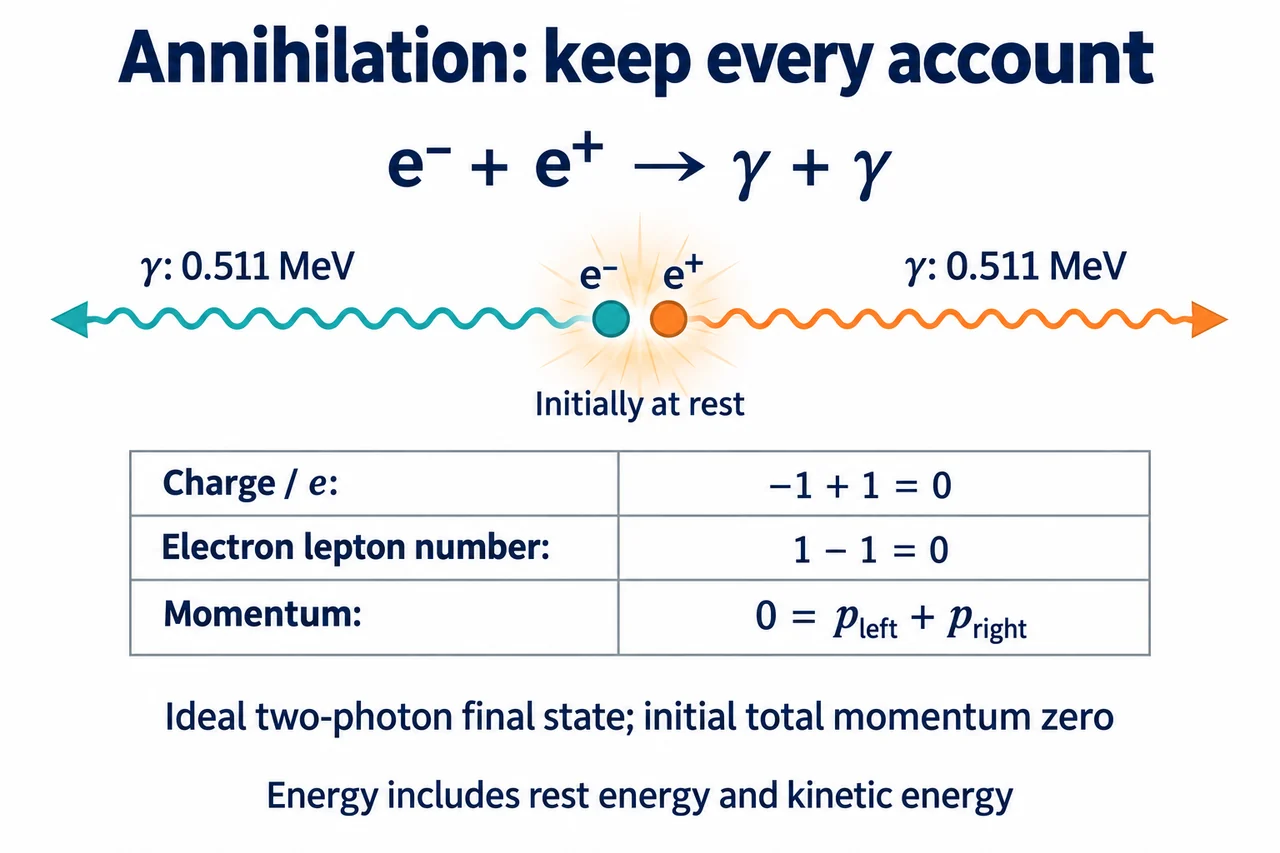
Image: illustration, not a documentary photograph. Original teaching model created for myAudience. · Original generated teaching illustration; no board endorsement or source textbook artwork reproduced.
Conservation tests rule out reactions, but do not guarantee them
A proposed reaction can be tested by adding conserved quantities before and after it. This lesson assumes quark charges, baryon number and separate lepton numbers. First identify every particle, including antiparticle bars, and organise accounts for charge Q, baryon number B, electron lepton number Lₑ, muon lepton number Lμ and strangeness S. Work with signed totals rather than counting how many symbols appear. A neutral particle can still change the balance of B, S or a lepton number.
Charge and baryon number must balance in the syllabus reactions, and the required lepton-family accounts must balance in the weak examples. Strangeness is conserved in strong interactions, but a weak interaction can change it by 0 or ±1 in this model. A process that changes S cannot be labelled strong just because a hadron participates. The interaction responsible for a reaction and the particles present are different questions.
Consider an original proposed strong collision p + p → p + n + π⁺. Charge is +2 before and +1 + 0 + 1 = +2 after. B is 2 before and 1 + 1 + 0 = 2 after; all lepton numbers and S are zero. These tests do not rule it out. The extra pion must still obtain its rest energy and any kinetic energy from the incoming system. Without sufficient available energy, a balanced list of quantum numbers is still impossible.
Momentum is a vector and energy a scalar, and both are conserved for the complete isolated system. In a collision, check the directions of momenta as well as the total energies. In annihilation, opposite equal-energy photons can carry zero total momentum while each carries nonzero energy. In pair production near a nucleus, include nuclear recoil rather than checking only the new pair. A missing participant may be revealed by a mismatch, but a bookkeeping table alone does not predict its detailed energy or direction.
When a question supplies an unfamiliar particle, use its given data instead of guessing from the name. State a rejection precisely: 'electron lepton number changes from 0 to +1' is stronger reasoning than 'the decay looks wrong'. Conversely, say 'not excluded by these conservation checks' rather than 'must occur'. Rates, dynamical selection rules and initial conditions also matter. Computer checks can independently confirm sums, but their conclusion is only as reliable as the particle data and the assumptions entered.
The two-photon plate illustrates one precisely stipulated annihilation state, not every balanced reaction. To use it as evidence, check both vector momentum and scalar energy, then separately test the unfamiliar hadron data below.
The two opposing photon arrows depict a special initial state: negligible total kinetic energy and zero total momentum, followed by exactly two photons. Each photon carries 0.511 MeV, so the total final energy is 1.022 MeV. Opposite arrows alone are insufficient: their momentum magnitudes must also be equal. For a real photon p = E/c, so equal energies make the two momentum vectors cancel. The electron contributes electron-family lepton number +1 and the positron −1; the photons contribute zero. Their charges also sum to zero. An antiparticle is not negative mass or negative energy. A neutral antineutron still differs in baryon number from a neutron.
**Worked energy and direction test.** A hypothetical detector report gives two photons of 0.400 and 0.622 MeV in opposite directions from an isolated pair initially at rest. The energy sum is 1.022 MeV, but momentum is not conserved: the remaining magnitude is (0.622−0.400) MeV/c = 0.222 MeV/c. The report cannot describe the stipulated isolated two-photon event. It could motivate investigating recoil, initial motion, missed particles or detector calibration; none may be assumed without evidence. Using the rounded exercise conversion 1 eV = 1.60×10⁻¹⁹ J and c = 3.00×10⁸ m/s, the imbalance is 1.184×10⁻²² kg m/s.
**Transfer.** Keep two photons, each 0.511 MeV, but let their angle be 170°. Their total momentum magnitude is 2(E/c)cos(85°), approximately 0.08907 MeV/c, rather than zero. Explain why a correct energy total does not repair the vector failure. Conversely, if an initial electron and positron have equal opposite momenta and total kinetic energy 0.200 MeV, the same two-photon centre-of-momentum model gives 0.611 MeV per photon. Initial motion with nonzero total momentum generally removes equal photon energies in the laboratory frame.
**Threshold check.** A 1.50 MeV photon converts near a heavy nucleus to an electron–positron pair. In the recoil-neglected approximation the combined kinetic energy is at most 1.50−1.022 = 0.478 MeV. This is not automatically 0.239 MeV for each particle: the sharing depends on momentum and recoil. A free lone photon cannot make the pair in vacuum. A nucleus supplies a momentum account, not missing rest energy; a finite-mass recoil slightly raises the true threshold. Intensity cannot rescue a single 0.90 MeV photon under the stipulated single-photon process.
For a cross-topic valence-quark comparison, group constituents symbolically without treating them as literal orbits. For uud, the charge sum is 2/3+2/3−1/3 = +1; for udd it is 2/3−1/3−1/3 = 0. Both contain three quarks with B = 1/3 each, giving B = 1. A meson contains a quark and an antiquark, so B = 1/3−1/3 = 0. The pion u anti-d and kaon u anti-s have identical charge +1 but different strangeness. Charge alone cannot identify a hadron. Anti-s carries S = +1, whereas s carries S = −1. An antiproton anti-u anti-u anti-d has Q/e = −1 and B = −1; neutral does not imply zero baryon number for an antineutron.
**Supplied unfamiliar data:** Λ⁰ = uds, Q/e = 0, B = 1, S = −1, rest energy 1116 MeV; K⁺ = u anti-s, Q/e = +1, B = 0, S = +1, rest energy 494 MeV; p = uud, Q/e = +1, B = 1, S = 0, rest energy 938 MeV; π⁻ = d anti-u, Q/e = −1, B = 0, S = 0, rest energy 140 MeV; π⁺ has Q/e = +1, B = 0, S = 0, rest energy 140 MeV. All leptonic family numbers are zero. Values are deliberately rounded supplied teaching data, not a new experimental mass measurement.
**Worked strong-production check.** Test π⁻ + p → K⁺ + Λ⁰. Initial (Q/e,B,S) = (0,1,0); final = (1,1,0). Strangeness balances, but charge fails, so reject. Now test π⁻ + p → K⁺ + Λ⁰ + π⁻. Both sides give (0,1,0). The initial rest-energy sum is 1078 MeV and final rest-energy sum 1750 MeV. At least 672 MeV of extra centre-of-momentum energy above the initial rest sum is required. This is not a fixed-target beam threshold: momentum conservation makes that threshold larger. Additive conservation is necessary, not proof that a reaction occurs or dominates.
**Worked weak-decay check.** Λ⁰ → p + π⁻ gives charge 0 = +1−1, B 1 = 1+0 and ΔS = +1. The final rest sum is 1078 MeV, leaving 38 MeV for final kinetic energy in the Λ rest frame. The two momenta must be equal and opposite; the energies are not necessarily equal because the masses differ. A strong decay would violate its strangeness conservation, whereas the specified weak change is permitted. Do not infer a lifetime from the ledger alone.
**Family trap.** Compare μ⁻ → e⁻ + anti-νₑ + νμ with μ⁻ → e⁻ + anti-νμ + νₑ. Both balance charge and total lepton number +1, but only the first balances electron and muon families separately in this curriculum model. For the second, electron-family final number is +2 and muon-family final number is −1, versus initial 0 and +1. Each family account must be written. Neutrino oscillations are beyond this assessed bookkeeping model; they should not be invoked to rescue the wrong elementary decay equation.
As a cross-topic nuclear-decay comparison, the following nuclide equations keep A unchanged because beta processes change a neutron into a proton or vice versa. The mass number counts nucleons, not the sum of masses of all emitted particles. For carbon-14 beta-minus the daughter has Z = 7, balanced by the emitted electron's charge −1. The antineutrino supplies electron-family lepton number −1 to cancel the electron's +1. It is an electron antineutrino, not an electron neutrino. Sodium-22 beta-plus produces a positron and electron neutrino and reduces Z to 10. Capture consumes an electron and reduces beryllium's Z from 4 to 3. The nuclide notation in these equations represents nuclear identity; whole-atom electronic rearrangement is a further account, not a reason to alter A.
**Worked correction task.** Diagnose ¹⁴₆C → ¹⁴₇N + e⁻ + νₑ. A and charge balance, but the final electron-family number is +2 instead of zero. Replacing νₑ with anti-νₑ corrects that account. In ²²₁₁Na → ²²₁₀Ne + e⁺ + anti-νₑ, the same family number is −2; replace the antineutrino with νₑ. Bookkeeping alone still cannot prove an energetically possible decay. A free proton cannot beta-plus decay to a heavier neutron and positron; a suitable nucleus can because total initial and final nuclear energies differ.
**Original synthetic energy-sharing exercise.** Stipulate a beta-minus transition with available kinetic energy Q = 0.800 MeV and one event with electron kinetic energy 0.250 MeV, daughter recoil 0.002 MeV and negligible neutrino rest energy. The antineutrino carries 0.548 MeV. If another event has electron energy 0.700 MeV and the same stipulated recoil, the antineutrino carries 0.098 MeV. This changing sharing illustrates why the electron spectrum can be continuous. A two-body final state with fixed initial rest energy would impose a fixed electron energy in the parent's rest frame. Energy sharing does not by itself complete the vector momentum account; directions and recoil must also be consistent. The recoil values here are hypothetical inputs, not measured or claimed solutions to the full kinematics.
**Standalone bare nucleus.** For a bare ²³₁₁Na nucleus, use e = 1.60×10⁻¹⁹ C and approximate nucleon mass 1.67×10⁻²⁷ kg, neglect binding and proton/neutron mass differences. Charge is 11e = 1.76×10⁻¹⁸ C, approximate mass 23×1.67×10⁻²⁷ = 3.841×10⁻²⁶ kg, and q/m = 4.582×10⁷ C/kg. A singly ionised Na⁺ atom has charge +e and nearly the same mass at this approximation, giving 4.166×10⁶ C/kg. Their ratio is 11, not 23. A neutral atom has zero specific charge. The calculation distinguishes missing electrons from changed nucleus identity; electron removal does not change the isotope.
Worked example: Test the proposed decay n → p + e⁻ without any neutrino.
Q: 0 = +1 − 1; B: 1 = 1 + 0.
Lₑ: initially 0, finally +1, so the stated final state fails.
Adding ν̄ₑ supplies Lₑ = −1 and also permits energy and momentum sharing.
Answer: The two-particle final state is rejected by electron lepton-number conservation; the beta-minus final state includes ν̄ₑ.
Check your understanding: A proposed strong reaction changes S from 0 to +1. Is charge balance enough to accept it?
Answer: No; it fails strangeness conservation for a strong interaction.
Why: Conservation accounts must all be checked under the specified interaction, rather than accepting a reaction after the first successful sum.