Why a bright beam can still fail to eject electrons
By UK A Level Physics · independent study · myAudience
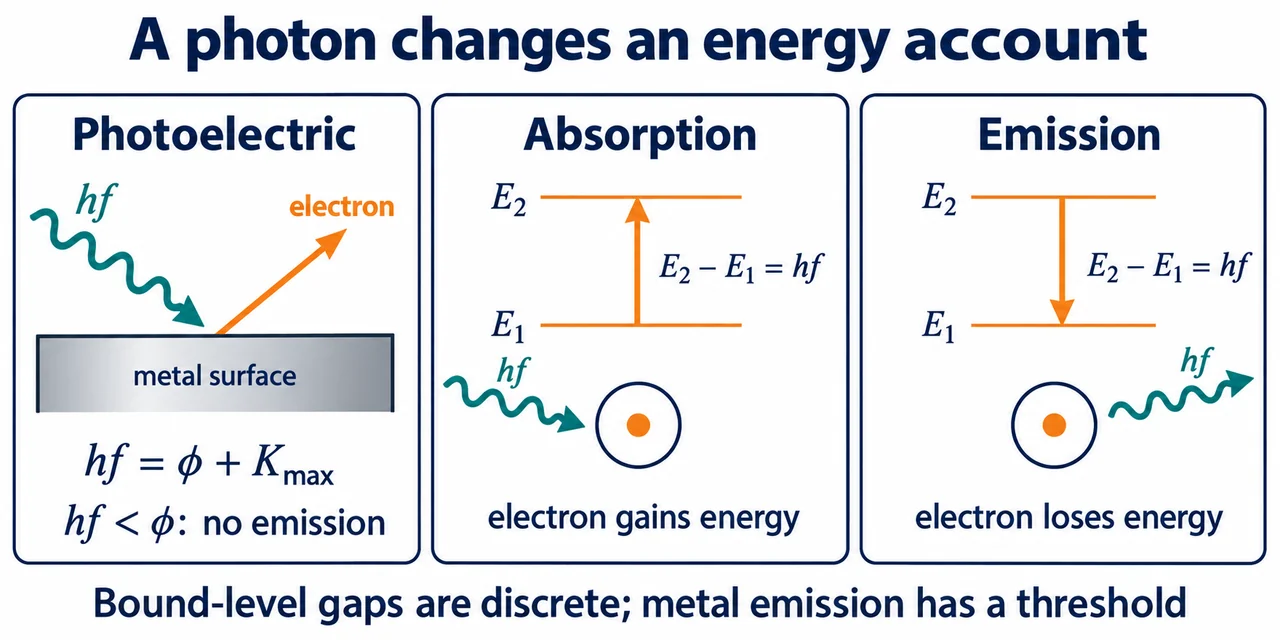
Image: illustration, not a documentary photograph. Original teaching model created for myAudience. · Original generated teaching illustration; no board endorsement or source textbook artwork reproduced.
Why a bright beam can still fail to eject electrons
The photoelectric effect is the emission of electrons from a surface after it absorbs suitable electromagnetic radiation. This lesson assumes photon energy and energy conversion. The work function φ is the minimum energy needed to remove an electron from that surface. A threshold frequency f₀ exists because a single photon must supply at least φ; therefore hf₀ = φ. In this school single-photon model, a more intense beam below threshold cannot compensate by giving each photon more energy.
Above threshold, photon energy is shared between escape and the electron's kinetic energy. The photoelectric equation is hf = φ + Eₖ,max. The maximum is used because electrons can lose differing amounts of energy before escaping; not every emitted electron has that kinetic energy. Raising frequency increases Eₖ,max. Raising intensity at fixed frequency increases the incident photon rate and can increase the emitted-electron rate, provided the apparatus collects them adequately, but it does not raise the maximum energy.
Stopping potential Vₛ is the magnitude of the opposing potential difference that just stops the most energetic photoelectrons from reaching the collector. The relationship is eVₛ = Eₖ,max when energy is in joules. If kinetic energy is expressed in eV, its numerical value equals the stopping potential in volts for an electron. The specification requires this concept but does not require experimental determination of stopping potential. Actual measured photocurrents can depend on surface condition, geometry and collection voltage.
Graphing Eₖ,max against f gives a straight line of gradient h and vertical intercept −φ in the ideal model; the frequency-axis intercept is f₀. Graphing Vₛ against f instead gives gradient h/e. Pay attention to the axis quantities and units before interpreting a gradient. A threshold supports the photon explanation because the relevant input is energy per quantum; a purely classical continuous-energy account would not naturally explain this frequency threshold in the same way.
A teacher may demonstrate discharge of a charged electroscope with an appropriate metal surface and ultraviolet light or use a photocell. Surface condition and lamp spectrum can affect the observations, so a failure to discharge is not automatically a disproof of the photon model. These demonstrations are illustrative skills opportunities, not additional numbered required practicals. The explanation here is original, and the numerical surface below is a stipulated teaching model rather than a measured material or copied examination question.
In the metal panel the incoming wavy arrow transfers a photon energy hf. The escaping electron arrow leaves the surface. The work function φ is the minimum energy to remove an electron from the metal; any remainder can be kinetic energy. The equation labels K_max because electrons can emerge with less energy after internal losses. The other panels show a bound atom. An upward electron-level arrow requires absorption; a downward transition emits a photon. Photon energy is the positive gap E₂−E₁ in either direction. The arrow describes a change of state, not a little electron flying vertically in real space. An atomic level resonance and a metal work-function threshold are different mechanisms.
**Original synthetic photoelectric table:** f/(10¹⁴ Hz) = 5.0,6.0,7.0; K_max/eV = 0.170,0.584,0.998. Using h = 4.14×10⁻¹⁵ eV s for this exercise, each extra 10¹⁴ Hz supplies 0.414 eV. Thus the gradient is 4.14×10⁻¹⁵ eV s and φ = 2.070−0.170 = 1.900 eV. Threshold f₀ = φ/h = 4.589×10¹⁴ Hz. The central data are constructed to lie exactly on this teaching line; that is not evidence of experimental precision.
**Demanding check.** Suppose each synthetic K value has an illustrative bound ±0.030 eV and f is exact. The end-pair limiting gradients are (0.968−0.200)/(2×10¹⁴) = 3.84×10⁻¹⁵ and (1.028−0.140)/(2×10¹⁴) = 4.44×10⁻¹⁵ eV s; the middle interval also contains both lines. Explain why a fitted slope near h supports the single-photon model but cannot by itself exclude a shared energy calibration error. At fixed f = 4.0×10¹⁴ Hz, doubling intensity leaves hf = 1.656 eV below φ and produces no emission in the elementary single-photon model. Above threshold it can increase the emission rate, not K_max. No stopping-potential measurement has been performed.
**Atomic transfer.** Supplied hypothetical bound energies are −5.0, −3.0 and −1.0 eV, with ionisation at 0. An atom initially at −5.0 eV can absorb a 2.0 eV photon to reach −3.0 eV, but a 3.0 eV photon matches no stated gap and is below ionisation. Assume isolated narrow bound levels and the elementary single-photon model; do not claim this excludes every broadening or multiphoton mechanism. From −1.0 eV direct decay to −5.0 eV gives a 4.0 eV photon; a cascade through −3.0 eV gives two 2.0 eV photons. With hc = 1240 eV nm, their wavelengths are 310 and 620 nm respectively. A 3.0 eV colliding electron can instead excite the 2.0 eV gap and retain 1.0 eV; an absorbed photon cannot leave a leftover fragment of itself. This distinction explains why collision excitation and resonant absorption need different accounts.
Worked example: A model surface has φ = 2.20 eV. Photons of 3.10 eV strike it. Find Eₖ,max and Vₛ, then state the effect of doubling intensity at the same frequency.
Eₖ,max = 3.10 − 2.20 = 0.90 eV.
For one electron, 0.90 eV corresponds to e × 0.90 V, so Vₛ = 0.90 V.
Doubling intensity changes photon rate, not energy per photon; Eₖ,max is unchanged.
Answer: Eₖ,max = 0.90 eV; stopping potential magnitude 0.90 V; emitted-electron rate may rise but maximum energy does not.
Check your understanding: At half the threshold frequency, will a brighter beam eject electrons in this model?
Answer: No.
Why: Each photon still supplies only half the minimum escape energy; the statement assumes single-photon emission rather than advanced multiphoton effects.