Diffraction and emission require complementary evidence
By UK A Level Physics · independent study · myAudience
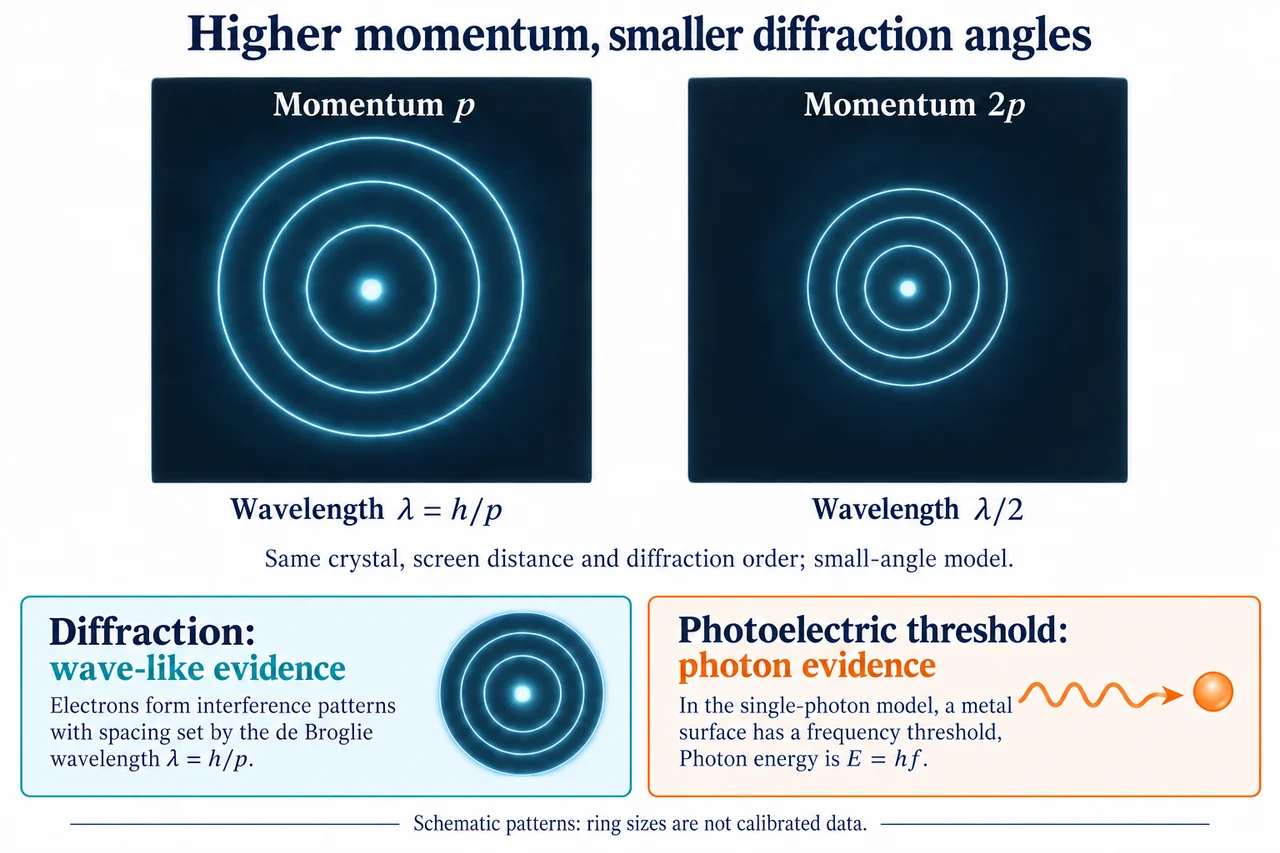
Image: illustration, not a documentary photograph. Original teaching model created for myAudience. · Original generated teaching illustration; no board endorsement or source textbook artwork reproduced.
Diffraction and emission require complementary evidence
Electron diffraction and the photoelectric effect challenge an exclusively classical picture of matter and light. This lesson assumes photon reasoning and momentum p = mv for a nonrelativistic particle. A diffraction pattern is wave-like evidence, while electron emission governed by individual photon energy is particle-like evidence for light. Wave–particle duality names the need for both kinds of description; it does not mean an electron literally switches between being a tiny billiard ball and a visible water wave.
The de Broglie relation assigns wavelength λ = h/p. For a slow electron relative to light speed, p = mv, so λ = h/(mv). The unit check is J s divided by kg m s⁻¹, giving metres. Higher momentum gives a shorter wavelength; doubling momentum halves wavelength. At sufficiently high speed the simple p = mv approximation fails, although λ = h/p remains the guiding relation when momentum is treated appropriately.
A crystalline target has regularly spaced scattering structures. When electron wavelength is comparable to relevant spacings, waves scattered along different paths can reinforce or cancel, producing an intensity pattern. With target geometry unchanged, increasing electron momentum shortens wavelength and generally decreases the diffraction angles, so a small-angle pattern contracts. Geometry and crystal spacing also matter; changing the pattern does not uniquely prove momentum changed unless those conditions are controlled.
A teacher-led electron diffraction tube can illustrate this trend while accelerating voltage is varied and target conditions are kept fixed. does not expect details of particular particle-diffraction methods in this section. No tube operation or safe high-voltage practice is established by reading this account. We also do not claim the practical study is completed: that activity concerns light interference and diffraction, and still requires its own methods, data and practical participation.
Scientific models change when reproducible observations expose limitations. A convincing explanation must account for both diffraction and the threshold behaviour of photoelectric emission, rather than selecting whichever observation favours a preferred classical story. Peer review tests methods and arguments, while further independent experiments test reliability; neither is a guarantee against error. Treat this final lesson as a synthesis of the first cohort. Advanced historical developments and electron-microscope calculations belong to a later optional pathway, not automatic coverage of Turning Points in Physics.
The plate compares schematic diffraction screens at momentum p and 2p, holding crystal, screen distance and diffraction order fixed. λ = h/p halves the wavelength when momentum doubles. Small-angle geometry therefore predicts approximately half the ring radius in the same order, but these generated ring sizes are not calibrated data and must not be measured as experimental ratios. The second evidence card concerns a metal surface in a single-photon model, not a universal statement that every material has the same threshold.
Original transfer challenge: at fixed screen distance, a synthetic diffraction-ring radius changes from 24 mm to 12 mm. A student concludes that electron speed must have doubled. Give the conditional argument and two alternatives, then test a second student’s claim that electron wavelength disappears when speed rises. Model answer: in the same diffraction order, unchanged crystal spacing and small-angle geometry make radius proportional to wavelength. Halving radius then halves λ and doubles momentum. Speed doubles only when p = mv remains a justified nonrelativistic approximation and electron mass is unchanged. A different diffraction order or a changed crystal spacing can invalidate the first inference; changing screen distance is another possible cause if the stated control fails. Wavelength remains h/p and becomes smaller, not zero, at finite momentum. The initial example v = 2.0 × 10⁶ m/s is small relative to c, while an unqualified extrapolation toward c requires relativistic momentum. The answer must connect controlled variables, proportionality and model limits rather than merely repeat “wave–particle duality”.
Worked example: For an electron with m = 9.11 × 10⁻³¹ kg and speed 2.0 × 10⁶ m s⁻¹, calculate its de Broglie wavelength using h = 6.63 × 10⁻³⁴ J s.
p = mv = 1.822 × 10⁻²⁴ kg m s⁻¹.
λ = 6.63 × 10⁻³⁴ / 1.822 × 10⁻²⁴ = 3.63886… × 10⁻¹⁰ m.
This is 0.36 nm to two significant figures; v is small compared with c, supporting the nonrelativistic approximation.
Answer: λ ≈ 3.6 × 10⁻¹⁰ m = 0.36 nm.
Check your understanding: With crystal geometry fixed, what happens to wavelength and diffraction angles when momentum doubles?
Answer: Wavelength halves; diffraction angles decrease in the same diffraction order.
Why: λ = h/p makes the wavelength change explicit, and a shorter wavelength requires less angular path difference for reinforcement.