Energy goes somewhere: warming and cooling
By UK GCSE Chemistry · independent study · myAudience
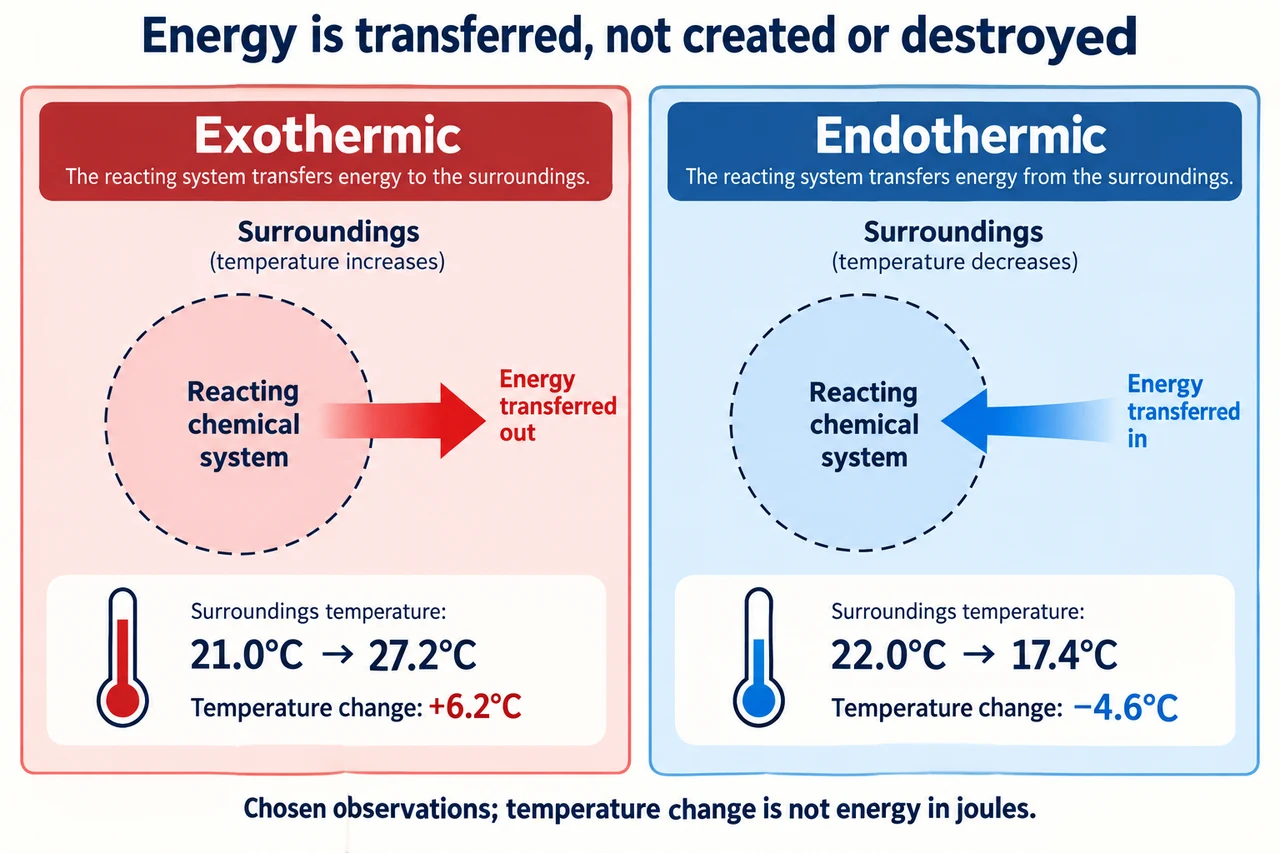
Image: illustration, not a documentary photograph. Original teaching model created for myAudience. · Original generated teaching raster; no exam-board or textbook artwork copied.
Energy goes somewhere: warming and cooling
Begin by drawing a boundary around the reacting substances. That chosen system exchanges energy with the solution, container and wider room that we call its surroundings. An exothermic reaction transfers energy out of the reacting system; an endothermic reaction takes energy in. The words describe a direction of transfer, not whether a substance is inherently hot or cold. If a thermometer rises while the surroundings receive energy from a reaction, the observation supports an exothermic classification under those conditions. Energy has moved between stores; it has not been created by the chemical change.
The temperature reading is evidence that needs an explanation. For a mixture that starts at 21.0 °C and reaches 27.2 °C, the observed change is +6.2 °C. In a comparable cooling example, 22.0 °C to 17.4 °C gives −4.6 °C. Those are temperature differences, not amounts of energy in joules. A larger temperature rise need not mean a more energetic reaction if different masses of solution, different containers or different amounts of reactant were used. This GCSE practical concerns temperature measurements; calculating energy from mass and heat capacity is not required here.
Follow the arrows in the generated plate before looking at the colours. The red exothermic arrow crosses the dashed system boundary outwards; the blue endothermic arrow crosses it inwards. The temperature labels refer to surroundings that are being monitored. Neither diagram is a map of individual particles travelling along an energy arrow, and the fictional values are not reported experiment results. If the boundary were enlarged to include the reacting mixture and cup together, the description of transfers across that enlarged boundary would change; conservation would not.
Combustion is a useful exothermic example because energy transferred to surroundings can warm a room or move through an engine. Neutralisation and many oxidation reactions provide other examples. Thermal decomposition illustrates an endothermic change: a continuing energy supply can be needed while the reaction takes place. A fuel being exothermic does not mean it begins reacting without an activation barrier. A process that takes energy in is not automatically spontaneous at room temperature, and an initially warm solution can still cool because of an endothermic change.
Application claims should link the direction of transfer to a job. A chemical warming pack can be useful when its reaction transfers energy to its surroundings; a cooling pack can take energy from an injured area through the pack. Suitability also depends on how much the temperature changes, how long the effect lasts, the materials and safe use. Do not conclude that every pack with a cold wrapper uses the same reaction or that reading a chemistry explanation is medical advice. The useful reasoning is that an intended temperature effect follows from a controlled transfer.
A fair classification comparison records the initial temperature immediately before mixing and follows readings to find the relevant highest or lowest temperature. A single later reading may miss the extremum as energy exchanges with the room. The cup and thermometer also exchange energy, so the observed change is not a perfect measure of the reacting substances alone. If a solution cools in a room colder than the solution, a no-reaction comparison helps distinguish ordinary cooling from an additional reaction effect. Repeat readings and a clear boundary make a stronger explanation than colour alone.
Transfer challenge: mixture A changes from 19.5 °C to 24.0 °C, while B changes from 30.0 °C to 27.0 °C. A student calls B exothermic because its final temperature is higher than A’s and claims A creates 4.5 units of energy. Correct the classification and unit claim, then explain why the two temperature changes alone cannot rank the energy per equal amount of reaction. State one control and one extra comparison that would make the inference more convincing.
Reasoned answer: A has a +4.5 °C rise and supports an exothermic classification; B has a −3.0 °C fall and supports an endothermic classification if the change is attributable to reaction. Final temperature is not the classification test. A temperature difference is not energy created, and conservation still applies. Equal reaction amounts, solution amounts and comparable apparatus would be needed before interpreting the size of a temperature change; an otherwise matched non-reacting comparison can reveal background heat exchange. Indicative author criteria reward the direction, arithmetic, units, confounding explanation and bounded conclusion, not a memorised warm/cold slogan.
Worked example: An otherwise matched reacting mixture starts at 23.6 °C and reaches 18.9 °C. Classify the observed change, calculate it and explain what a matched non-reacting comparison at 23.6 °C contributes.
Calculate final minus initial: 18.9 − 23.6 = −4.7 °C.
A fall consistent with energy being taken from monitored surroundings supports an endothermic classification.
If the non-reacting comparison also cools, ordinary heat exchange contributes. Compare changes before attributing the entire −4.7 °C to reaction.
Answer: The observed change is −4.7 °C, not −4.7 J. Reaction attribution needs the comparison and experimental conditions.
Check your understanding: Can an exothermic reaction require an initial energy input?
Answer: Yes. An activation barrier can require an initial input even though the overall reaction transfers energy to surroundings.
Why: The energy needed to start rearrangement and the overall difference between reactants and products are different comparisons. A spark does not make combustion endothermic.