Higher: count bonds and keep the energy sign
By UK GCSE Chemistry · independent study · myAudience
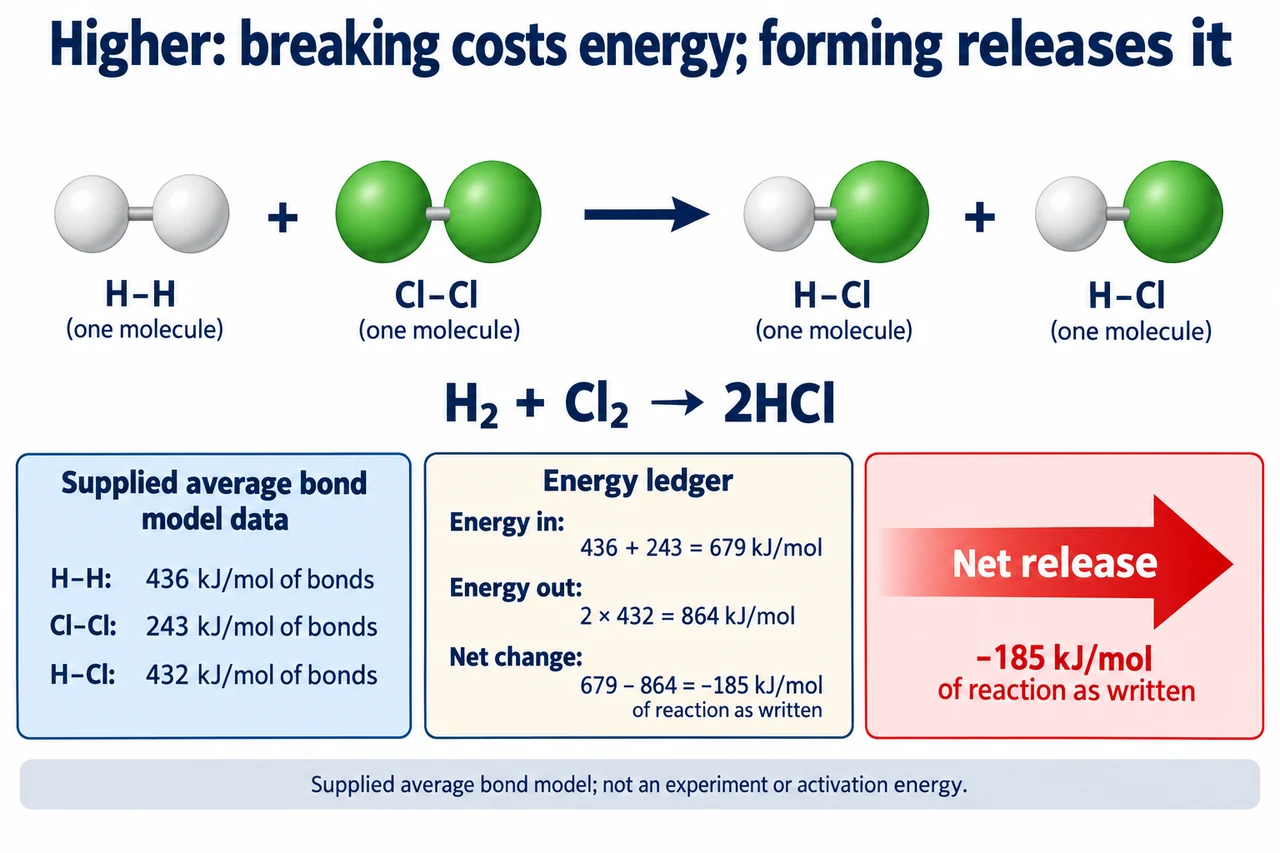
Image: illustration, not a documentary photograph. Original teaching model created for myAudience. · Original generated teaching raster; no exam-board or textbook artwork copied.
Higher: count bonds and keep the energy sign
This Higher-only lesson explains an energy balance by counting the bonds in a balanced reaction. Breaking a covalent bond requires energy input; forming a bond transfers energy out. A reaction’s overall change depends on both accounts. The familiar claim “breaking bonds releases their stored energy” reverses the bond-breaking account and cannot explain an exothermic reaction correctly. Energy release is associated with forming the product bonds, compared with the input needed for breaking reactant bonds.
First balance the chemical equation, then count bonds for the quantities shown. For H2 + Cl2 → 2HCl, break one H–H bond and one Cl–Cl bond; form two H–Cl bonds. The coefficient 2 multiplies the number of molecules and therefore the bond count. It is not a subscript that changes HCl into a different chemical formula. Check atom conservation before calculating: two hydrogen atoms and two chlorine atoms occur on each side.
The generated plate supplies chosen average bond energies: H–H 436, Cl–Cl 243 and H–Cl 432 kJ mol−1 of bonds. Breaking requires 436 + 243 = 679; forming releases 2 × 432 = 864. The net input minus release is 679 − 864 = −185 kJ per mole of reaction as written. A negative balance corresponds to an exothermic estimate because more energy is transferred out during formation than is taken in during breaking. The coloured spheres count atoms; they are not a laboratory arrangement or measured atomic sizes.
Average bond energies are model inputs rather than exact promises for every molecular environment. They commonly describe gas-phase bond dissociation averages, so a bond-energy estimate need not equal an experimentally determined reaction value involving particular compounds or different physical states. Retain the word estimate and the supplied units. A discrepancy is not a licence to reverse the sign convention; it is a reason to examine the model, conditions and data. This calculation is distinct from the GCSE temperature-change practical, which does not require an energy calculation.
Apply the accounting to methane combustion as a separate original exercise using supplied approximate values. CH4 + 2O2 → CO2 + 2H2O contains four C–H and two O=O bonds to break; products contain two C=O and four O–H bonds to form. With 413, 498, 805 and 464 kJ mol−1 respectively, the input is 2648 and release is 3466; the estimate is −818 kJ mol−1 of reaction. Count the double bonds using their supplied double-bond value once, not twice as a single-bond value.
The reaction amount also matters. The −185 estimate for one mole of the hydrogen/chlorine reaction corresponds to forming two moles of HCl. For half that reaction amount, the estimated energy transfer magnitude is half as large: 92.5 kJ out. The bond energy of H–Cl has not halved; fewer bonds have formed. Reversing the original reaction exchanges input and release and gives +185 for the same reaction amount. A calculated balanced equation still needs chemical conditions before becoming a feasible experimental proposal.
Transfer challenge: a student obtains +247 from 436 + 243 − 432, calls it exothermic because chlorine is reactive, and says adding a catalyst must make it negative. Diagnose the missing multiplicity, incorrect classification argument and catalyst inference. Then find the predicted net change if the supplied H–Cl bond value were 330 rather than 432, while the other supplied values stayed fixed. Treat that last exercise as hypothetical data, not a claim about real HCl.
Reasoned answer: two H–Cl bonds must form, giving 679 − 864 = −185 with the first data. The balance, not a reactivity adjective, explains the estimated exothermic classification. A catalyst can change a pathway’s activation barrier without changing the endpoint bond-energy account. With the hypothetical 330 value, the release would be 660 and the net estimate +19, an endothermic balance for those supplied numbers. Author criteria require balanced atoms, all bond multiplicities, arithmetic, sign interpretation and an explicit model limitation; memorising “bonds contain energy” earns no justified conclusion.
Worked example: Use the plate’s values for H2 + Cl2 → 2HCl to estimate the energy transferred when 0.25 mol H2 reacts completely with sufficient Cl2. Explain the distinction between the result and activation energy.
One mole of reaction: break 436 + 243 = 679; form 2 × 432 = 864; net = −185 kJ mol−1.
For 0.25 mol of reaction, 0.25 × (−185) = −46.25 kJ, about −46.3 kJ at three significant figures.
This is an overall bond-energy estimate. It does not give the activation barrier or a practical measured value.
Answer: About 46.3 kJ is transferred out in the supplied complete-reaction model; the sign of the net system change is negative.
Check your understanding: Why is 436 + 243 − 432 not the correct expression for the displayed reaction?
Answer: The products contain two HCl molecules, so two H–Cl bonds form and the formation account must be 2 × 432.
Why: Coefficients multiply bond counts. Omitting one product bond changes the account despite the written equation conserving atoms.