Stored reactants, series voltage and rechargeable choices
By UK GCSE Chemistry · independent study · myAudience
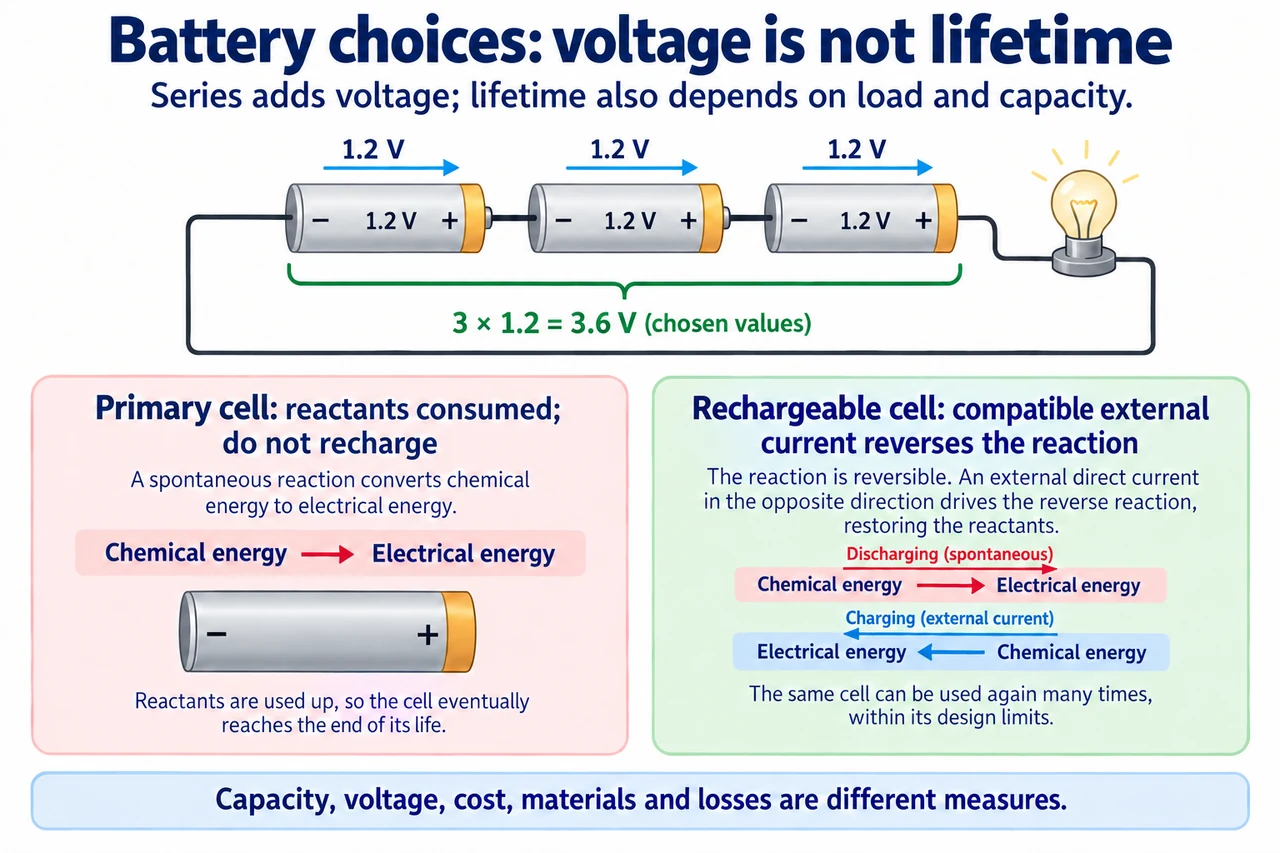
Image: illustration, not a documentary photograph. Original teaching model created for myAudience. · Original generated teaching raster; no exam-board or textbook artwork copied.
Stored reactants, series voltage and rechargeable choices
A battery supplies electrical energy using chemical cells. In the school series model, correctly oriented cells contribute voltage differences that add. The generated plate shows three chosen cells, each 1.2 V, joined positive-to-negative in the series path: their combined voltage is 3.6 V. That number describes the potential difference of the set under the chosen conditions. It does not say that three times as much current must flow in every circuit or that the device runs for three times as long.
Cells with the same voltage can contain different amounts of active materials and supply different amounts of charge before their useful discharge ends. Voltage, capacity, power and operating duration answer different questions. The same three-cell series arrangement can behave differently with different loads; real voltage can also vary through discharge. The corrected subtitle therefore says lifetime depends on load and capacity. Avoid both unsupported extremes: “series always lasts longer” and “series can never affect duration”. Define the device and load before making a duration comparison.
A primary, non-rechargeable cell eventually ceases to provide useful current as its reaction no longer proceeds adequately, including depletion of its reactants. Such a cell is not designed for charging by an external source; common non-rechargeable alkaline cells are an example. A rechargeable cell uses a suitably reversible reaction driven in the opposite direction by compatible external current. The distinction is chemical and engineered, not whether the case has a familiar cylindrical shape. The illustration is a concept comparison, not a charger design or permission to recharge a primary cell.
Read the two lower cards as energy accounts. During discharge, a chemical change transfers energy to an electrical circuit and some to surroundings. During compatible charging, energy supplied electrically drives restoration of reactants, with losses and design limits. Charging does not recreate all original material perfectly forever or violate conservation. A rechargeable cell can degrade over repeated cycles; a claim of a fixed number of cycles needs the actual product’s tested conditions. We do not infer a commercial lifetime from the generated drawing.
For an original cost comparison, suppose a primary set costs £3 per replacement and a rechargeable set plus suitable charger costs £24, with charging electricity costing £0.08 per comparable use. After n comparable uses, the stated simplified costs are £3n and £24 + £0.08n. At nine uses, the primary cost is £27 and the rechargeable cost is £24.72; at eight, they are £24 and £24.64. The rechargeable option first becomes cheaper at nine whole uses in this model. These are fictional prices, not a current buying recommendation.
Cost is only one criterion. A stronger evaluation asks whether the device supports the cell type, whether outputs and available duration meet the job, how often it is used, and what material production, charging electricity and end-of-life treatment involve. Recycling can recover some materials, but its availability and recovery are not assumed perfect. Comparing only purchase price ignores repeated replacement; comparing only “rechargeable” ignores electricity, durability and suitability. A reasoned conclusion may change when frequency, lifetime or charging access changes.
Transfer challenge: a student recommends rechargeables for every device because “they have higher voltage, never use up chemicals and are free after purchase”. Correct each claim using the plate and simplified cost model. Then assess a device used only twice before storage and another used thirty times, stating what must be checked before treating the model’s cheaper option as the better overall choice. Show how a failed rechargeable set after six uses changes the calculation without inventing a product guarantee.
Reasoned answer: cell type does not universally determine higher voltage; discharge consumes or changes reactants and charging restores them within limits; electricity and eventual replacement have costs. At two uses, the model gives £6 versus £24.16; at thirty, £90 versus £26.40 if the rechargeable set remains suitable and serviceable. A failure after six uses means the assumed long service life fails, so replacement costs must be included rather than extending the original line. Author criteria require explicit assumptions, correct totals and several relevant environmental or practical considerations, not a slogan that one technology is always best.
Worked example: Under the fictional model, compare twelve uses: primary set £3/use; rechargeable set and suitable charger £24 upfront plus £0.08/use. Compute totals and saving, with one limitation.
Primary total = 12 × £3 = £36.
Rechargeable total = £24 + 12 × £0.08 = £24.96.
Saving in the model = £36 − £24.96 = £11.04, provided the rechargeable set remains suitable for all twelve comparable uses.
Answer: The simplified model favours the rechargeable option by £11.04 at twelve uses; real product suitability and lifetime remain untested.
Check your understanding: Why does adding three 1.2 V cells in series not prove three times the operating duration?
Answer: The 3.6 V sum describes voltage. Duration also depends on the load, available charge and discharge behaviour.
Why: A voltage calculation cannot stand in for a lifetime test. Keep series orientation, device compatibility and the chosen use conditions explicit.