Hydrogen fuel cells: continuous supply, bounded claims
By UK GCSE Chemistry · independent study · myAudience
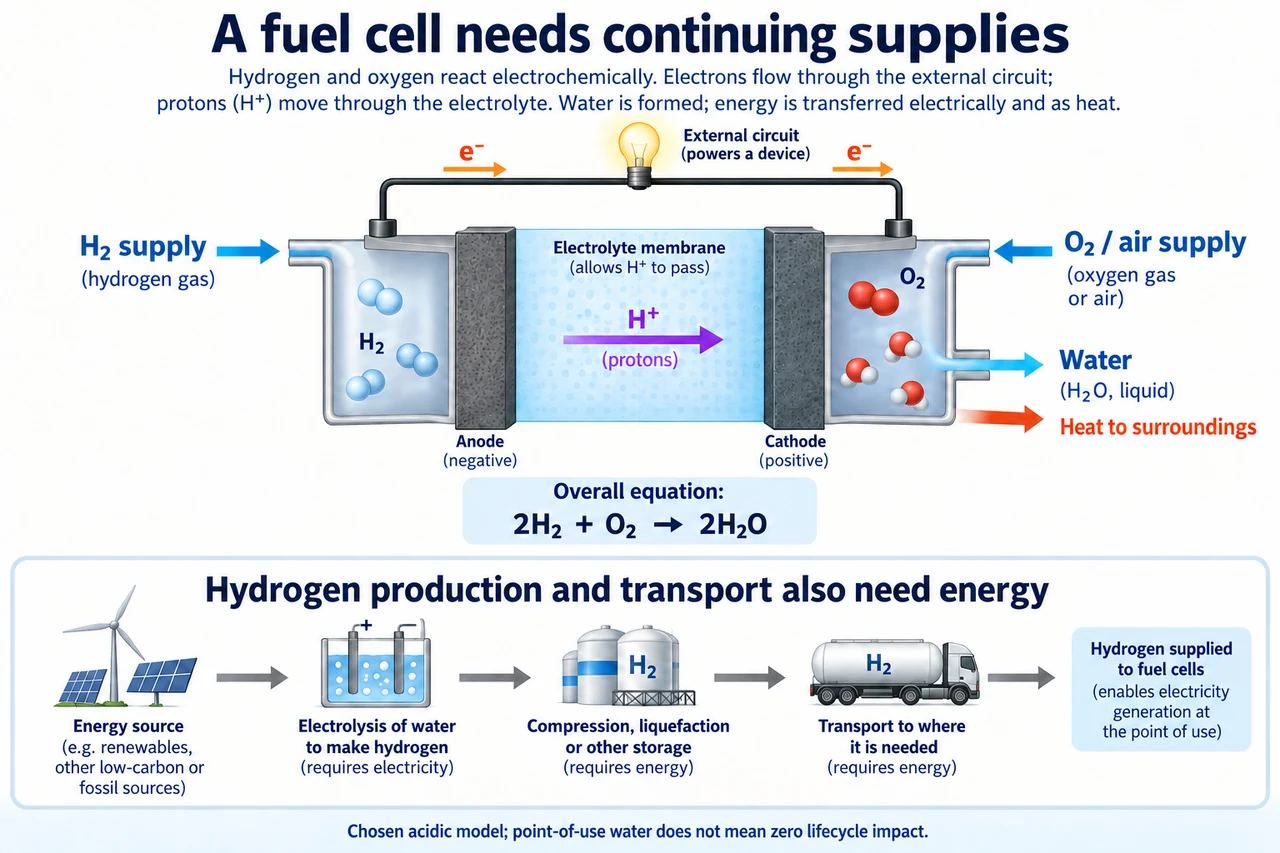
Image: illustration, not a documentary photograph. Original teaching model created for myAudience. · Original generated teaching raster; no exam-board or textbook artwork copied.
Hydrogen fuel cells: continuous supply, bounded claims
A fuel cell differs from a sealed battery with stored reactants because fuel and oxidant are supplied from outside while it operates. In a hydrogen fuel cell, hydrogen reacts with oxygen to produce water and transfer energy electrically, with heat transferred to surroundings. The balanced overall account is 2H2 + O2 → 2H2O. The coefficient ratio expresses the chemical consumption, not a guarantee of a particular electrical output or the efficiency of an actual commercial device.
The generated cutaway is a chosen acidic proton-exchange model. Hydrogen reaches the anode side, where its electrons enter the external circuit; hydrogen ions pass through the electrolyte membrane. Oxygen enters the cathode side, where it participates in forming water using the arriving ions and electrons. The separate routes matter: electrons do not cross the membrane in this model, and hydrogen ions do not travel through the metal lamp circuit. This common-tier reading explains the device; detailed balanced half-equations are reserved for its Higher companion.
Follow the actual arrows rather than interpreting a molecule’s colour as a pathway. The external orange arrows run from left anode through the load to right cathode, while the purple hydrogen-ion arrow runs through the membrane. Water leaves on the right and the red heat arrow denotes transfer, not a material product called heat. The drawn water is liquid for this illustration; real water management and conditions vary. The diagram is not a buildable device, storage instruction or measured efficiency experiment.
Continuous operation is conditional on continuing usable supplies and a functioning device. If hydrogen stops arriving, the cell cannot sustain the same reaction indefinitely. The oxygen may come from air; that does not remove the need for fuel. A rechargeable battery can be recharged from an electrical source after discharge, while a fuel cell is supplied with reactants for operation. These distinctions do not determine every engineering design: a system can combine a fuel cell with a battery, but neither component magically replaces the other’s inputs.
For a chosen stoichiometric model, 6 mol H2 with sufficient oxygen can form 6 mol H2O and requires 3 mol O2 for complete conversion. If only 2 mol O2 is available with the same hydrogen, oxygen can support consumption of 4 mol H2 and formation of 4 mol H2O, leaving 2 mol H2 unreacted in the ideal account. This is a chemical ratio exercise, not a gas-handling plan. It does not assign electrical energy: that would require additional supplied data and a defined system boundary.
A point-of-use statement and a lifecycle statement are different. The hydrogen–oxygen reaction has no carbon-containing reactant, so it does not itself make carbon dioxide as its product. Hydrogen must nevertheless be produced from compounds and then processed or transported. The lower panel shows electrolysis as one pathway, with electricity supply and storage/transport energy; other production pathways also exist. “Water at the outlet” therefore cannot prove zero upstream emissions, zero material impact or a universally superior environmental choice.
Transfer challenge: a fictional assessment table gives option A 4 kg of upstream emissions per stated service and option B 1 kg, while both have a water-only fuel-cell reaction at point of use. A student labels both zero-impact, calls the lower number proof of a clean fuel forever, and claims a hydrogen fuel cell needs no refuelling because oxygen is in air. Correct the three claims, compare only what the table supports and list two further criteria for a decision. Treat the supplied table as a model, not present-day production statistics.
Reasoned answer: the point-of-use reaction excludes carbon dioxide from that reaction but not upstream or material impacts. Under the stated service and boundary, B has 3 kg less of the specified upstream emissions, a 75% reduction relative to A; the conclusion cannot be extended to other services or full lifecycle impacts without data. Air supplies oxygen, not the required hydrogen. Costs, fuel availability, durability, storage/transport constraints and comparable performance can affect a decision. Author criteria reward balanced chemistry, explicit boundary and comparison denominator, relevant trade-offs and uncertainty rather than an unqualified “clean” label.
Worked example: A chosen ideal fuel-cell account has 5 mol H2 and 1.5 mol O2 available. Find the limiting reactant, water formed and hydrogen remaining. Explain why this does not calculate electrical output.
Each mol O2 reacts with 2 mol H2, so 1.5 mol O2 can consume 3 mol H2. Oxygen is limiting.
The equation gives 3 mol H2O and leaves 5 − 3 = 2 mol H2.
Electrical output requires additional energy/performance information and a boundary, not just the balanced chemical ratio.
Answer: Ideal result: 3 mol water and 2 mol hydrogen remaining. No measured output or handling instructions are implied.
Check your understanding: Does the absence of carbon dioxide from the hydrogen–oxygen reaction prove no lifecycle emissions?
Answer: No. Production, energy supply, processing, transport and materials must also be considered.
Why: The reaction’s product list covers one chemical boundary. It cannot replace evidence for the complete supply chain or operating service.