Higher: balance the fuel-cell electron account
By UK GCSE Chemistry · independent study · myAudience
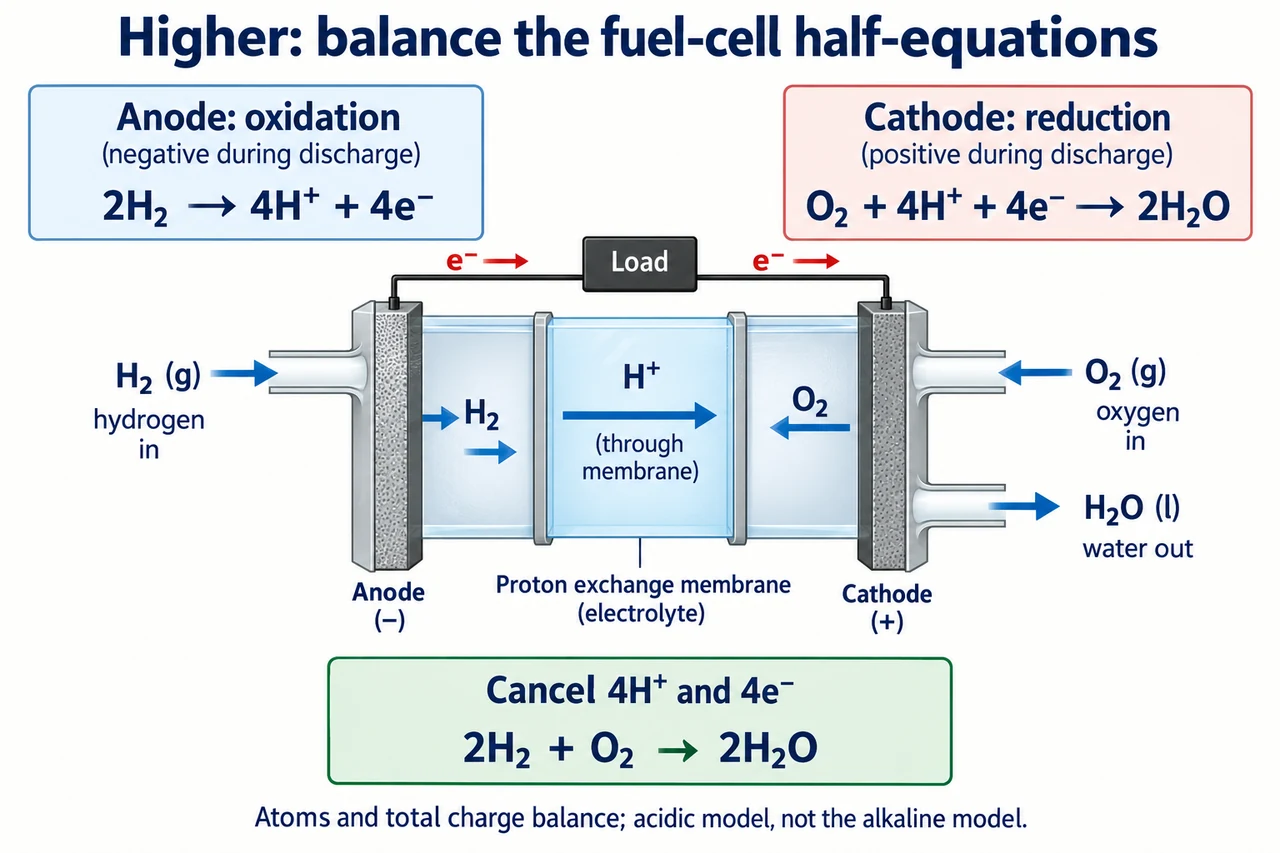
Image: illustration, not a documentary photograph. Original teaching model created for myAudience. · Original generated teaching raster; no exam-board or textbook artwork copied.
Higher: balance the fuel-cell electron account
This Higher-only companion balances the electron transfer in the chosen acidic hydrogen fuel cell. Keep the conditions explicit: an alkaline model uses different half-equations, so combining an acidic hydrogen-ion expression with an unrelated alkaline hydroxide expression can produce a wrong account. Oxidation means electron loss and reduction means electron gain. During fuel-cell discharge the anode is negative and the cathode positive; those signs must not be copied from an externally driven electrolysis diagram.
Start at the hydrogen side. One H2 molecule can be written as H2 → 2H^+ + 2e^-. Two hydrogen atoms appear on both sides. The right-hand total charge is +2 − 2 = 0, matching the neutral molecule. Electrons are products of this oxidation half-equation. To match the oxygen half-account used on the selected plate, multiply every term by two: 2H2 → 4H^+ + 4e^-. Multiplying only the electron coefficient would break conservation of both atoms and charge.
At the oxygen side, the acidic reduction account is O2 + 4H^+ + 4e^- → 2H2O. There are two oxygen atoms and four hydrogen atoms on both sides, while +4 from the ions and −4 from the electrons give zero total charge on the left. The water product is neutral. Electrons are reactants here because reduction gains them. If a proposed expression balances atoms but leaves a net charge difference, it is not a valid half-equation.
Add the two multiplied half-equations. The four hydrogen ions and four electrons appear on opposite sides and cancel, leaving 2H2 + O2 → 2H2O. Cancelling is bookkeeping for internally transferred species; it does not mean that ions or electrons never took part. Each oxygen molecule’s four-electron reduction matches the oxidation of two hydrogen molecules. An overall equation that retained electrons as a final product would leave the circuit’s transfer unaccounted for.
The selected illustration separates the external electron route from the membrane’s hydrogen-ion route. The anode label records oxidation and its negative discharge sign; the cathode label records reduction and its positive discharge sign. The blue arrows inside the fuel inlet spaces are supply directions rather than a claim that neutral hydrogen or oxygen crosses the membrane. The molecule equations are a reaction model, not a literal drawing of every intermediate, catalyst surface or operating condition.
The electron ratio can test a more demanding quantitative account. In the ideal complete-conversion model, 0.30 mol H2 produces 0.60 mol transferred electrons and uses 0.15 mol O2 while producing 0.30 mol water. A stated electron amount of 0.30 mol for the same hydrogen misses the factor of two in its oxidation. These amount calculations do not by themselves give current or operating duration: the rate of electron transfer and additional physical data would be required. No laboratory or device performance is being reported.
Transfer challenge: a student writes H2 → H^+ + e^-, O2 + 2H^+ + 2e^- → H2O, calls the hydrogen electrode positive “because anodes are positive”, and concludes the sum is H2 + O2 → H2O. Diagnose every atom, charge and sign issue. Supply a consistent pair of acidic half-equations, cancel them and explain why correcting the electrode sign alone would not fix the unbalanced chemistry.
Reasoned answer: the first expression loses a hydrogen atom and needs 2H^+ + 2e^-; the second needs four hydrogen ions, four electrons and two waters to conserve oxygen and hydrogen. Multiply the first correct equation by two, then cancel four ions and four electrons to obtain 2H2 + O2 → 2H2O. Anode is defined by oxidation; its sign is negative here during fuel-cell discharge, unlike the positive anode in driven electrolysis. Charge checks alone cannot find every atom error, so both must be audited. Author criteria reward each independent conservation check, correct electron location and coefficients, explicit acidic conditions and the distinction between definition and device sign.
Worked example: Write the acidic hydrogen fuel-cell half-equations and use them to determine the ideal electron and oxygen amounts for complete reaction of 0.20 mol H2.
Hydrogen oxidation: H2 → 2H^+ + 2e^-. Oxygen reduction: O2 + 4H^+ + 4e^- → 2H2O.
Double the hydrogen equation to match four electrons; cancel to give 2H2 + O2 → 2H2O.
0.20 mol H2 transfers 0.40 mol electrons and needs 0.10 mol O2, producing 0.20 mol water.
Answer: All atom and total-charge counts balance. The chosen amounts describe complete reaction, not an electrical-current measurement.
Check your understanding: Why is “anode is always positive” an unsafe rule when moving from electrolysis to a fuel cell?
Answer: Anode means oxidation. It is positive in the driven electrolysis example but negative during this fuel-cell discharge.
Why: The chemical definition is stable; electrode sign depends on the device’s operation. Identify oxidation first instead of transferring a memorised sign between different systems.