The mole links counting to a balance reading
By UK A Level Chemistry · independent study · myAudience
myAudience original generated educational illustration · Original commissioned illustration
The mole links counting to a balance reading
A mole measures amount of substance by counting specified entities. Under the modern SI definition, one mole contains exactly 6.02214076 × 10²³ entities. Specify whether these are atoms, molecules, formula units, ions or electrons: one mole of water molecules contains two moles of hydrogen atoms. The equation N = nN_A links entity number N to amount n. An enormous counting unit is useful because laboratory samples contain enormous numbers of microscopic entities.
Relative atomic mass A_r compares the mean mass of an atom in a sample with one twelfth of the mass of a carbon-12 atom. Relative molecular mass M_r makes the corresponding comparison for a molecule. Both are ratios with no unit. For an ionic solid, relative formula mass avoids implying that isolated molecules make up the lattice. Add relative atomic masses with the multiplicities in the formula, including every atom inside brackets.
Molar mass M is mass per amount and does have a unit, commonly g mol⁻¹. At routine A Level precision its numerical value in g mol⁻¹ matches the relative mass. That practical equality does not turn M_r into a mass measured in grams. The dimensional equation is n = m/M. If a task writes n = mass/M_r with grams understood, spell out the implied molar-mass conversion in your reasoning so the units still make sense.
Using illustrative A_r values Mg = 24.3, O = 16.0 and H = 1.0, magnesium hydroxide has relative formula mass 24.3 + 2(16.0 + 1.0) = 58.3. A 2.915 g sample therefore has amount 0.05000 mol with the stated values. It contains twice that amount of hydroxide ions as formula units. A coefficient counts complete formula units; a subscript describes their composition. Interchanging them changes the chemistry.
Keep intermediate calculator digits and round at the end to precision justified by the supplied data. Exact entity counts in a formula and the exact SI Avogadro constant do not create extra uncertainty, but an experimental mass does. Before calculating, estimate the scale: a few grams of a substance with molar mass near 60 g mol⁻¹ should give much less than one mole. This estimate often catches an inverted division immediately.
An electron can be the specified entity in a mole calculation. The exact Avogadro constant is 6.02214076×10^23 mol−1. Count electron transfer from the equation rather than using the electron mass in n=m/M unless the problem actually supplies a mass of free electrons. For Cu2++2e−→Cu, two moles of electrons correspond to one mole of copper atoms deposited in the ideal model. Charge transfer adds a second bridge: Q=n(e−)F, where F=NAe≈96485.33212 C mol−1. This is a transfer exercise, not a claim of experimental current efficiency. Competing reactions, incomplete collection or nonconstant current would need separate evidence. Relative atomic/formula masses are dimensionless; molar masses carry g mol−1. A mole of NaCl formula units is not a mole of NaCl molecules in an ionic solid.
An additional worked transfer uses the following chosen data. Synthetic ideal deposition produces 0.6350 g Cu using M(Cu)=63.50 g mol−1. Find electron moles, number and charge. n(Cu)=0.01000 mol; n(e−)=0.02000 mol from the 2:1 ratio. N(e−)=1.204428152×10^22, reported 1.204×10^22, and Q=1929.7066 C, reported 1930 C (four significant figures). Consider this transfer question: If 0.0300 mol electrons reduce Al3+ ideally, how many Al atoms form? Reasoned answer: The equation requires three electrons per atom, so n(Al)=0.0100 mol and N=6.02×10^21 atoms to three significant figures. Consider this transfer question: Compare particles in 0.100 mol CO2 and 0.100 mol MgCl2 formula units. Reasoned answer: Each has 0.100NA specified entities. CO2 has 0.300 mol atoms; MgCl2 has 0.100 mol Mg2+ and 0.200 mol Cl− in its ideal ionic accounting. Same entity amount is not same mass or same particle type.
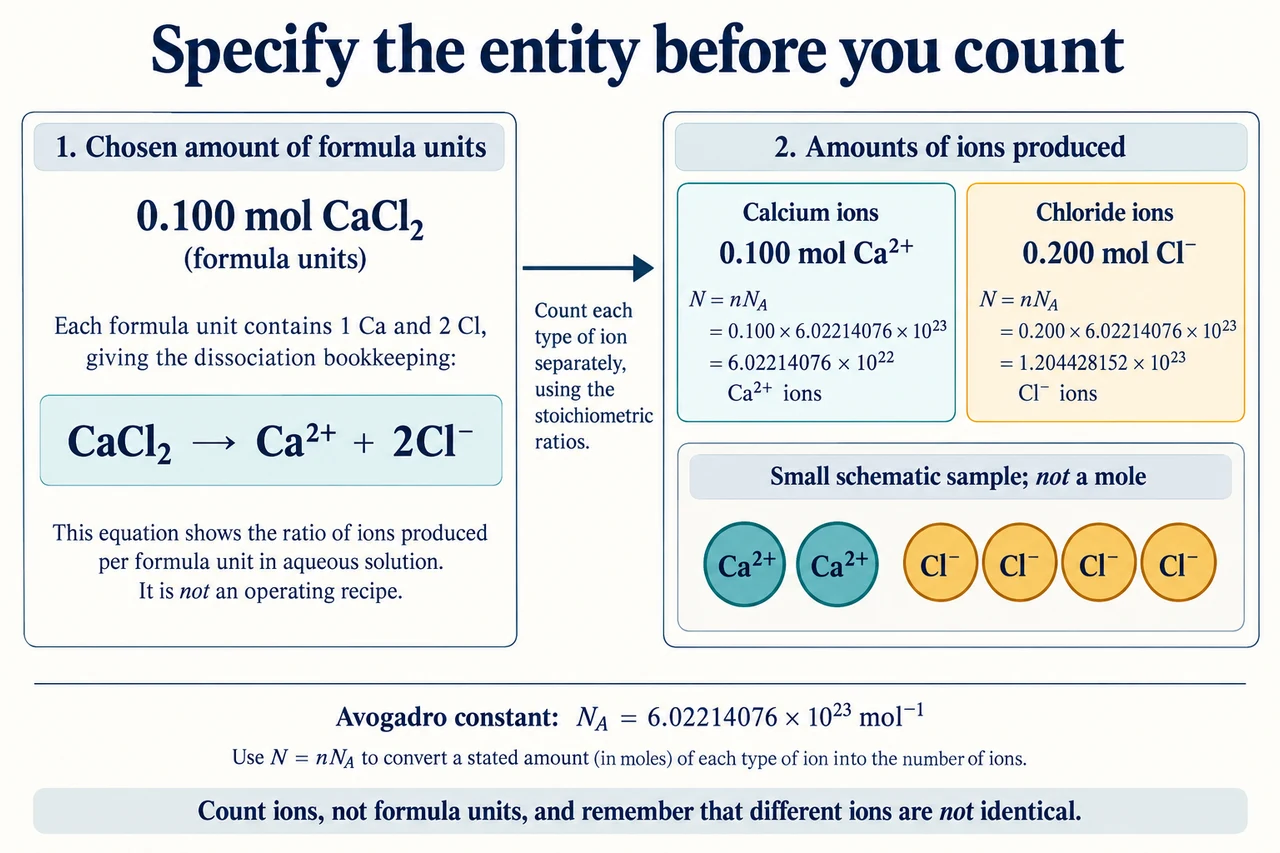
The illustration counts the specified ions separately. Its two calcium badges and four chloride badges are a small schematic showing the 1:2 ratio, not an actual sample of one mole. The chosen 0.100 mol formula-unit amount gives 0.100 mol calcium ions and 0.200 mol chloride ions in dissociation bookkeeping. Multiplying each by the same Avogadro constant changes the count, not the identity of the entity. No count in this picture is a measurement of a dissolved sample. Image: illustration, not a documentary photograph. The introductory check also remains relevant: Does 0.10 mol of CaCl₂ contain 0.10 mol or 0.20 mol of chloride ions? 0.20 mol of chloride ions. There are two chloride ions per formula unit.
Worked example: A 3.60 g sample of water has M = 18.0 g mol⁻¹. Use N_A = 6.02214076 × 10²³ mol⁻¹ to find water molecules and hydrogen atoms.
n = 3.60/18.0 = 0.200 mol.
Water molecules: 0.200N_A = 1.204428152 × 10²³.
Each molecule has two H atoms: double the entity count.
Answer: 1.20 × 10²³ water molecules and 2.41 × 10²³ hydrogen atoms, to three significant figures.
Check your understanding: Compare particles in 0.100 mol CO2 and 0.100 mol MgCl2 formula units.
Answer: Each has 0.100NA specified entities. CO2 has 0.300 mol atoms; MgCl2 has 0.100 mol Mg2+ and 0.200 mol Cl− in its ideal ionic accounting. Same entity amount is not same mass or same particle type.
Why: Credit a valid derivation and explicit model assumptions, coherent units or electron/charge counts, and a justified critique of the proposed inference. An unsupported numerical answer or recalled shape name alone does not demonstrate the reasoning. Additional unfamiliar assessed practice and any laboratory performance remain unverified.