Solution concentration and titration reasoning
By UK A Level Chemistry · independent study · myAudience
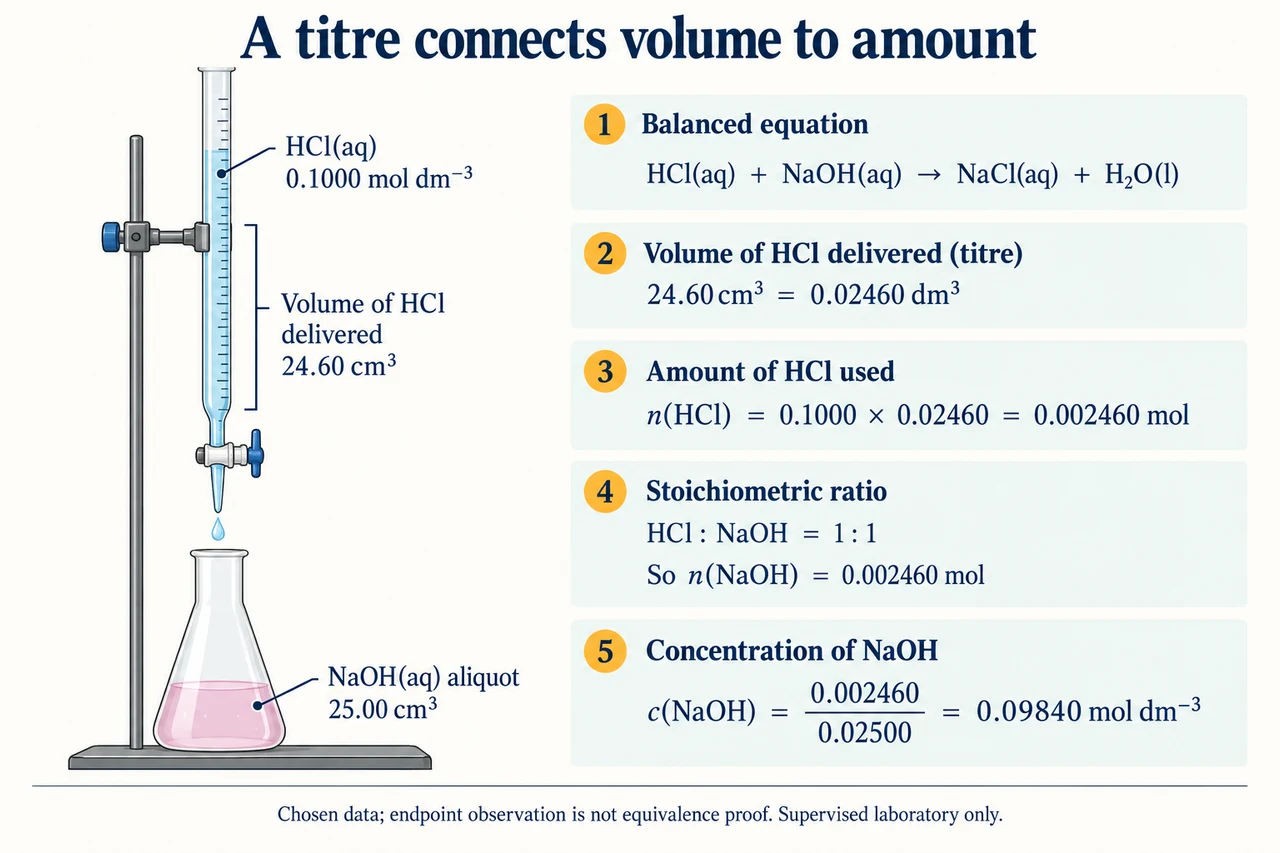
myAudience original generated educational illustration · Original commissioned illustration
Solution concentration and titration reasoning
Amount concentration describes how much solute is present per solution volume: c = n/V. When c is in mol dm⁻³, V must be in dm³; 25.00 cm³ is 0.02500 dm³. The volume is the total solution volume, not the water initially poured in. Dissolving 0.0100 mol and making the final volume 0.100 dm³ gives 0.100 mol dm⁻³. Adding more solvent reduces concentration while preserving the solute amount if none is lost or reacted.
Preparing a volumetric solution links the mass calculation to transfer technique. In a supervised laboratory, a known mass of a suitable standard is dissolved, transferred quantitatively with rinsings to a volumetric flask, made up to the mark and mixed thoroughly. The meniscus is read at eye level after the solution reaches the appropriate temperature. Leaving solid in the weighing vessel or failing to mix changes the amount or concentration actually sampled. This written explanation is preparation for the practical study, not evidence that it has been performed.
A pipette supplies a known aliquot; a burette delivers a measured variable volume until an observed endpoint. In an acid–base titration, the indicator must suit the reaction and endpoint, and the balanced equation gives the mole ratio. Endpoint is an observation; equivalence is the stoichiometric condition. Rinse the pipette with the solution it will transfer and the burette with its titrant so residual water does not unpredictably dilute them. Appropriate supervised risk assessment and handling remain essential.
Use a rough trial to locate the endpoint, then repeat with careful dropwise addition near it. Select consistent measured titres according to a stated rule rather than choosing values that make the answer attractive. For synthetic titres 24.60, 24.65 and 25.10 cm³, the first two form a close pair, giving 24.625 cm³ before rounding. The third requires investigation; excluding it does not prove it was wrong. Record the rough result separately and retain original readings.
A titre is the difference of two burette readings. With each reading assigned a maximum uncertainty of ±0.05 cm³, the conservative absolute bound for a titre is ±0.10 cm³. At 24.625 cm³ this is about 0.406%. Repetition helps assess random scatter but does not remove systematic dilution or calibration error. Explain the direction of a proposed error through amount and volume, rather than assuming every mistake makes the answer larger.
A separate carbonate transfer connects its balanced equation to titration arithmetic; the newly selected plate instead depicts the original HCl/NaOH example. CO3^2− needs two H+ per formula unit for complete reaction to CO2 and water; the acid amount therefore must be divided by two. Endpoint detection needs an indicator suitable for that complete reaction, not the earlier carbonate-to-hydrogencarbonate stage. A written calculation and schematic are preparation for practical study, not a performed practical or CPAC evidence. Use this original synthetic reading table in cm3: rough 0.20→25.10; run 1 0.15→24.75; run 2 1.20→25.85; run 3 0.30→25.40. Subtraction gives 24.90, 24.60, 24.65, 25.10. With a declared concordance criterion of difference≤0.10 cm3, select runs 1 and 2, mean 24.625 (display 24.63). Retain all readings and label the rough. Run3 is not erased: the discrepancy warrants another careful repeat and an endpoint/handling investigation. The previous lesson deliberately bounded only the two burette readings at ±0.05 cm3 each, hence ±0.10 cm3. For this separate fictional uncertainty budget, stipulate an additional ±0.05 cm3 endpoint bound, giving ±0.15 cm3 in total; this is a problem assumption, not a freshly verified handbook quotation. These are different budgets, not contradictory arithmetic. The question-supplied apparatus and endpoint assumptions govern the answer. A conservative sum of bounds is not a statistical standard deviation or a 95% confidence interval. For carbonate concentration cB=cAVtitre/(2Valiquot), fractional bounds add in a conservative first-order product/quotient estimate. If acid concentration is ±0.20%, the 25.00 cm3 pipette is ±0.06 cm3 and titre ±0.15 cm3, the bound is about 0.20+0.24+0.609=1.049%. Reporting many digits in a mean does not justify many digits in concentration. More repeats can reveal scatter but cannot remove the same dilution error from every aliquot.
Error direction follows the equation. Water left in a titrant burette dilutes the actual acid, requiring a larger titre; calculating with its nominal concentration overestimates carbonate. Water in the conical flask adds solvent but no carbonate and, absent endpoint effects, does not change acid equivalents needed. An air bubble initially in the burette tip that fills during delivery makes the apparent delivered volume too large. Concordance cannot alone establish accuracy. An additional worked transfer uses the following chosen data. Synthetic 25.00 cm3 carbonate aliquot consumes a mean 24.625 cm3 of 0.1000 mol dm−3 HCl. Calculate carbonate concentration and the stated full bound. n(HCl)=0.0024625 mol; n(CO3^2−)=0.00123125 mol; c=0.04925 mol dm−3. Relative first-order bound=0.01049137056, about 1.05%; absolute≈0.00051670 mol dm−3. A sensible uncertainty report is (0.04925±0.00052) mol dm−3 under this budget; a final exam answer may round as instructed. Consider this transfer question: A second synthetic method gives 0.05030±0.00020 mol dm−3. Are the two bounds consistent? Reasoned answer: First interval is approximately[0.04873, 0.04977]; second[0.05010, 0.05050]. They do not overlap, so the stated bounds do not explain the discrepancy. Investigate calibration, dilution and endpoint bias rather than declare either method correct from precision alone. Consider this transfer question: Would doubling both aliquot and expected titre necessarily halve the total percentage uncertainty? Reasoned answer: Only fixed absolute volume contributions approximately halve; acid concentration percentage uncertainty does not. Capacity, endpoint behaviour and safety constraints may change. State which uncertainty terms scale and compare the revised budget rather than make a universal claim.
The new illustration uses the original hydrochloric-acid/sodium-hydroxide 1:1 worked example: 24.60 cm³ acid delivered to a 25.00 cm³ aliquot gives 0.09840 mol dm⁻³ base. The burette sketch is not a calibrated scale from which to infer the titre; real titre is final minus initial reading. The separate carbonate transfer below uses a 2:1 acid/carbonate ratio and is not depicted. Both require a suitable endpoint and supervised risk assessment; neither is a performed practical. Image: illustration, not a documentary photograph. The introductory check also remains relevant: Would using the burette volume directly as 24.60 in cV give the right amount? No; it would overestimate the amount by a factor of 1000. The concentration unit requires dm³, so cm³ must be divided by 1000.
Worked example: 25.00 cm³ of NaOH requires 24.60 cm³ of 0.1000 mol dm⁻³ HCl. Find the NaOH concentration.
HCl + NaOH → NaCl + H₂O gives a 1:1 ratio.
n(HCl) = 0.1000 × 0.02460 = 0.002460 mol = n(NaOH).
c(NaOH) = 0.002460/0.02500.
Answer: 0.09840 mol dm⁻³.
Check your understanding: Would doubling both aliquot and expected titre necessarily halve the total percentage uncertainty?
Answer: Only fixed absolute volume contributions approximately halve; acid concentration percentage uncertainty does not. Capacity, endpoint behaviour and safety constraints may change. State which uncertainty terms scale and compare the revised budget rather than make a universal claim.
Why: Credit a valid derivation and explicit model assumptions, coherent units or electron/charge counts, and a justified critique of the proposed inference. An unsupported numerical answer or recalled shape name alone does not demonstrate the reasoning. Additional unfamiliar assessed practice and any laboratory performance remain unverified.