Gas calculations need absolute temperature and SI units
By UK A Level Chemistry · independent study · myAudience
myAudience original generated educational illustration · Original commissioned illustration
Gas calculations need absolute temperature and SI units
The ideal gas equation pV = nRT connects pressure, volume, amount and absolute temperature. Pressure comes from molecular collisions with container walls; the ideal model treats molecular volume as negligible and ignores intermolecular attractions. Real gases approach this model better at sufficiently low pressure and high temperature, away from condensation. A correct ideal-gas calculation is conditional on that model; it does not establish that every real gas behaves ideally.
With R = 8.314 J mol⁻¹ K⁻¹, use pressure in pascals, volume in cubic metres, amount in moles and temperature in kelvin. Convert 100 kPa to 100000 Pa and 250 cm³ to 2.50 × 10⁻⁴ m³. Kelvin temperature is Celsius temperature plus 273.15. In an exam use the conversion or constant supplied. Multiplying Celsius directly by R gives an invalid physical scale and can even predict nonsensical negative volumes.
Rearrange the equation before substitution: n = pV/(RT), or M = mRT/(pV) when determining molar mass from mass m and gas amount. The mass unit fixes the molar-mass unit: grams give g mol⁻¹. Check the units through pV: Pa m³ equals joules. Dividing by RT, whose units are J mol⁻¹, leaves moles. Unit cancellation offers an independent check on algebra that visual familiarity with the formula cannot provide.
For a volatile-liquid investigation, a measured mass is related to a measured vapour volume at known pressure and temperature. The vapour must actually fill the measured space under the stated conditions. Air contamination, leaks, incomplete vaporisation or condensation break that assumption. This is a specification opportunity for apparatus and data reasoning, not an extra numbered required practical or a suggested unsupervised home procedure.
Gas volumes in balanced-equation calculations follow mole ratios only when volumes refer to gases at the same temperature and pressure within the ideal approximation. One should not apply a universal room-temperature molar volume to conditions the problem explicitly changes. An order-of-magnitude check is helpful: a few hundred cubic centimetres near ambient conditions should be roughly hundredths of a mole, not tens of moles.
A gas calculation combines stoichiometry with a physical-state model. First find moles from the balanced reaction, then use pV=nRT. A volume ratio equals a mole ratio only for gases compared at the same temperature and pressure in the ideal approximation. It is not a mass ratio and cannot be used directly for a liquid reagent. Gas collected over water has a total pressure containing water vapour. If vapour pressure is supplied, subtract it before solving for dry-gas amount. A leak gives a smaller collected volume and a smaller inferred amount; a hot gas read using room temperature can bias the result in the opposite direction. Pressure, temperature, volume and calibration each contribute to uncertainty, so a precise syringe reading does not prove an accurate molar result.
An additional worked transfer uses the following chosen data. Synthetic 0.2500 g CaCO3 (100.0 g mol−1) reacts completely with excess acid. Predict dry CO2 at 298.0 K and 100.0 kPa using R=8.314462618 J mol−1 K−1. CaCO3+2HCl→CaCl2+H2O+CO2, so n(CO2)=0.002500 mol. V=nRT/p=6.19427465×10−5 m3=61.94 cm3. This is an ideal, dry-gas prediction, not a learner measurement. Consider this transfer question: A synthetic 60.0 cm3 wet sample is at 100.0 kPa and 298.0 K; water vapour pressure is 3.17 kPa. Find dry CO2 moles. Reasoned answer: pCO2=96.83 kPa; n=96830×60.0×10−6/(8.314462618×298)=0.0023448266 mol≈0.00234 mol. Treating100.0 kPa as CO2 pressure would overestimate amount. Consider this transfer question: Given bounds ±1.0 cm3, ±0.5 kPa and ±1.0 K for that wet sample and exact supplied vapour pressure, estimate the relative bound. Reasoned answer: For n=pdryV/(RT), add1/60+0.5/96.83+1/298≈0.02519=2.52%. If vapour pressure is uncertain its contribution must also enter; the supplied exact assumption is a teaching simplification.
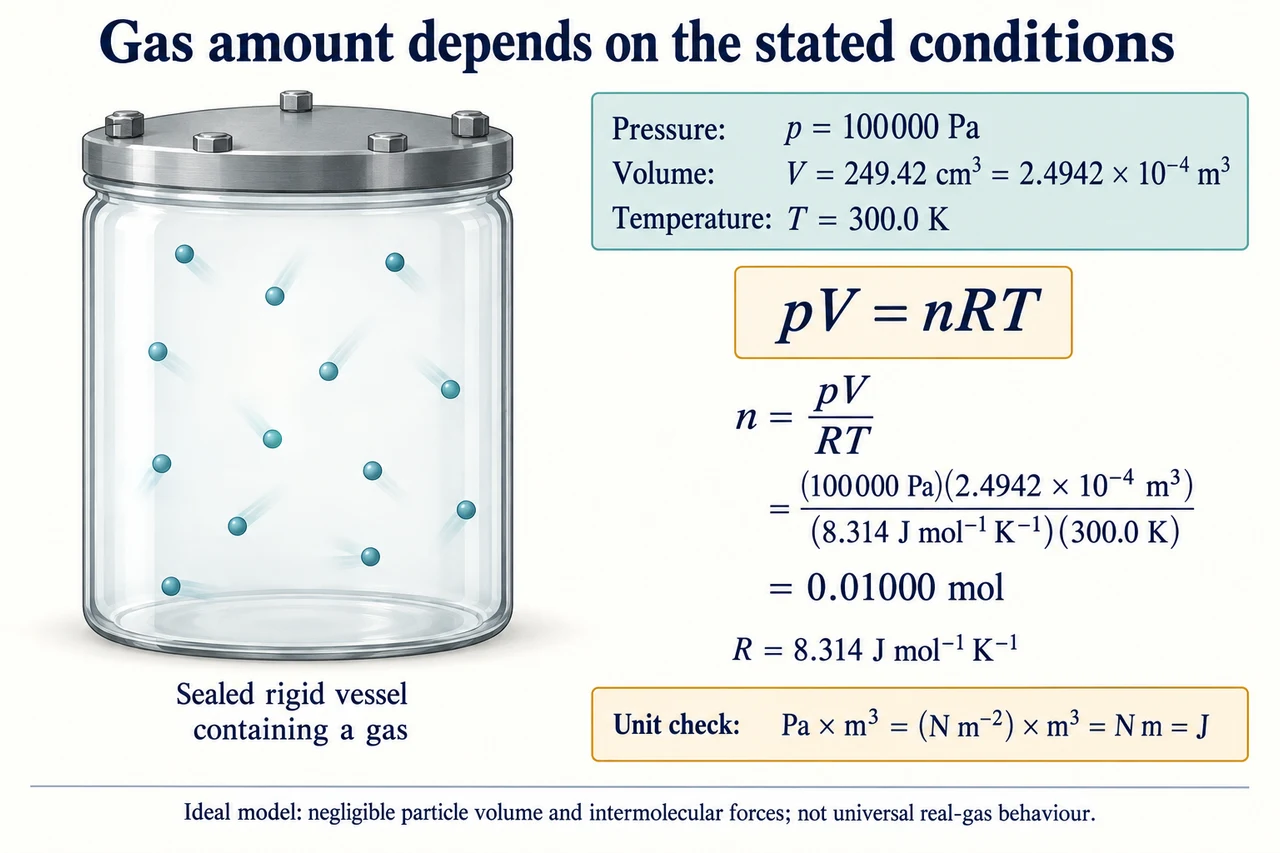
The vessel illustration labels a chosen ideal state, not experimentally measured conditions. Its few gas dots represent separated moving entities qualitatively; they are not the number of entities in 0.01000 mol. Follow the conversion from cubic centimetres to cubic metres before substituting. The pressure and temperature labels are part of the model, so neither a room-temperature volume shortcut nor Celsius substitution can replace them. Image: illustration, not a documentary photograph. The introductory check also remains relevant: At fixed n and T, what happens to ideal-gas volume when pressure doubles? It halves. At constant amount and absolute temperature, nRT stays fixed. The product pV must therefore remain constant: doubling p requires half the volume.
Worked example: At 100000 Pa and 300.0 K, a gas occupies 249.42 cm³. Use R = 8.314 J mol⁻¹ K⁻¹ to find n.
V = 249.42 × 10⁻⁶ m³.
n = 100000 × 249.42 × 10⁻⁶ /(8.314 × 300.0).
The unrounded result is 0.01000 mol.
Answer: 0.01000 mol, taking pressure as specified to sufficient precision.
Check your understanding: Given bounds ±1.0 cm3, ±0.5 kPa and ±1.0 K for that wet sample and exact supplied vapour pressure, estimate the relative bound.
Answer: For n=pdryV/(RT), add1/60+0.5/96.83+1/298≈0.02519=2.52%. If vapour pressure is uncertain its contribution must also enter; the supplied exact assumption is a teaching simplification.
Why: Credit a valid derivation and explicit model assumptions, coherent units or electron/charge counts, and a justified critique of the proposed inference. An unsupported numerical answer or recalled shape name alone does not demonstrate the reasoning. Additional unfamiliar assessed practice and any laboratory performance remain unverified.