Composition gives atom ratios, not mass ratios
By UK A Level Chemistry · independent study · myAudience
myAudience original generated educational illustration · Original commissioned illustration
Composition gives atom ratios, not mass ratios
An empirical formula gives the simplest whole-number ratio of atoms in a compound. A molecular formula gives the actual numbers in one molecule. They answer different questions: an empirical ratio CH₂ does not distinguish C₂H₄ from C₃H₆. A separate relative molecular mass can identify the multiplier. For a lattice without discrete molecules, an ionic formula expresses a ratio; inventing a molecular formula for the whole crystal is inappropriate.
Mass ratios are not atom ratios because different elements have different molar masses. Convert each mass to an amount using n = m/M, then divide all amounts by the smallest. If composition is given by percentage, a hypothetical 100 g sample makes the percentage values convenient masses without asserting that this much material was measured. All percentages must refer to the same sample basis, and omitted elements require explicit treatment.
Ratios such as 1:1.5 should be multiplied throughout by two, giving 2:3. Rounding 1.5 to 2 before this step changes the inferred compound. Small deviations from simple ratios may reflect measurement uncertainty, but a poor fit cannot be dismissed automatically. Report assumptions about purity and the completeness of composition data. A contaminated sample can produce precise-looking arithmetic that corresponds to no single compound.
Once the empirical formula is known, add its relative atomic masses. Divide the measured M_r by that empirical formula mass to find a whole-number multiplier. Multiply every subscript by the same factor. An inconsistent or clearly non-integer multiplier signals a problem in the data, interpretation or earlier rounding; do not force it into a desired answer without explanation. The molecular formula must reproduce both the atom ratio and the supplied relative mass.
A metal-oxide mass experiment illustrates how data are obtained. The gain in mass can represent oxygen combined only if material is retained and the reaction is complete. Repeated heating, cooling and weighing to constant mass checks whether the mass still changes, but does not prove purity or rule out another product. Magnesium can react with nitrogen as well as oxygen; a supervised method must address relevant side reactions. The specification lists this as a skills opportunity rather than the practical study.
Composition inference is a constrained ratio problem. Divide each element mass by its stated molar atomic mass, then scale the atom amounts to a small whole-number ratio. Do not round 1.5 to2 before testing multiplication by 2. A molecular formula must be an integer multiple of the empirical formula and must fit the independently assigned molecular mass. For combustion evidence, carbon amount follows CO2 and hydrogen amount is twice H2O amount. Oxygen in the original compound can be found by mass difference only if the compound contains no other elements and combustion/collection is quantitative. Missing carbon dioxide or water makes the inferred oxygen-by-difference misleading. A neat integer ratio is not evidence that those assumptions held.
An additional worked transfer uses the following chosen data. Synthetic 0.300 g compound containing only C,H,O gives 0.440 g CO2 and 0.180 g H2O on complete combustion. Use C12,H1,O16; assigned Mr 60. Deduce formulas. nC=0.440/44=0.0100 mol; nH=2×0.180/18=0.0200 mol. Their masses are 0.120 and 0.0200 g, so oxygen mass 0.160 g and nO=0.0100 mol. Ratio 1:2:1 gives CH2O (30); multiplier 60/30=2 gives C2H4O2. This does not distinguish structural isomers. Consider this transfer question: If collected water is only 90% of the true amount, can the same procedure reliably identify oxygen content? Reasoned answer: No: inferred hydrogen is too low and oxygen-by-difference too high. Correct quantitatively only if collection efficiency is independently justified; otherwise report the violated assumption. Consider this transfer question: A proposed empirical CH2O formula is paired with assigned Mr 74. What should you do? Reasoned answer: 74/30 is not a whole number. Recheck mass assignment, composition, rounding and sample purity; do not force an arbitrary integer multiplier.
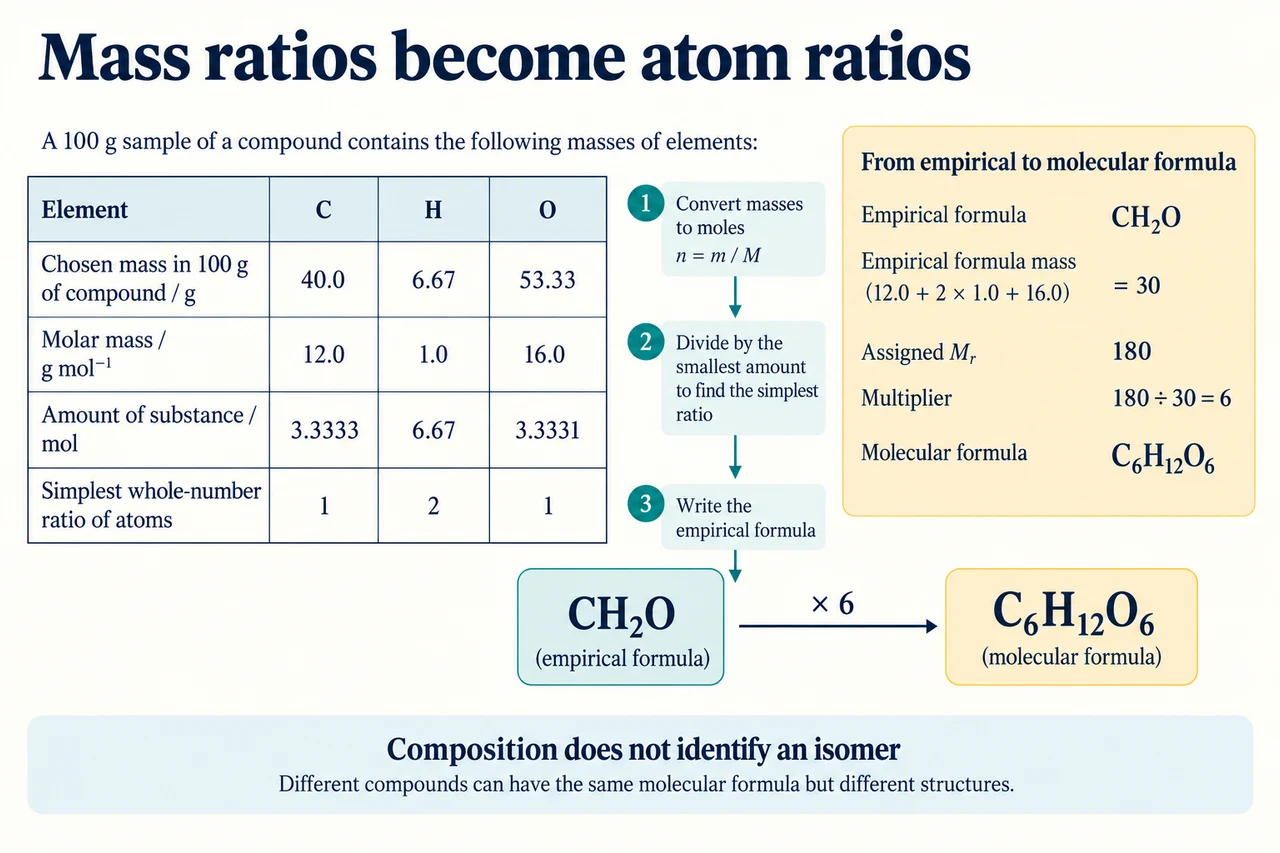
The illustration follows one synthetic composition through mass-to-amount conversion and the simplest 1:2:1 ratio. Its assigned relative molecular mass 180 selects multiplier six; that is different from the separate combustion example below, whose assigned mass is 60 and multiplier two. No molecular structure is drawn because neither composition nor molecular formula uniquely identifies an isomer. The oxygen amount is based on the stated complete composition, not a direct atom count. Image: illustration, not a documentary photograph. The introductory check also remains relevant: Does an empirical formula uniquely identify a substance? No. Several molecular sizes and structural isomers can share the same simplest ratio.
Worked example: A synthetic organic sample is 40.0% C, 6.67% H and 53.33% O; M_r = 180. Use A_r C = 12.0, H = 1.0, O = 16.0.
For 100 g: amounts are 3.3333, 6.67 and 3.333125 mol.
Divide by the smallest: approximately 1:2:1, giving CH₂O.
Empirical formula mass is 30; 180/30 = 6.
Answer: Empirical CH₂O; molecular C₆H₁₂O₆. Data do not uniquely identify an isomer.
Check your understanding: A proposed empirical CH2O formula is paired with assigned Mr74. What should you do?
Answer: 74/30 is not a whole number. Recheck mass assignment, composition, rounding and sample purity; do not force an arbitrary integer multiplier.
Why: Credit a valid derivation and explicit model assumptions, coherent units or electron/charge counts, and a justified critique of the proposed inference. An unsupported numerical answer or recalled shape name alone does not demonstrate the reasoning. Additional unfamiliar assessed practice and any laboratory performance remain unverified.