Balanced equations connect quantities and process choices
By UK A Level Chemistry · independent study · myAudience
myAudience original generated educational illustration · Original commissioned illustration
Balanced equations connect quantities and process choices
A balanced equation conserves the number of atoms of each element, and an ionic equation also conserves total charge. Change coefficients, never a compound's subscripts, to balance a stated reaction. For example, 2Al + 3Cl₂ → 2AlCl₃ conserves aluminium and chlorine. Coefficients express ratios of reacting amounts, not equal masses. State symbols describe the actual conditions, and aqueous means dissolved in water rather than simply liquid.
For an ionic equation, write dissolved strong electrolytes as their ions and remove unchanged spectator ions from both sides. The precipitation equation Ag⁺(aq) + Cl⁻(aq) → AgCl(s) describes the formation of a solid without treating it as separated aqueous ions. Atoms and charge both balance. A net equation loses information about spectator species, so it answers a different question from a full equation rather than replacing all full equations indiscriminately.
Convert each available reactant quantity into moles, then compare n divided by its equation coefficient. The smallest value limits the reaction extent. Calculate product amount from that extent and its coefficient, and convert to the quantity asked for: mass, gas volume or concentration. The reactant with the smaller mass is not necessarily limiting. For gas volumes use the same-condition mole ratio or pV = nRT; for solutions use the measured concentration and volume.
Theoretical yield assumes the limiting reactant follows the stated equation completely. Percentage yield compares actual isolated product with that theoretical amount, using the same units. Atom economy instead measures how much of the stoichiometric reactant mass becomes the desired product; include all coefficients in the relative-mass totals. A process can have 100% theoretical atom economy yet a poor actual yield. A reported yield over 100% suggests wet or impure product, faulty data or an incorrect model.
High atom economy can reduce unwanted material, treatment costs and resource waste, but selecting an industrial process also involves toxicity, energy, solvent use, sourcing, separation and worker or community impacts. A numerical percentage alone cannot settle an ethical comparison. State which product is desired and what system boundary is used. A clear argument explains a benefit, its mechanism and a limitation rather than calling a reaction 'green' without supporting reasoning.
Unfamiliar balancing follows conservation, not remembered names. For complete combustion of CxHyOz, begin CxHyOz+(x+y/4−z/2)O2→xCO2+(y/2)H2O, then multiply to remove fractional coefficients. This assumes the products stated are CO2 and water; different chemistry needs different products. Do not change formula subscripts to make totals balance. Original transfer set: (a) C4H9OH+O2→CO2+H2O; (b) Al+CuSO4→Al2(SO4)3+Cu; (c) Ba2++PO4^3−→Ba3(PO4)2. Answers are C4H9OH+6O2→4CO2+5H2O; 2Al+3CuSO4→Al2(SO4)3+3Cu; 3Ba2++2PO4^3−→Ba3(PO4)2(s). The ionic charge sum is +6−6=0. Atom balance without charge balance is insufficient. For gas-volume transfer, consider N2+3H2→2NH3. Original idealised feed is 120 cm3 N2 and 300 cm3 H2, all volumes referred to identical temperature and pressure. Hydrogen limits conversion:100 cm3 N2 reacts, 200 cm3 NH3 forms and 20 cm3 N2 remains. This assumes complete conversion of the limiting reagent and all species gaseous; industrial equilibrium prevents treating this as an actual Haber yield. Process evaluation must separate theoretical atom economy from isolated yield and resource demand. A current EPA page (updated 7 April 2026) records a historical 2010 HPPO award comparison: wastewater reduced by 70–80%, energy by 35%, and construction cost by up to25% relative to traditional technologies. These are dated reported comparisons with incompletely specified baselines, not universal 2026 plant measurements. It also describes only water as reaction coproduct; solvent, catalyst handling and upstream peroxide manufacture still matter in the process boundary.
HPPO equation C3H6+H2O2→C3H6O+H2O has desired-product atom economy58/(42+34)=76.3% using C12,H1,O16. It need not be100% merely because the coproduct is water. An original synthetic decision table compares bids for 1.00 tonne saleable PO: A uses 10.0 GJ, 10.0 m3 wastewater and index 100 capital; B uses 6.5 GJ, 2.5 m3 and index 75, but has feed cost£1100 rather than£900. These bids are invented for AO3 practice, loosely reflecting reported percentage comparisons, and cannot be quoted as plant data. An additional worked transfer uses the following chosen data. Using the synthetic bids, energy£20/GJ and wastewater£15/m3, calculate variable costs and evaluate whether B must be selected. A costs 900+200+150=£1250/t. B costs 1100+130+37.50=£1267.50/t. B reduces energy by (10−6.5)/10=35%, wastewater75% and capital index 25%; it is £17.50/t dearer in this limited variable-cost model. Capital amortisation, upstream feed impacts, co-product markets, reliability, capacity and uncertainty are missing. Select conditionally under stated priorities, not by one favourable metric. Consider this transfer question: For1.00 mol propylene and excess peroxide, synthetic isolated yield 85.0%, calculate product mass and distinguish it from atom economy. Reasoned answer: Theoretical PO mass 58.0 g; isolated mass 49.3 g. Yield85.0% compares obtained with theoretical product; atom economy76.3% compares theoretical desired-product mass with stoichiometric reactants. Do not multiply them and call the result either definition. Consider this transfer question: Find the feed-cost ceiling for B to match A and critique the dated EPA comparison. Reasoned answer: B nonfeed costs 167.50, so feed ceiling1250−167.50=£1082.50/t. EPA is primary government reporting of a historical award, but baseline technologies, boundaries and uncertainty are insufficient for a present investment verdict; request comparable contemporary audits. The reported ranges are not statistical confidence intervals.
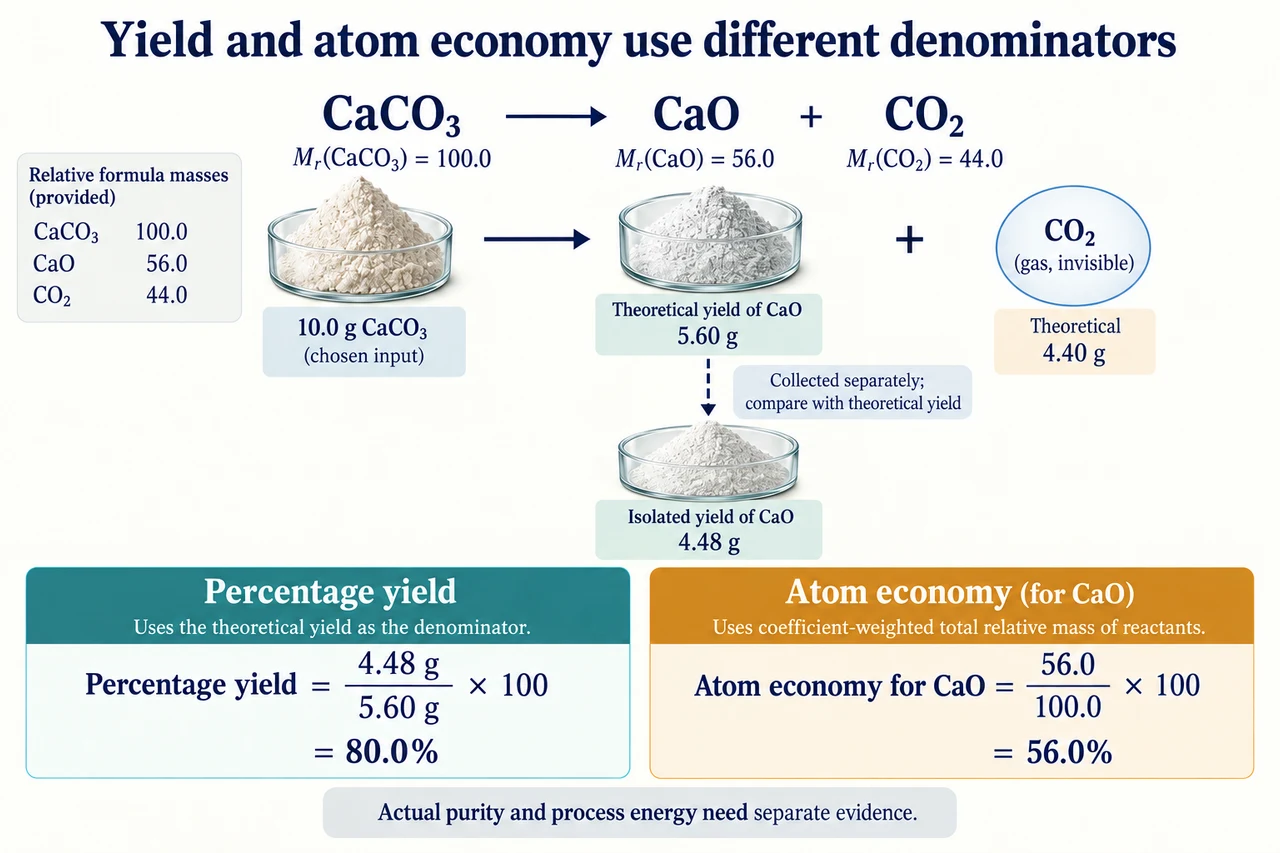
The illustration keeps two denominators visibly separate. The chosen isolated 4.48 g is compared with theoretical 5.60 g for yield; the desired CaO relative mass 56.0 is compared with stoichiometric reactant total 100.0 for atom economy. Its containers are bookkeeping symbols, not an experimental procedure. An 80% yield does not imply 80% atom economy, and neither percentage measures all energy, toxicity or upstream impacts. Image: illustration, not a documentary photograph. The introductory check also remains relevant: In 2H₂ + O₂ → 2H₂O, are 0.30 mol H₂ and 0.20 mol O₂ exactly stoichiometric? No; H₂ limits the reaction, producing 0.30 mol water and leaving 0.05 mol O₂. Compare 0.30/2 = 0.15 with 0.20/1 = 0.20, not the raw amounts alone.
Worked example: CaCO₃ → CaO + CO₂. Start with 10.0 g CaCO₃, M = 100.0 g mol⁻¹, and isolate 4.48 g CaO, M = 56.0 g mol⁻¹. Calculate yield and atom economy for CaO.
n(CaCO₃) = 0.100 mol, so theoretical CaO mass = 5.60 g.
Percentage yield = 4.48/5.60 × 100.
Atom economy for desired CaO = 56.0/100.0 × 100.
Answer: 80.0% yield; 56.0% atom economy.
Check your understanding: Find the feed-cost ceiling for B to match A and critique the dated EPA comparison.
Answer: B nonfeed costs167.50, so feed ceiling1250−167.50=£1082.50/t. EPA is primary government reporting of a historical award, but baseline technologies, boundaries and uncertainty are insufficient for a present investment verdict; request comparable contemporary audits. The reported ranges are not statistical confidence intervals.
Why: Credit a valid derivation and explicit model assumptions, coherent units or electron/charge counts, and a justified critique of the proposed inference. An unsupported numerical answer or recalled shape name alone does not demonstrate the reasoning. Additional unfamiliar assessed practice and any laboratory performance remain unverified.