Ionic formulas describe neutral ratios in a lattice
By UK A Level Chemistry · independent study · myAudience
myAudience original generated educational illustration · Original commissioned illustration
Ionic formulas describe neutral ratios in a lattice
An ionic bond is electrostatic attraction between oppositely charged ions. An ionic crystal is an extended arrangement, so the attraction is not confined to one designated partner as a molecule-like sketch might suggest. Electron transfer can explain how some ions form, but transfer is not itself the bond. Once formed, each ion interacts with neighbours throughout the lattice. A formula such as NaCl gives the neutral ratio, not the size of a molecule.
Periodic-table position helps predict common simple main-group ions. Group 1 metals commonly form +1 ions, Group 2 +2, and halogens −1. Aluminium commonly forms Al³⁺, while oxygen often forms O²⁻. These patterns concern common chemical species rather than every possible ion of an element. Transition metals may have several charges, so a name, oxidation state or other information is needed rather than a mechanical group-number rule.
A polyatomic ion remains a charged group when incorporated into a formula. Important examples are sulfate SO₄²⁻, hydroxide OH⁻, nitrate NO₃⁻, carbonate CO₃²⁻ and ammonium NH₄⁺. Remember both composition and overall charge. The charge is not assigned to every atom separately, and nitrate is not interchangeable with nitride. Brackets show repeated groups: Ca(NO₃)₂ contains two nitrate groups rather than a changed nitrate composition.
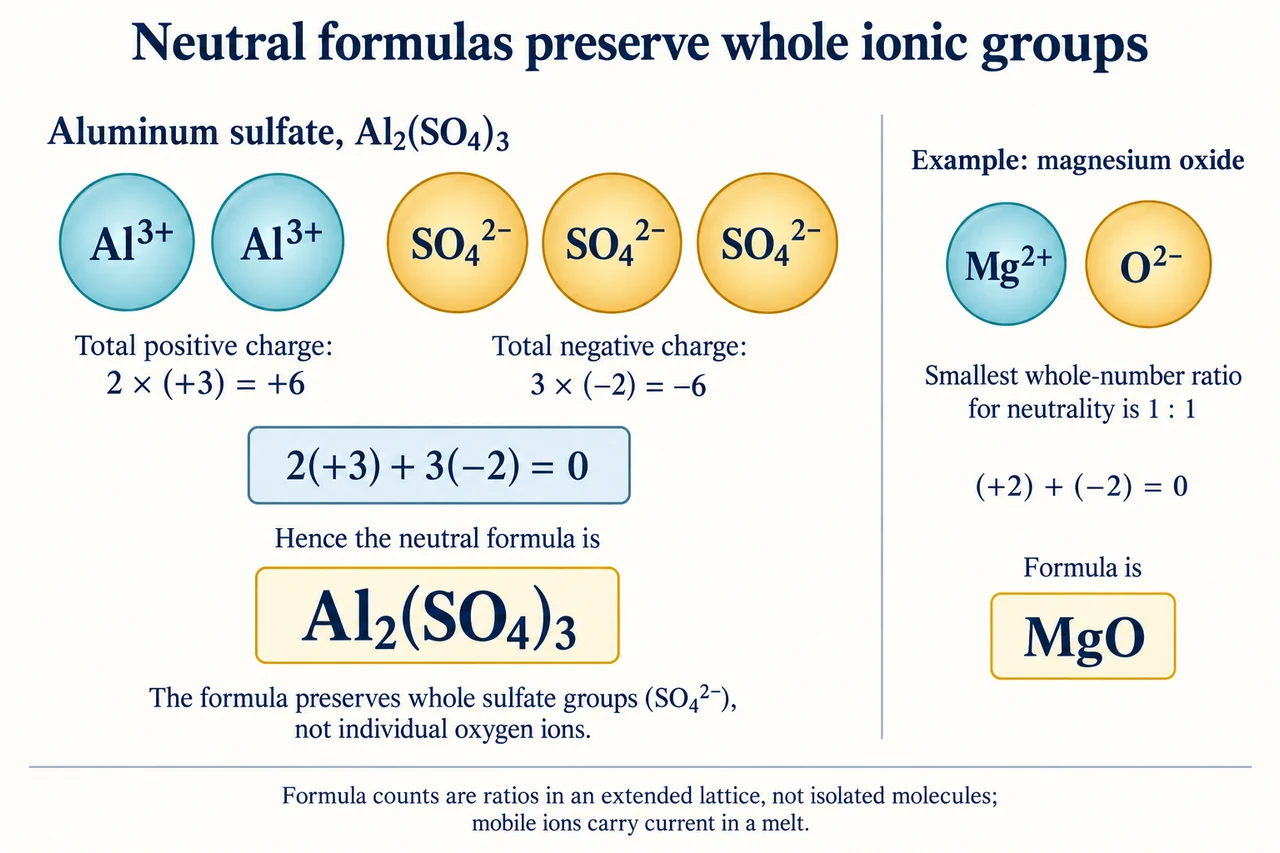
Construct a formula by finding the smallest whole-number combination with total charge zero. With Al³⁺ and SO₄²⁻, two aluminium ions supply +6 and three sulfates supply −6, giving Al₂(SO₄)₃. Check the total charge explicitly. Cross-multiplying charge magnitudes is a shortcut that needs reduction when both share a factor; Mg²⁺ and O²⁻ give MgO, not a claimed distinct Mg₂O₂ formula unit.
Strong attractions generally make an ionic lattice difficult to melt. In a solid its ions cannot migrate through the material, so it does not conduct by ionic motion; a molten sample can conduct because ions move. A dissolved sample conducts if mobile ions are actually present, but not every ionic solid is appreciably soluble. Use bonding, structure and mobility as separate explanatory steps. Solubility alone does not conclusively identify an unknown structure.
Formula ratios follow electroneutrality, not an assumed one-to-one ion pair. Aluminium sulfate requires 2Al3+ and 3SO4^2− because +6 and−6 cancel. Polyatomic ions remain groups in this accounting; brackets distinguish three sulfate groups from a change in their internal composition. The formula describes the repeat ratio throughout a lattice, not an isolated molecule. A separate drawing exercise specifies a finite 4×4 slice containing 8Na+ and 8Cl− with alternating neighbours. It is a planar cut through an extended three-dimensional structure, not a complete 16-ion crystal, a NaCl molecule or proof of sixfold coordination. Solid ions cannot migrate through the lattice under ordinary conductivity testing; a melt or aqueous solution can transport charge. The ionic attraction has not vanished when ions become mobile. In that exercise, circles are schematic species markers: the different radii are qualitative, and the spaces are not measured interionic separations.
An additional worked transfer uses the following chosen data. Write formulas from Fe3+/O2−, NH4+/SO4^2− and Mg2+/PO4^3−; specify a neutral finite-count ionic drawing. Fe2O3, (NH4)2SO4 and Mg3(PO4)2. A neutral magnesium phosphate fragment needs 3Mg2+ and 2PO4^3−, or integer multiples. Show whole phosphate groups and charges, not five identical unlabeled dots. Consider this transfer question: Does 8Na+ and 8Cl− demonstrate the full coordination of bulk NaCl? Reasoned answer: No. Neutrality is shown, but a 4×4 two-dimensional finite slice has edge sites and omits out-of-plane neighbours. State the three-dimensional extension explicitly. Consider this transfer question: An unknown solid does not conduct, but its melt does. Must it be NaCl? Reasoned answer: The evidence supports mobile ions in the melt and an ionic candidate, but does not identify NaCl uniquely. Composition and further controlled property tests are needed.
The illustration uses two Al³⁺ badges and three SO₄²⁻ badges to represent the neutral 2:3 formula ratio. Each sulfate badge stands for one whole charged group, not an unlabelled atom. These five badges are charge bookkeeping, not actual crystal positions or an isolated molecule. The small MgO comparison shows why equal charge magnitudes reduce to a 1:1 formula. Distinguish this ratio argument from the retained two-dimensional NaCl slice discussion, which is a separate drawing exercise. Image: illustration, not a documentary photograph. The introductory check also remains relevant: Why does molten sodium chloride conduct but its solid usually does not? Its ions become mobile on melting. Charge carriers exist in both states; their ability to migrate differs.
Worked example: Construct the formula of ammonium carbonate.
NH₄⁺ carries +1 and CO₃²⁻ carries −2.
Two ammonium groups balance one carbonate group.
Brackets keep each repeated ammonium group intact.
Answer: (NH₄)₂CO₃; total charge +2 − 2 = 0.
Check your understanding: An unknown solid does not conduct, but its melt does. Must it be NaCl?
Answer: The evidence supports mobile ions in the melt and an ionic candidate, but does not identify NaCl uniquely. Composition and further controlled property tests are needed.
Why: Credit a valid derivation and explicit model assumptions, coherent units or electron/charge counts, and a justified critique of the proposed inference. An unsupported numerical answer or recalled shape name alone does not demonstrate the reasoning. Additional unfamiliar assessed practice and any laboratory performance remain unverified.