Shared pairs and donated pairs describe covalent bonds
By UK A Level Chemistry · independent study · myAudience
myAudience original generated educational illustration · Original commissioned illustration
Shared pairs and donated pairs describe covalent bonds
A single covalent bond involves a shared electron pair attracted to both bonded nuclei. Sharing does not require each atom to exert the same attraction or each electron to remain halfway between nuclei. A line in a displayed formula represents one shared pair, two lines a double bond and three a triple bond. Electron-pair bookkeeping is useful, but the drawn lines are symbols rather than rods that physically hold atoms together.
Before drawing a simple electron structure, count all valence electrons, adding electrons for negative charge and subtracting them for positive charge. Identify bonding and lone pairs and check the final total. Two oxygen atoms contribute twelve valence electrons to O₂: four are represented in its double bond and eight as lone pairs. The elementary electron-pair drawing is useful for chemical bookkeeping but does not explain all quantum properties, such as oxygen's magnetism.
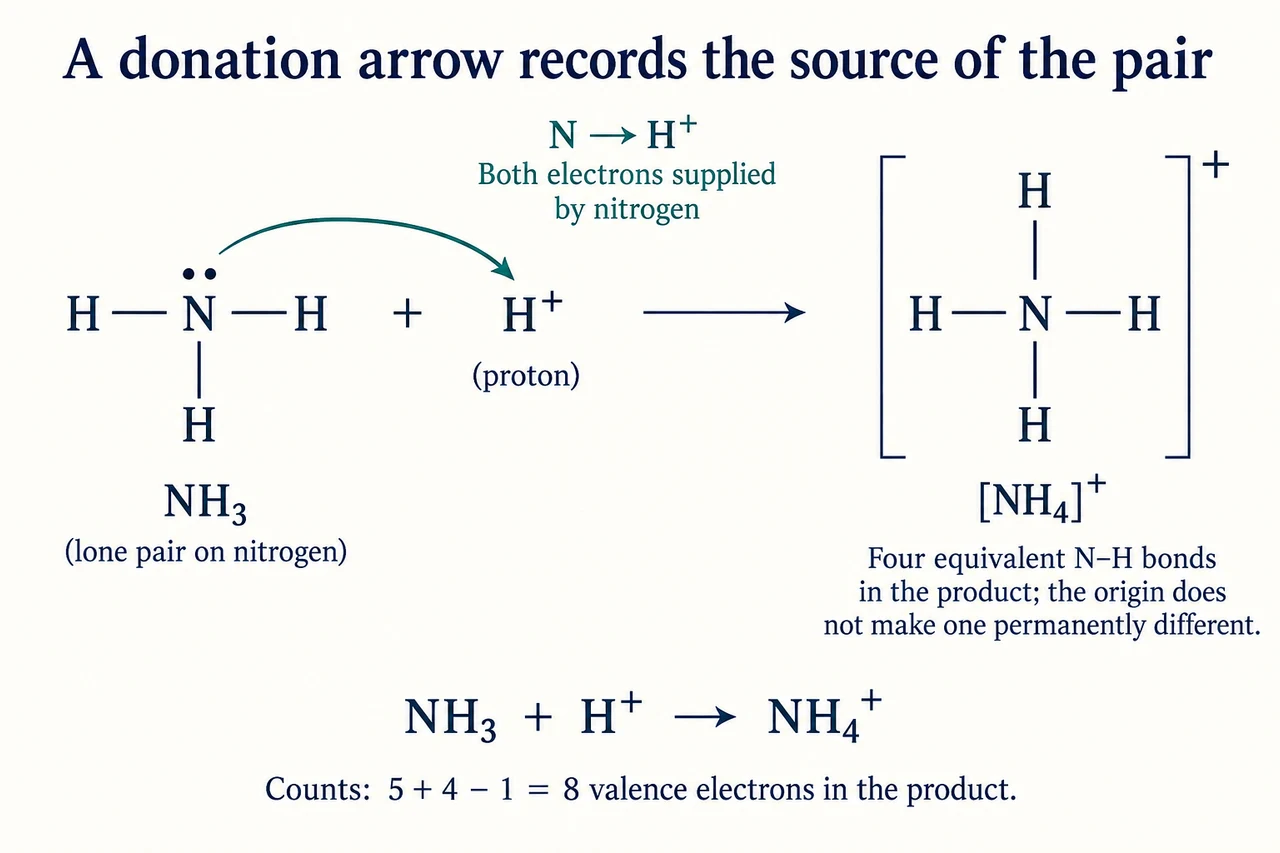
In a co-ordinate or dative covalent bond, both electrons in the shared pair originate from the same donor atom. A donor needs a lone pair and an acceptor needs an available electron-pair site. Draw the donation arrow from donor towards acceptor. In NH₃ + H⁺ → NH₄⁺, nitrogen supplies its lone pair to the proton. The proton is not bringing a spare electron; that is why the origin of the pair matters.
After ammonium forms, its four N–H bonds are equivalent in the simple structural description. Labelling one bond dative records its formation, not a permanent inferior class of bond or a uniquely longer bond. Retain the overall positive charge in a drawing. The eight valence electrons around nitrogen in NH₄⁺ follow from 5 + 4 − 1, so leaving out the positive charge would also spoil the electron count.
Distinguish bonding electrons from non-bonding lone pairs. Both influence shape, but only the bonding pairs appear as bond lines. A displayed formula therefore cannot always supply all the information needed for a shape explanation. Add appropriate lone pairs and charges when asked for an electron-pair representation. Later bonding models can describe delocalised electrons and species that an elementary local-pair drawing does not capture completely.
A shared electron pair attracts both nuclei; a dot-and-cross diagram tracks electron origin, not distinguishable physical kinds of electron. In dative formation, the donor provides both electrons of the pair. NH3+H+→NH4+ uses the nitrogen lone pair and an arrow N→H. The resulting tetrahedral ion does not contain a permanently special weak fourth bond identifiable from electron origin. For CO2, carbon supplies four valence electrons and each oxygen six:16 total. Two double bonds use8 electrons, and two lone pairs on each oxygen use the other8; carbon has no lone pair. VSEPR counts the two directions as two regions. Confusing four shared pairs with four regions predicts the wrong shape. Formal charge bookkeeping is a separate model from partial charge in a polar bond.
An additional worked transfer uses the following chosen data. Construct the donor/acceptor argument for NH3 reacting with BF3 without calling either species an ion. N has a lone pair; electron-deficient B has an available acceptor orbital. The coordinate-bond arrow is N→B. Both reagents can be neutral; dative formation is not defined by opposite ionic charges. Consider this transfer question: Why does an arrow H→N misrepresent formation of NH4+ from NH3 and H+? Reasoned answer: H+ has no electron pair to donate; N provides both electrons. Reverse the arrow and account for the overall+1 charge. Consider this transfer question: Explain why two CO2 double bonds do not imply tetrahedral geometry. Reasoned answer: Each double bond is one directional electron-density region. There are two regions around C with no C lone pair, so their arrangement is linear.
The illustration distinguishes the nitrogen lone pair before formation from four equivalent N–H bonds in the ammonium product. Count exactly three H atoms bonded to the reagent nitrogen and four in the product, while including overall positive charge. The donation annotation points from nitrogen towards the accepting proton. Its lines and electron dots are bookkeeping symbols, not literal rods or individually distinguishable kinds of electron. Image: illustration, not a documentary photograph. The introductory check also remains relevant: Is the donation arrow H → N correct in this reaction? No. H⁺ has no electron pair to donate; the pair originates on nitrogen.
Worked example: Explain the arrow used when ammonia bonds to H⁺.
Nitrogen in NH₃ has a lone pair.
H⁺ accepts that pair.
Draw N → H for the newly donated pair and show the product charge +.
Answer: The arrow points from nitrogen to hydrogen; the product is NH₄⁺.
Check your understanding: Explain why two CO2 double bonds do not imply tetrahedral geometry.
Answer: Each double bond is one directional electron-density region. There are two regions around C with no C lone pair, so their arrangement is linear.
Why: Credit a valid derivation and explicit model assumptions, coherent units or electron/charge counts, and a justified critique of the proposed inference. An unsupported numerical answer or recalled shape name alone does not demonstrate the reasoning. Additional unfamiliar assessed practice and any laboratory performance remain unverified.