Repulsion models predict molecular geometry
By UK A Level Chemistry · independent study · myAudience
myAudience original generated educational illustration · Original commissioned illustration
Repulsion models predict molecular geometry
Valence-shell electron-pair repulsion treats electron regions around a central atom as charge clouds that arrange to reduce repulsion. Begin with an electron structure including charge and lone pairs, then count regions. A multiple bond is one directional region for geometry although it contains more than one shared pair. The arrangement of all electron regions and the shape named from atom positions are different descriptions when lone pairs are present.
With two bonding regions and no lone pairs the arrangement is linear, with 180° between bonds; three give trigonal planar, 120°; four give tetrahedral, about 109.5°. Methane has four bonding regions, while ammonia has three bonding pairs and one lone pair: its atoms form a trigonal pyramid, about 107°. Water has two bonding pairs and two lone pairs, so its atoms form a bent shape, about 104.5°.
Lone-pair repulsion is stronger than bond-pair repulsion in the simple hierarchy: lone–lone exceeds lone–bond, which exceeds bond–bond. Lone pairs occupy space around the central atom and compress bond angles in familiar related examples. They do not count as extra invisible atoms in the molecular-shape name. The familiar ammonia and water angles are approximate values for those species, not a formula that assigns every four-region molecule the same compressed angle.
Five regions give a trigonal-bipyramidal arrangement with ideal angles of 90°, 120° and 180°. Equatorial lone pairs avoid more 90° interactions than axial ones: SF₄ is a seesaw shape, ClF₃ T-shaped and XeF₂ linear in this model. Six regions give an octahedral arrangement, with 90° and 180°; SF₆ is octahedral, BrF₅ square pyramidal and XeF₄ square planar. The names concern bonded atom positions and require correct lone-pair placement.
The same approach applies to ions. NH₄⁺ has four bonding regions and no lone pair on nitrogen, hence tetrahedral geometry. Use the species charge when counting electrons rather than assuming the neutral atom total. The method supports unfamiliar examples, but it is an explanatory model rather than a precise computational prediction of every bond angle. Describe regions, arrangement, lone-pair effect and final atomic geometry in that order.
For singly bonded central atoms surrounded by monovalent halogens, a useful bookkeeping shortcut is domains=(central valence electrons+bonded monovalent atoms−positive charge+negative charge)/2. Then subtract bonding domains to find lone pairs. This assumes a closed-shell Lewis count with single terminal bonds; it is not a universal formula for radicals, multiple bonds or electron-deficient species. Verify by total valence electrons and terminal octets. For SF4, total electrons6+4×7=34: four S–F bonds use8 and four terminal F octets need 24 nonbonding electrons, leaving 2 on S, hence one lone pair and 5 domains. ClF3 totals 28, uses 6 in bonds and 18 on terminal F, leaving 4 on Cl: two lone pairs and 5 domains. XeF2 totals 22, uses 4+12, leaving 6: three lone pairs and 5 domains. Put lone pairs equatorial in the ideal trigonal-bipyramidal arrangement to reduce 90° interactions. The atom shapes are seesaw, T-shaped and linear. For SF6, total 48 uses 12+36 leaving 0:6 bonds and 0 lone pairs. BrF5 totals 42 uses 10+30 leaving 2:5 bonds and 1lone pair. XeF4 totals 36 uses 8+24 leaving 4:4 bonds and 2 lone pairs. Six domains give octahedral arrangements; one absent atom gives square pyramidal, and opposite lone pairs give square planar. Exact distorted angles need experimental or computational evidence; ideal 90°/180° is not a claim that every real bond angle equals its ideal value.
Unfamiliar ions test charge bookkeeping rather than name recall. IF4− has 8 effective central electrons and 4 bonds:6 domains with 2 lone pairs, square planar. PCl4+ has 4 effective central electrons and 4 bonds:4 domains with 0 lone pairs, tetrahedral. IF2− has 8 effective central electrons and 2 bonds:5 domains with 3 lone pairs, linear. The negative charge adds an electron to the total species count; it does not add a bonded atom. An additional worked transfer uses the following chosen data. Derive BrF4− and ClF2+ shapes by total-electron counting and identify an invalid shortcut use for CO2. BrF4− totals 7+28+1=36; bonds8 and terminal lone electrons24 leave4 on Br, two lone pairs and 6 domains, square planar. ClF2+ totals 7+14−1=20; bonds4 and terminal12 leave4 on Cl, two lone pairs and 4 domains, bent (tetrahedral electron arrangement). CO2 has multiple bonds and divalent terminal O; use a Lewis structure, not the monovalent single-bond shortcut. Consider this transfer question: Compare90° lone-pair/bond interactions for an axial versus equatorial lone pair in five domains. Reasoned answer: Axial interacts at 90° with three equatorial bond domains; equatorial interacts at 90° with two axial domains. The equatorial position reduces stronger lone-pair interactions in this simplified model. Consider this transfer question: Why is XeF4 square planar but SF4 seesaw despite four terminal atoms? Reasoned answer: XeF4 has 6 domains with two opposite lone pairs; SF4 has 5 with one equatorial lone pair. Bonded-atom count alone cannot determine geometry.
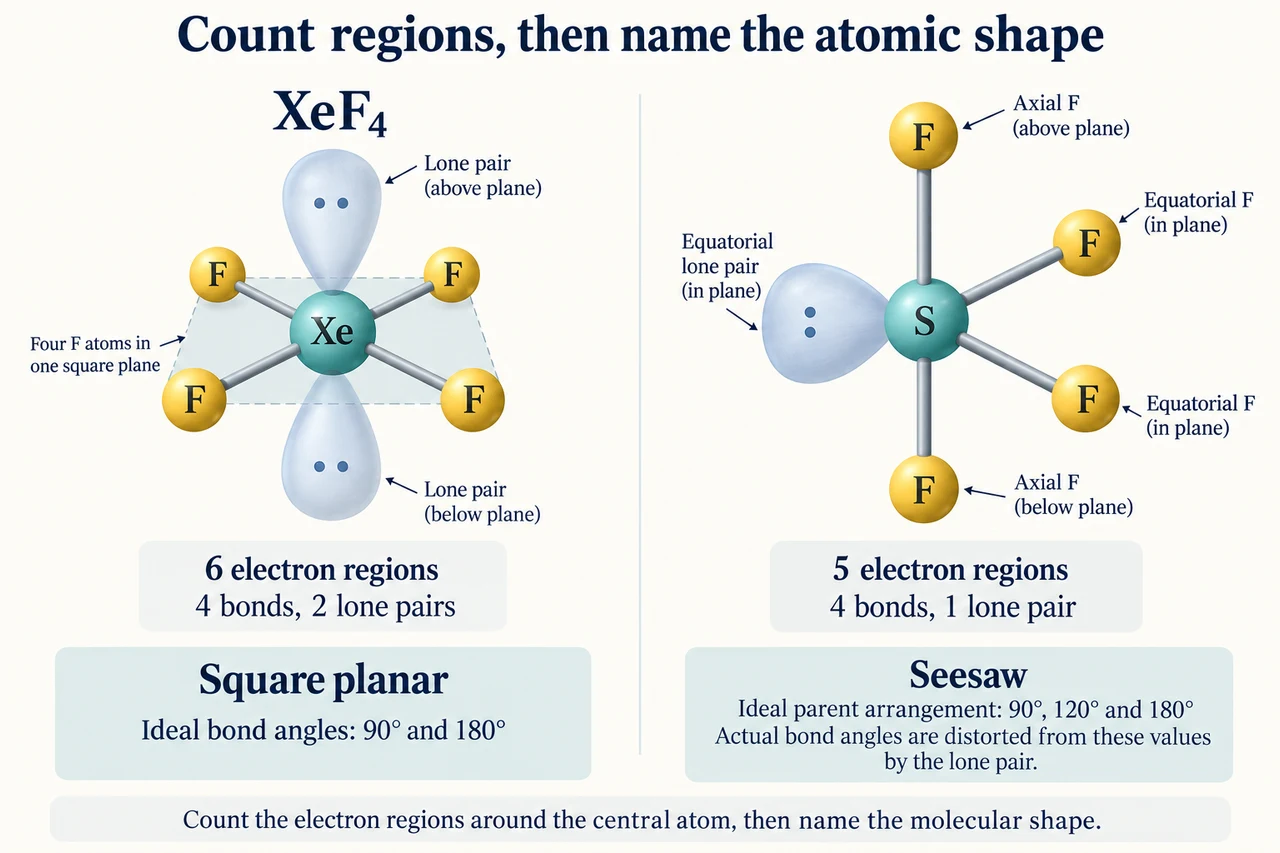
The illustration compares four bonded atoms in two different electron arrangements. XeF₄ has six regions with two opposite lone pairs and square-planar bonded-atom positions; SF₄ has five regions with one equatorial lone pair and a seesaw atomic shape. The broad lone-pair clouds are not extra atoms. Perspective is schematic and the labelled parent angles describe ideal arrangements, not measured distorted angles for every bond. Image: illustration, not a documentary photograph. The introductory check also remains relevant: Why is CO₂ linear despite having two double bonds? It has two directional bonding regions around carbon and no lone pair on carbon. Each double bond counts as one region for the spatial arrangement, giving 180°.
Worked example: Deduce XeF₄ shape from four Xe–F bonding regions and two lone pairs around Xe.
Six electron regions imply an octahedral arrangement.
Put the two lone pairs opposite one another to reduce their interaction.
The four F atoms lie at the corners of a square around Xe.
Answer: Square planar, ideal F–Xe–F angles 90° and 180°.
Check your understanding: Why is XeF4 square planar but SF4 seesaw despite four terminal atoms?
Answer: XeF4 has6domains with two opposite lone pairs; SF4 has5with one equatorial lone pair. Bonded-atom count alone cannot determine geometry.
Why: Credit a valid derivation and explicit model assumptions, coherent units or electron/charge counts, and a justified critique of the proposed inference. An unsupported numerical answer or recalled shape name alone does not demonstrate the reasoning. Additional unfamiliar assessed practice and any laboratory performance remain unverified.