Metallic bonding connects mobile electrons to properties
By UK A Level Chemistry · independent study · myAudience
myAudience original generated educational illustration · Original commissioned illustration
Metallic bonding connects mobile electrons to properties
Metallic bonding is attraction between positive metal ions and delocalised electrons within an extended lattice. Delocalised means the electrons are not assigned to one atom or one local bond. The material remains electrically neutral overall: positive and negative charge balance. The metal is therefore not simply a pile of positive ions, and the electrons are not a separate coating on its surface.
For magnesium, the simple model associates the two outer electrons of each atom with the delocalised electron population and represents positive ionic cores arranged in the lattice. This connects atomic configuration to bulk bonding without claiming that individual free Mg²⁺ ions float through a solid. It is a deliberately simplified description of a many-particle electronic system, useful for explaining physical properties at this stage.
A potential difference causes the delocalised electrons to carry charge through a solid metal. Metallic conduction therefore differs from ionic conduction: electrons can move while the ionic cores remain at their average lattice positions. Metals can conduct when molten as well. A thermal explanation involves energy transfer by mobile electrons and lattice vibrations; electrical and thermal conductivity should not be treated as identical measurements.
Many metals are malleable because layers can change relative positions while attraction to the delocalised electrons continues. A displacement does not bring a whole layer of like ions into an unopposed situation as it can in a simple ionic-crystal fracture model. Do not explain malleability by saying the metallic bonds disappear. It is the capacity to reorganise while retaining collective attraction that matters.
Melting requires energy to disrupt the organised solid structure, but metals differ greatly in melting point. Charge density, structure and electronic details matter, so 'all metals have high melting points' is too broad. When interpreting an unknown, combine several properties and keep anomalies visible. A diagram of magnesium should label positive cores and a delocalised population, preserve overall neutrality and state that drawn sizes and spacings are schematic.
Electron mobility and electrostatic cohesion must be explained together. Magnesium contributes valence electrons to a delocalised electronic structure around positive ion cores; attraction persists while electrons carry current. Metallic conductivity is not repeated Na⁺-style ion migration, and a melting metal can retain mobile electronic carriers.
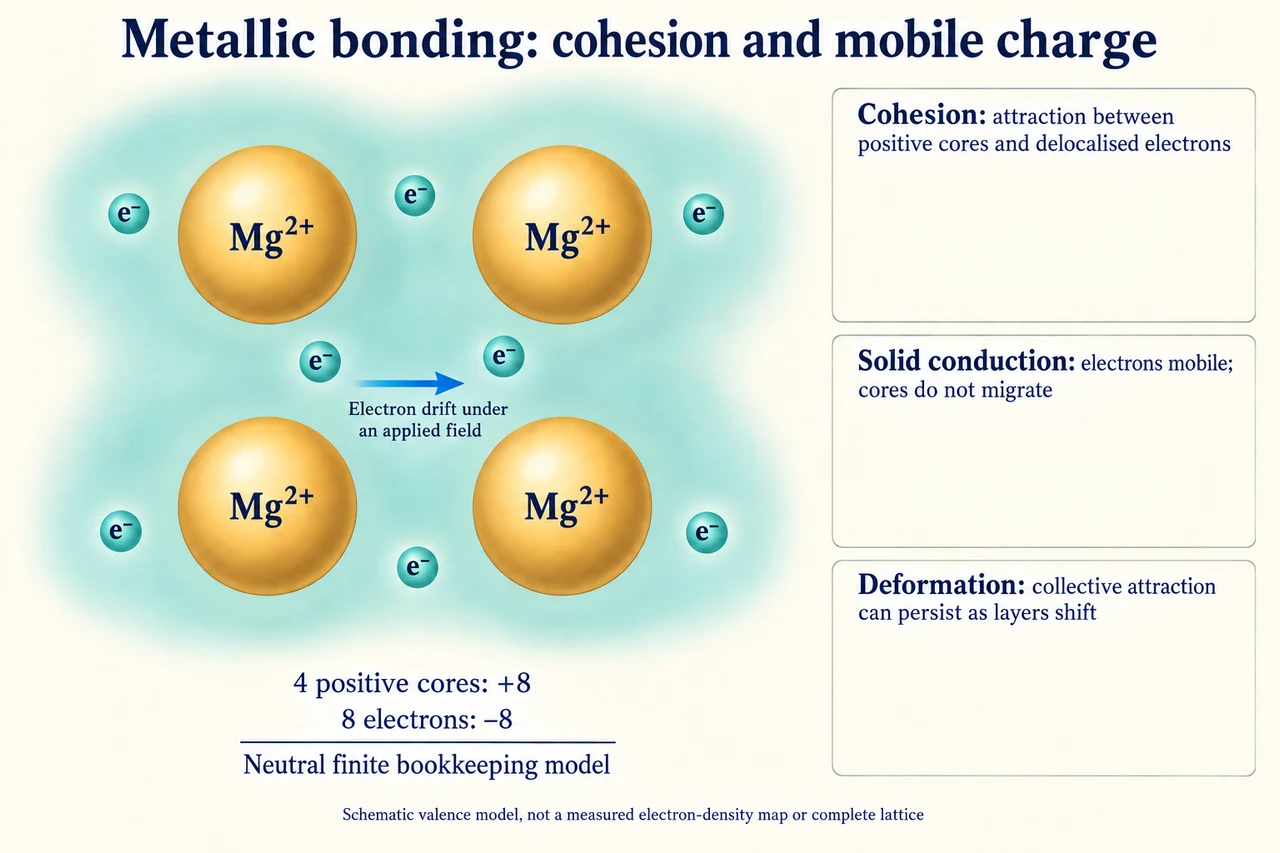
A finite bookkeeping sketch with 4 Mg²⁺ cores and 8 electron symbols is neutral. It is only an electron-count model; it cannot localise each mobile electron beside its original atom. If arrows illustrate electron motion, distinguish them from force arrows. Under deformation, metallic attraction can remain as ion-core layers move, whereas juxtaposing like charges in an ionic lattice helps explain brittleness.
A model explains only the observations it actually represents. The positive core in the magnesium picture includes the nucleus and inner electrons, rather than being a bare +12 nucleus. Counting two valence electrons per core is a useful charge-accounting description; it does not prove that every electron contributes identically to electrical current or that electrons follow the drawn path. In a fuller quantum description, electronic states extend across a solid and their occupation and interactions help determine transport. Such a band model goes beyond the local shared-pair convention used for a covalent bond. The sea metaphor is therefore a bridge to an explanation, not literal electron fluid between isolated molecules. Metallic attraction also includes a many-particle balance of attractive and repulsive interactions, so stronger bonding cannot be read directly from the number of dots in a cartoon. Read the illustration as one finite window into an extended metal: four Mg²⁺ cores and eight e⁻ symbols give +8 and −8, respectively. The shared tinted region continues beyond the window; no dot is permanently owned by its nearest core. The arrow illustrates an electron drift under a field, not the electrostatic force on a positive ion or a measured trajectory. Motion and cohesion are different parts of the same explanation: mobile electronic charge can flow while the lattice remains a solid. The side cards connect those features to conduction and deformation, but do not measure a resistance or simulate a real deformation. Compare this four-core drawing with the eight-core worked example rather than silently confusing the two counts.
Worked example: In the simplified magnesium model, how many delocalised electrons are associated with eight Mg²⁺ cores? Additional worked reasoning: Compare what transports charge in solid Mg, solid NaCl and molten NaCl.
Eight cores carry total relative charge +16.
Sixteen electrons provide charge −16.
The model region is neutral overall.
Mobile delocalised electrons in Mg; no ordinary mobile lattice-ion carrier in solid NaCl; mobile cations and anions in molten NaCl. The carrier and its permitted motion explain the difference, rather than the word bonding alone.
Answer: 16 delocalised electrons in this simplified neutral region. Mobile delocalised electrons in Mg; no ordinary mobile lattice-ion carrier in solid NaCl; mobile cations and anions in molten NaCl. The carrier and its permitted motion explain the difference, rather than the word bonding alone.
Check your understanding: Are moving metal ions the principal charge carriers in a solid copper wire? Transfer 1: A sketch has 6 Mg²⁺ cores and 6 electrons. Is it neutral? Transfer 2: Would replacing eight electron dots with eight fixed Mg⁻ ions improve a metallic diagram?
Answer: No; delocalised electrons carry charge. Transfer 1: No. Cores total +12 and electrons −6, leaving +6. A neutral valence bookkeeping sketch requires 12electrons; this is not a measured free-electron count. Transfer 2: No. It replaces delocalised electrons with invented discrete anions and misrepresents metallic cohesion and carrier mobility.
Why: The ionic cores do not migrate through the solid as ions do in a molten salt. Explain the carrier, geometry or donor/acceptor mechanism, then state where the simplified model stops. A named example alone is not an explanation.