Structures explain why melting and conduction differ
By UK A Level Chemistry · independent study · myAudience
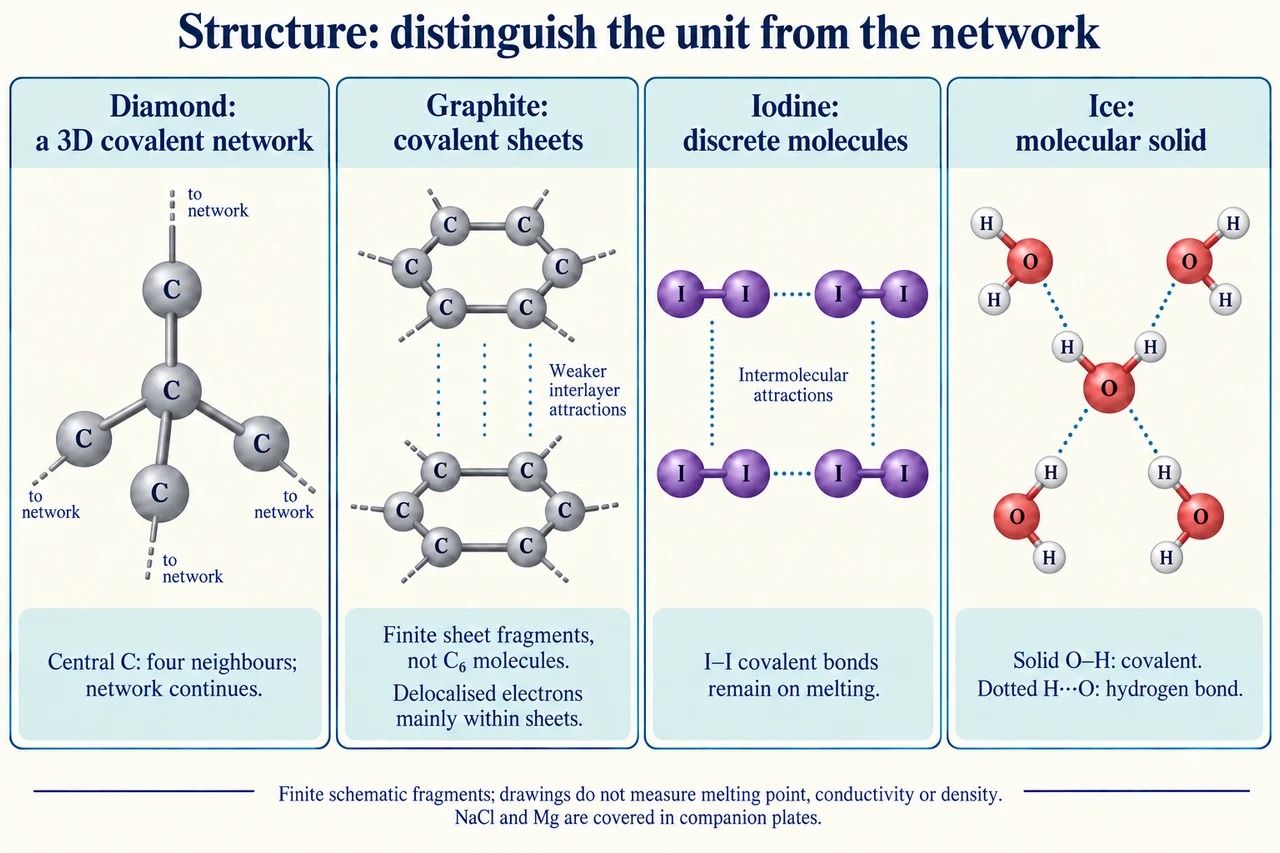
myAudience original generated educational illustration · Original commissioned illustration
Structures explain why melting and conduction differ
The specification compares ionic, metallic, giant covalent and molecular crystals. The crucial question is what repeats through the structure and what holds those units together. NaCl repeats ions, magnesium positive cores in a delocalised electron system, diamond an extended covalent network and iodine discrete I₂ molecules. A formula does not by itself identify the size of the bonded unit. Ask whether the material contains separate molecules or a continuing network.
Diamond has carbon atoms covalently bonded to four others in a three-dimensional tetrahedral network. Melting or disrupting that network involves strong covalent bonding, giving a very high thermal resistance. Its electrons are largely localised in bonding rather than available as mobile charge carriers, so ordinary diamond is an electrical insulator. Four connections in a drawing represent local connectivity, not four carbon molecules attached to a centre.
Graphite has carbon atoms bonded to three neighbours in extended sheets, with delocalised electronic states supporting conduction, especially along the layers. Attractions between sheets are much weaker than the bonding within them, allowing sliding. Graphite's high-temperature behaviour follows strong bonds within sheets, while softness concerns weaker interactions between sheets. Those properties are compatible; calling all of graphite's bonding weak loses the distinction of direction and scale.
Iodine contains I₂ molecules with strong covalent bonds inside each molecule and dispersion attractions between molecules. Melting rearranges the molecular solid by overcoming some intermolecular constraints, not normally breaking every I–I bond. Ice is likewise a molecular crystal, but its water molecules form a hydrogen-bonded arrangement. These two molecular solids show that the same broad structural category can contain different intermolecular interactions and markedly different physical behaviour.
During melting at a phase-change temperature, supplied energy changes the arrangement and potential energy of particles rather than simply increasing temperature. Freezing reverses the transfer. To classify unknown samples, a supervised comparison may test conductivity in specified states, melting behaviour and solubility, but one result rarely proves structure. A requested finite-particle drawing should show the stated number, a clear legend and continuation where a lattice is represented; this cohort leaves independent drawing practice outstanding.
A finite-count drawing must identify its counting unit and show continuation at cropped boundaries. The six assessed structures need different units: carbon atoms for diamond/graphite, H₂O molecules for ice, I2 molecules for iodine, ion cores and electron accounting for magnesium, separate Na+ and Cl− ions for sodium chloride. Drawing a finite cluster does not turn a giant lattice into a molecular solid.
Use this specified drawing challenge: diamond5 C atoms (one central with 4tetrahedral neighbours and outward continuation marks); graphite12 C atoms as two separated six-membered ring fragments with in-plane bonds and outward continuation marks; ice5 H₂O molecules (one central hydrogen-bonded to4 neighbours with 2 donor and 2 acceptor directions); iodine4 I₂ molecules, total 8 I atoms; magnesium4 Mg²⁺ cores with 8 electron symbols; NaCl 16 ions, 8 of each, as in the earlier ionic plate. These are drawing briefs and answer criteria. The present four-panel illustration supports selected fragments; the companion magnesium and sodium chloride plates support two further models. Neither illustrations nor an answer key establish independent drawing skill. Graphite rings are finite layer fragments, not separate C₆ molecules.
For energy reasoning, identify what separation disrupts. Iodine melting rearranges intermolecular interactions while covalent I–I bonds remain; diamond has an extended covalent network, so its thermal behaviour cannot be explained by weak forces between diamond molecules. Graphite conducts through delocalised electrons mainly within layers, despite strong in-plane covalent bonding. Its interlayer interactions allow relative layer motion; they do not imply every graphite property is caused by weak bonding. Read the four panels by their units and line conventions. Diamond shows a central carbon with four tetrahedral neighbours and continuation stubs: the five visible atoms are a network fragment, not a C₅ molecule. Graphite shows two six-carbon ring fragments from distinct sheets, with outward continuation and weaker attractions between sheets; the rings are not isolated C₆ molecules. Iodine shows four intact I₂ molecules, eight iodine atoms, and intermolecular links between them. The five-water local ice motif uses solid O–H bonds inside each molecule and dotted H···O links between molecules. Two links donated and two accepted by the central molecule illustrate local coordination, not every molecule in an infinite ice crystal. The companion ionic and metallic plates use different counting units. At ordinary pressure, diamond and graphite do not simply undergo a familiar classroom melting transition: their high-temperature behaviour can involve sublimation and transformation. The point is strong network cohesion, not a universally applicable melting number. A limited drawing is evidence for its own topology and stated count, not proof of a bulk property.
Worked example: A solid conducts, its layers slide, and its strongly bonded sheets resist thermal disruption. Which specified crystal best fits, and why? Additional worked reasoning: An unfamiliar solid is high melting and conducts when solid. Evaluate whether this proves a metal; give a relevant counterexample.
Mobile electronic states support conduction.
Weak interlayer attractions allow sliding.
Strong in-sheet covalent bonding accounts for thermal resistance.
No. Graphite is giant covalent and has mobile delocalised electrons. High melting suggests substantial cohesive interactions but is not a unique classifier. Test other evidence and state that conductivity alone does not identify the structure.
Answer: Graphite fits this combination; these observations alone do not establish purity. No. Graphite is giant covalent and has mobile delocalised electrons. High melting suggests substantial cohesive interactions but is not a unique classifier. Test other evidence and state that conductivity alone does not identify the structure.
Check your understanding: Does melting iodine normally require breaking the I–I bonds within molecules? Transfer 1: Why must a five-molecule ice fragment show both covalent and hydrogen-bond conventions? Transfer 2: Do the companion illustrations close the six-structure drawing requirement?
Answer: No. Transfer 1: Solid O–H bonds inside each molecule differ from dotted intermolecular H···O links. Label the convention; do not connect every atom with identical lines or depict melting as cleavage of all O–H bonds. Transfer 2: No. They support selected finite fragments and conventions, but independent specified-count drawings, complete three-dimensional arrangements and learner drawing review remain outstanding.
Why: The phase change primarily disrupts intermolecular organisation while I₂ molecules remain. Explain the carrier, geometry or donor/acceptor mechanism, then state where the simplified model stops. A named example alone is not an explanation.