Bond polarity and molecular polarity answer different questions
By UK A Level Chemistry · independent study · myAudience
myAudience original generated educational illustration · Original commissioned illustration
Bond polarity and molecular polarity answer different questions
Electronegativity describes an atom's ability within a covalent bond to attract the shared electron pair. If the two atoms differ, the electron distribution is uneven. Label the electron-rich end δ− and the electron-poor end δ+. These are partial charges: the bond remains covalent rather than being represented as two complete isolated ions. Electronegativity is not the same quantity as first ionisation energy, even though both relate to electronic behaviour.
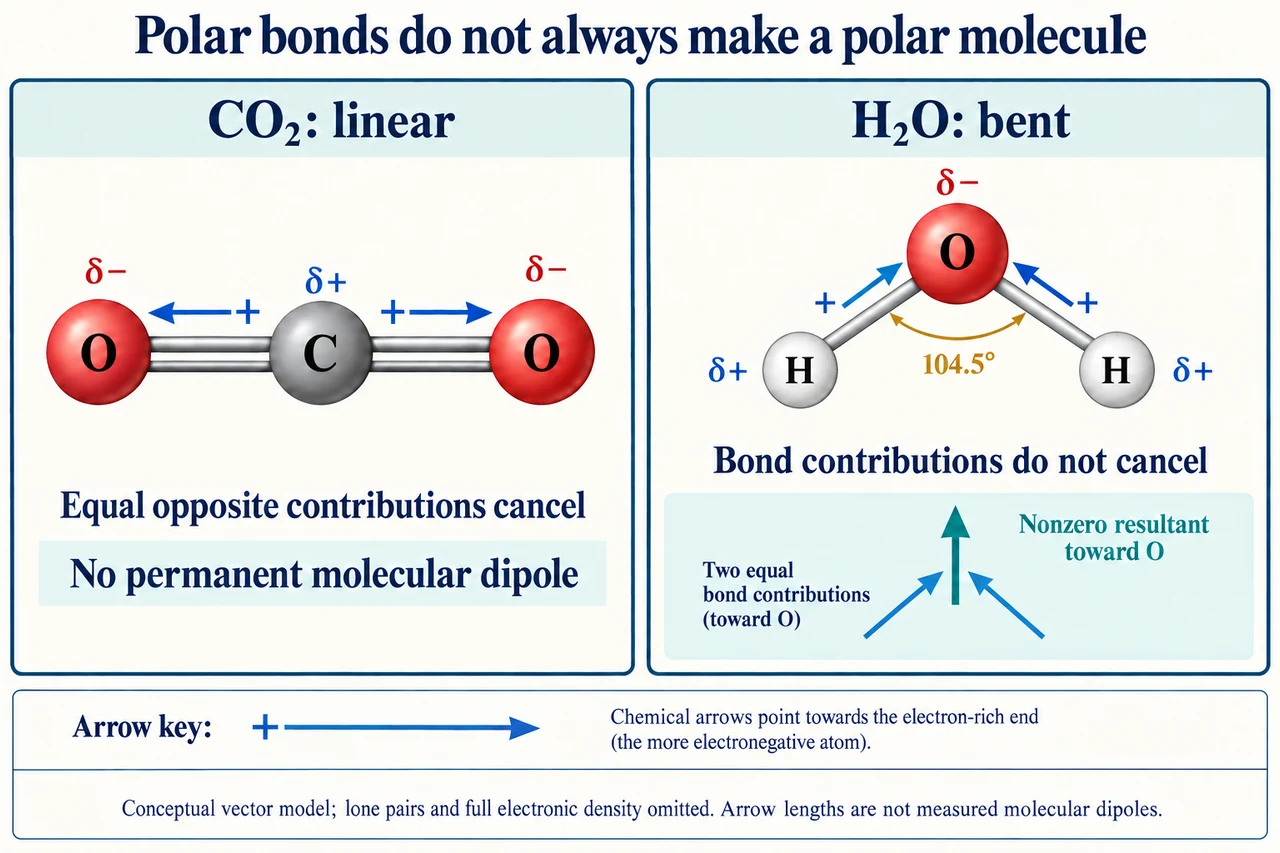
A bond dipole has direction and magnitude. In the chemical arrow convention used in this cohort, the direction points towards the more electronegative atom; some drawn dipole arrows also mark the positive end with a cross. The selected plate uses blue chemical-convention arrows, positive-tail crosses and explicit partial-charge labels, so its convention is stated here. Never infer a charge sign from colour alone. In a C–O bond oxygen is the electron-rich end.
A molecule's permanent dipole depends on the vector combination of its bond dipoles and overall electron distribution. Two polar bonds can cancel if their directions and magnitudes oppose suitably. CO₂ is linear and its equivalent C=O bond dipoles point in opposite directions, giving no permanent molecular dipole. Its non-polar molecular classification therefore does not mean that either C=O bond has equal sharing.
Water's bent geometry means its two O–H dipoles do not oppose in a straight line, so they combine to give a permanent dipole. In ideal tetrahedral CCl₄, four equivalent C–Cl contributions cancel by symmetry, whereas replacing one chlorine with hydrogen removes that complete symmetry. Use both geometry and bond identity. The rule 'different elements means polar molecule' fails because it ignores the three-dimensional arrangement.
A robust explanation identifies polar bonds, states their directions, establishes shape and judges cancellation. A two-dimensional page can conceal three-dimensional geometry, so do not decide solely from where labels happen to sit in a flat formula. The plate is a conceptual comparison of CO₂ and H₂O, omitting electron-density maps and water's lone pairs. It supports the cancellation argument but is not a measured picture or evidence that a molecule's electrons are static arrows.
Geometry must precede dipole addition. The chemical arrow points toward the electron-rich end and can carry a cross at its positive tail; this differs from the physics dipole-vector convention. The selected CO₂/H₂O plate uses chemical arrows with explicit partial charges and positive-tail crosses. The older draft artwork is retained as source history, not served by this lesson. The equal-vector expression 2d cos(θ/2) is a model of contributions, not a measurement of water dipole moment.
For ideal tetrahedral geometry, choose four unit directions (1,1,1), (1,−1,−1), (−1,1,−1), (−1,−1,1), each divided by √3. Their sum is zero. Thus four equivalent outward bond contributions in CCl₄ cancel. Replacing one bond with a different contribution destroys that equal-vector cancellation; CHCl₃ needs an actual bond-direction and electron-distribution argument, not an unqualified rule that every asymmetric molecule must be polar.
XeF₄ provides demanding transfer: its four equivalent Xe–F bonds lie in a square plane, and opposite contributions cancel; opposite lone-pair placement is also symmetric in the ideal model. SF₄ is a seesaw arrangement without that complete cancellation and has a permanent dipole. BF₃ is trigonal planar with equal contributions at 120°, cancelling, whereas NH₃ is trigonal pyramidal and retains a dipole. A lone pair is not an invisible terminal atom or a licence to add an arbitrary measured vector. In the selected plate, each chemical arrow follows a bond towards its electron-rich end: C→O in CO₂ and H→O in water. The positive-tail cross belongs to that convention, not to a separate extra atom or full ionic charge. CO₂ has equal opposite contributions; water has a bent arrangement and a nonzero bisector resultant. The inset is an ideal vector calculation, not a force diagram or a measured electron-density map. A local bond-pair picture and VSEPR are useful representations but not a full molecular-orbital calculation: the actual molecular dipole depends on the whole electronic and nuclear charge distribution, including lone-pair contributions. Therefore 2d cos(θ/2) illustrates cancellation under stipulated equal-vector assumptions, rather than deriving an exact experimental water dipole. Complete symmetry is a strong cancellation argument; asymmetry by itself is not a numerical measurement.
Worked example: Two equal idealised bond-dipole vectors have magnitude d. Compare their resultant for included angles 180° and 104.5°. Additional worked reasoning: Three equal planar contributions have directions 0°,120°,240°. Sum components; then replace the0° contribution d by 1.5d without changing geometry.
For equal vectors, resultant magnitude is 2d cos(θ/2).
At 180°, cos 90° = 0.
At 104.5°, 2 cos 52.25° ≈ 1.224.
x = d(1 − 1/2 − 1/2) = 0; y = d(0 + √3/2 − √3/2) = 0. Replacement leaves x = 0.5d, y = 0. This synthetic vector model shows why bond equivalence matters as well as symmetric geometry; it does not assign actual BF₃ bond moments.
Answer: Zero at 180°; about 1.224d at 104.5°. This is a vector model, not a measured dipole value for water. x = d(1 − 1/2 − 1/2) = 0; y = d(0 + √3/2 − √3/2) = 0. Replacement leaves x = 0.5d, y = 0. This synthetic vector model shows why bond equivalence matters as well as symmetric geometry; it does not assign actual BF₃ bond moments.
Check your understanding: Can a molecule have polar bonds but no permanent dipole? Transfer 1: Explain why square-planar XeF₄ can have polar bonds but zero permanent molecular dipole. Transfer 2: Would drawing H₂O as H–O–H in a flat line make it nonpolar?
Answer: Yes; linear CO₂ and symmetric tetrahedral CCl₄ are examples. Transfer 1: Identify Xe–F polarity, then opposite equal in-plane contributions and the symmetric electron arrangement. The vector cancellation concerns the whole molecule; no individual bond becomes nonpolar. Transfer 2: No. A connectivity formula is not a geometry measurement. Water is bent; equal chemical bond arrows toward O have a nonzero bisector resultant. The page arrangement cannot redefine the molecule.
Why: Their equivalent bond contributions cancel as vectors. Explain the carrier, geometry or donor/acceptor mechanism, then state where the simplified model stops. A named example alone is not an explanation.