Intermolecular forces explain molecular bulk behaviour
By UK A Level Chemistry · independent study · myAudience
myAudience original generated educational illustration · Original commissioned illustration
Intermolecular forces explain molecular bulk behaviour
Intermolecular forces act between molecules, while covalent bonds hold atoms together within a molecule. Separating water molecules during boiling primarily overcomes intermolecular attractions rather than decomposing each molecule into hydrogen and oxygen. This scale distinction explains why molecular substances can boil at moderate temperatures despite strong internal bonds. The phrase 'weak bonds break' is too ambiguous to explain a phase change; name which particles separate and which attraction is overcome.
Dispersion forces arise because fluctuating electron distributions produce instantaneous dipoles that induce dipoles in neighbours. They occur in all atoms and molecules, including non-polar ones. Larger, more easily distorted electron clouds often give stronger dispersion, while molecular shape changes the area of effective contact. I₂ therefore has significant attractions between molecules despite having no permanent bond dipole. A non-polar classification never means that particles exert no attraction on one another.
Molecules with permanent dipoles also experience orientation-dependent dipole–dipole interactions, alongside dispersion. A comparison cannot simply rank every polar molecule above every non-polar molecule in boiling point: size, shape and polarisability may outweigh the extra interaction. Analyse comparable compounds and relevant evidence. Melting points depend strongly on crystal packing too, so a neat boiling-point trend is not automatically a universal melting-point rule.
At this level, hydrogen bonding is identified when hydrogen bonded to N, O or F interacts with an appropriate lone pair, commonly on N, O or F in another molecule. The donor requires that suitably bonded hydrogen; an acceptor needs an available lone pair. A molecule with an oxygen atom but no O–H or N–H group can accept hydrogen bonds from water without hydrogen-bonding to identical molecules in the same way. This useful course rule does not exhaust the broader scientific definitions of hydrogen bonding.
Water's hydrogen-bonded ice structure is relatively open, accounting for ice being less dense than liquid water near melting. The liquid retains hydrogen bonding but has a more disordered, on-average more compact arrangement. Water's unusually high boiling point relative to neighbouring hydrides reflects hydrogen bonding in addition to dispersion. A deflected liquid jet can indicate interaction with an electric field, but it is not a direct ranking of all intermolecular forces. It is a suggested skills investigation, requiring controlled conditions rather than an endorsement claim.
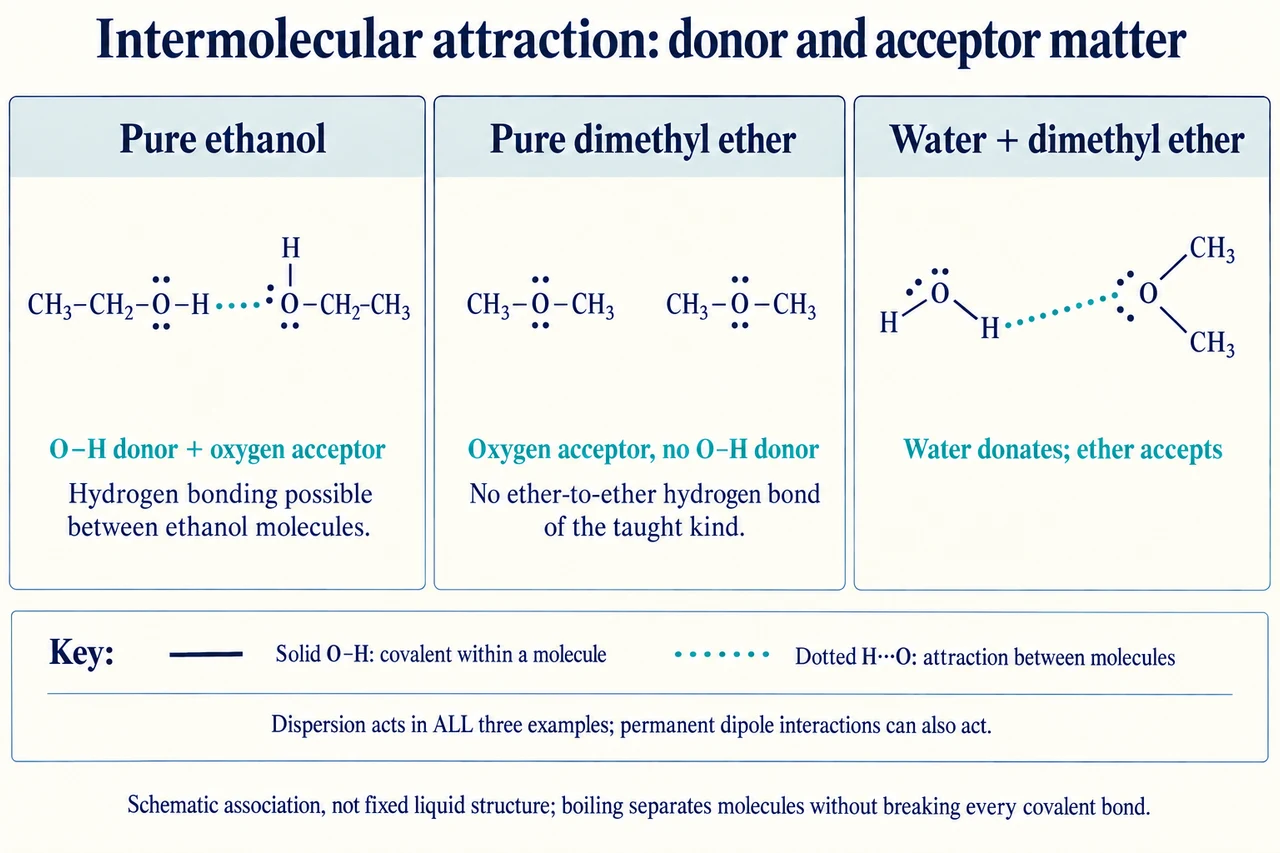
Classify interactions by the actual donor and acceptor sites. Ethanol has O–H donor and oxygen lone-pair acceptor; dimethyl ether has an oxygen acceptor but no O–H donor, so pure ether cannot form the same self hydrogen-bond network. Ether can nevertheless accept hydrogen bonds from water. Both have dispersion interactions; permanent molecular dipoles do not turn those off.
Equal formula/molar mass can help control a comparison but does not guarantee equal polarizability, contact geometry or packing. A boiling comparison mainly concerns separation of molecules in a liquid; melting also depends strongly on crystal packing. Hydrogen bonding offers a causal explanation for anomalous boiling within a suitably controlled comparison, not a universal ordering of every hydrogen-bonding substance above every heavier molecule.
Ice has a more open hydrogen-bonded arrangement than typical liquid water at the melting point. Melting permits a more compact distribution on average while many hydrogen-bond interactions remain. It does not convert H₂O molecules into H and O atoms or remove every hydrogen bond. A five-molecule drawing can illustrate local donor/acceptor geometry but cannot measure bulk density; the companion structure illustration supports a finite local ice motif; a complete periodic ice model and checked learner drawing remain outstanding. Read the donor–acceptor illustration before ranking any boiling points. The dotted ethanol H···O link lies between two distinct molecules; the solid O–H bond lies within the donor molecule. Pure dimethyl ether has an oxygen acceptor but lacks a hydrogen attached to N, O or F, so two ether molecules cannot supply the donor required by the rule taught here. In the mixture, water supplies an O–H donor to the ether oxygen. Dispersion acts in all three situations and is not switched off by adding a hydrogen bond. The snapshot does not claim a fixed arrangement in a moving liquid or draw all interactions. A hydrogen-bond association is not an additional full covalent O–H bond, so the ether oxygen has not acquired a third ordinary covalent substituent. These simplified local electron-pair drawings support donor and acceptor identification; they do not depict molecular orbitals or solve an intermolecular potential.
Worked example: Compare pure ethanol and pure dimethyl ether, both C₂H₆O, using their connectivity rather than formula alone. Additional worked reasoning: Compare hydrogen bonding in pure CH₃OCH₃, pure CH3CH₂OH and a mixture of CH₃OCH₃ with water.
Both contain electrons and therefore dispersion interactions.
Both have polar bonds and molecular dipoles.
Ethanol has O–H donors and oxygen lone-pair acceptors; the ether lacks an O–H donor.
Pure ether lacks an O–H donor, so no ether-to-ether hydrogen bonds of the taught kind. Ethanol can donate and accept. Water can donate to ether oxygen, so hydrogen bonding is possible in the mixture. State donor, acceptor and intermolecular nature in each.
Answer: Ethanol can form an extended hydrogen-bonding association between its own molecules; this helps explain its higher boiling point. No numerical boiling points are asserted. Pure ether lacks an O–H donor, so no ether-to-ether hydrogen bonds of the taught kind. Ethanol can donate and accept. Water can donate to ether oxygen, so hydrogen bonding is possible in the mixture. State donor, acceptor and intermolecular nature in each.
Check your understanding: Can dimethyl ether accept a hydrogen bond from water? Transfer 1: Synthetic density data are ice 0.917 ± 0.002 and liquid water 0.999 ± 0.002 g cm−3 at specified near-melting conditions. Does their uncertainty reverse the conclusion? Transfer 2: Why can counting total electrons alone fail to predict boiling order?
Answer: Yes, through an oxygen lone pair. Transfer 1: Intervals [0.915, 0.919] and [0.997, 1.001] are disjoint; ice is less dense under these synthetic conditions. This supports an open-structure explanation but does not independently prove the hydrogen-bond mechanism or describe all pressures and temperatures. Transfer 2: Dispersion depends on polarizability and contact geometry; permanent dipoles and hydrogen-bond networks also contribute. Use controlled comparisons and identify missing structural factors instead of a one-variable rule.
Why: The water supplies the donor O–H; an acceptor need not have its own O–H group. Explain the carrier, geometry or donor/acceptor mechanism, then state where the simplified model stops. A named example alone is not an explanation.