Macbeth: evidence, inference and the making of a tragic hero
By UK GCSE English Literature · independent study · myAudience
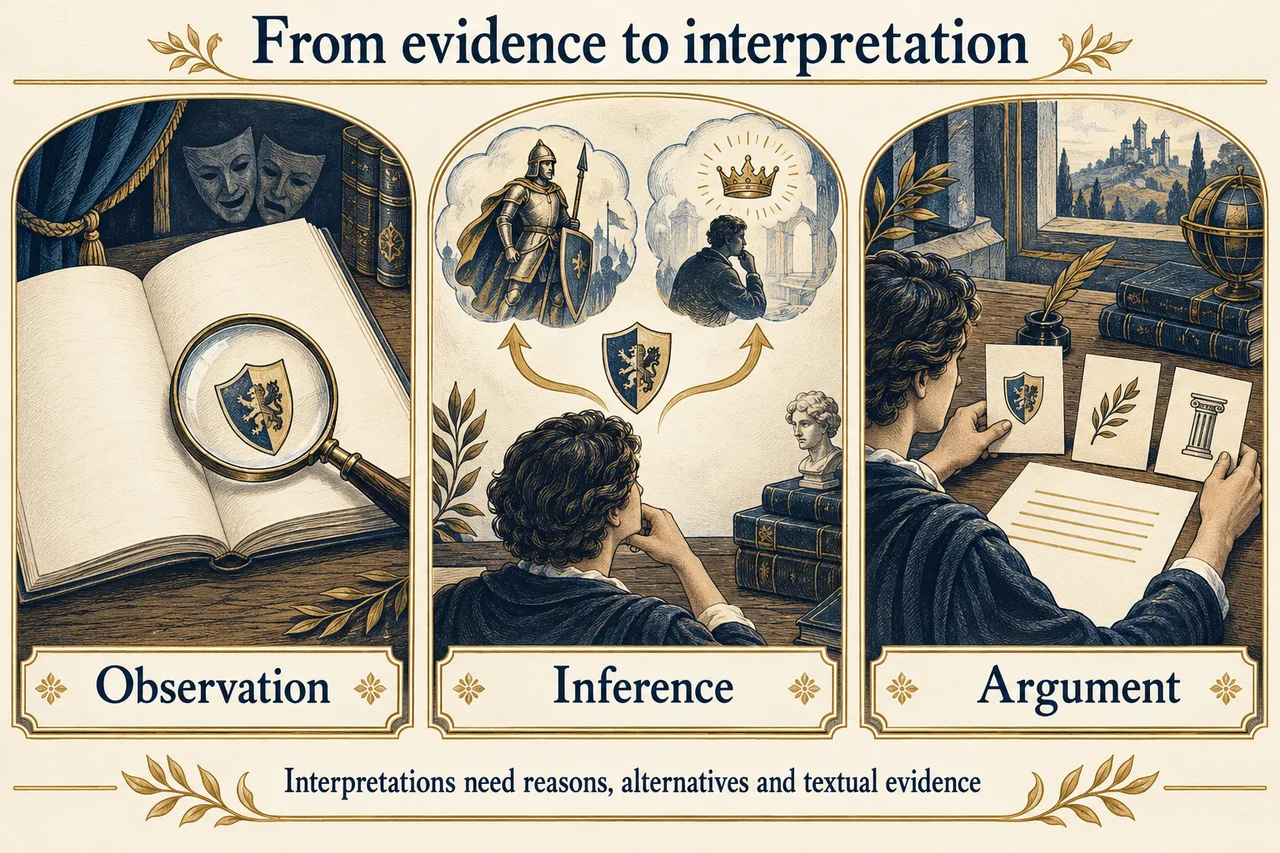
Image: illustration, not a documentary photograph. · Original generated educational illustration; pending editorial acceptance.
Macbeth: evidence, inference and the making of a tragic hero
Begin by reading Macbeth as a whole play, not as a collection of quotations. This cohort assumes that you can follow who speaks, paraphrase a scene and locate an act and scene in a complete lawful edition. A plot statement describes what happens; an inference explains something the words or action imply; an interpretation proposes what that pattern means. An interpretation becomes credible when it accounts for several details and survives awkward counterevidence. “Macbeth is evil” is a moral label, whereas “the play exposes the instability of honour founded on violence” is an arguable claim about Shakespeare's construction. The second claim needs testing, not automatic acceptance.
In 1.2, an injured captain describes Macbeth's violence in battle and Duncan rewards him. The audience hears a reputation before seeing Macbeth speak. This mediated introduction matters: public praise reaches us through a loyal soldier speaking to a king. Violence is initially presented as service, not simply condemned. In 1.3 Macbeth's imagination moves towards murder after the witches' greeting. The contrast permits a difficult question: has ambition corrupted an otherwise admirable soldier, or has royal approval hidden the danger in a culture that honours killing? Both readings use the opening, but neither should erase the distinction between fighting an armed rebel and killing a sleeping guest.
A tragic protagonist is the central character whose choices and suffering organise a tragedy. A protagonist need not be morally exemplary. A tragic flaw is one possible explanatory model, not a compulsory single-word diagnosis or an ancient rule mechanically followed by every play. Ambition, imaginative fear, dependence on masculine reputation and receptiveness to deceptive language interact here. If you select ambition as your main explanation, show how it develops through decisions. A theme is a recurring problem explored by a work; “power” names a subject, while “power acquired through violence creates insecurity rather than fulfilment” proposes a thematic relationship.
Precision requires distinguishing the play's setting from its composition and performance. The action concerns medieval Scotland, but the RSC places the probable composition around 1606 and stresses that exact dating is uncertain. The first surviving printed text is the 1623 First Folio. Those are source-supported historical statements. The claim that the opening encourages a Jacobean audience to question political violence is our interpretation. Do not write that every contemporary spectator shared the same belief, or that the play accurately reports the historical Macbeth. A drama adapts material to create conflict and theatrical effects; historical resemblance cannot establish documentary truth.
When you analyse a word, keep its immediate situation visible. The captain's “brave Macbeth” is praise from a participant in war; it is not a verdict from an all-knowing narrator. The adjective can first invite admiration, then become unstable as the audience witnesses later violence. That later instability is a retrospective effect: a subsequent scene changes how an earlier detail can be understood. Calling the phrase “foreshadowing” without showing the later relation adds little. Show exactly what remains continuous, such as readiness to kill, and what changes, such as victim, motive and legitimacy.
Build an evidence ledger with a location, literal observation, proposed significance and a possible objection. For 1.2, enter the report of battle, public honour and the objection that battlefield courage is not proof of future tyranny. For 1.3, enter Macbeth's private murderous thought and the objection that imagining an act is not yet doing it. This procedure prevents hindsight from making every early detail inevitable. Correct the misconception that an interpretation is strong because it is surprising: it is strong because it explains the text economically, acknowledges limits and produces a coherent argument that another reader can test.
The observation panel contains a shield symbol, not a quotation: return to the captain’s actual praise before making a claim about honour. The two thought images model competing interpretations of military reputation and private ambition. Neither proves a crime. The evidence cards in the final panel represent the need to explain why an observation supports an argument; their invented symbols are not additional textual evidence. Reading anchors: 1.2; 1.3. Read the complete lawful chosen text alongside this lesson. The commentary and answers are arguable original interpretations, not an official mark scheme.
Worked example: Original task: Write a paragraph arguing that the opening makes Macbeth admirable and dangerous at once. Use 1.2 and 1.3; do not assume his later crimes have already occurred.
Claim: distinguish public reputation from private response rather than list two character traits.
Evidence: the captain praises battle service; Macbeth subsequently entertains murder after the prophecy.
Method: analyse the order of presentation and the difference between reported action and private thought.
Qualification: lawful combat and regicide are different acts; continuity of violence is an interpretation, not moral equivalence.
Answer: Shakespeare first makes Macbeth valuable to the state before showing how that value can become dangerous. In 1.2 the captain’s “brave Macbeth” gives the audience a publicly approved identity, formed through violent service. Because Macbeth is introduced through another soldier’s report, his honour initially depends on a political community’s judgement. The private response to the witches in 1.3 then opens a gap between that reputation and an imagined murder. This sequence does not prove that his courage was always fraudulent: fighting a rebel differs from killing a guest. It does, however, allow us to question whether qualities rewarded in battle can be redirected towards personal advancement. Macbeth’s tragic interest lies partly in that disturbing continuity, as admirable capacity and destructive desire become difficult to separate.
Check your understanding: 1. Identify who praises Macbeth and why. 2. Explain how a private thought changes the audience’s understanding without proving a completed crime. 3. Transfer: plan a response to “Public honour is an unreliable guide to private morality”, using one later scene that complicates your opening claim.
Answer: 1. The captain praises military service to Duncan, so the praise has a situation and allegiance. 2. Private thought reveals desire or fear unavailable to Duncan; the gap invites suspicion, but imagining murder does not establish action. 3. Use Duncan’s welcome in 1.6 alongside Macbeth’s inward debate in 1.7, then the banquet in 3.4. Initially honour conceals intent; later public performance breaks down. The banquet complicates an absolute claim because outward behaviour begins to expose what reputation hid. Organise by the changing relationship between appearance and action, not by a list of crimes.
Why: The progression moves from literal comprehension to a bounded inference and then a whole-play argument. A stronger answer distinguishes the speaker’s judgement from Shakespeare’s arrangement of speakers. It does not diagnose Macbeth, assume a homogeneous audience or equate all violence. A defensible alternative could emphasise the hero’s initial loyalty, provided it explains why private murderous possibility is introduced so early.