Macbeth: conditional thought, ambition and responsibility
By UK GCSE English Literature · independent study · myAudience
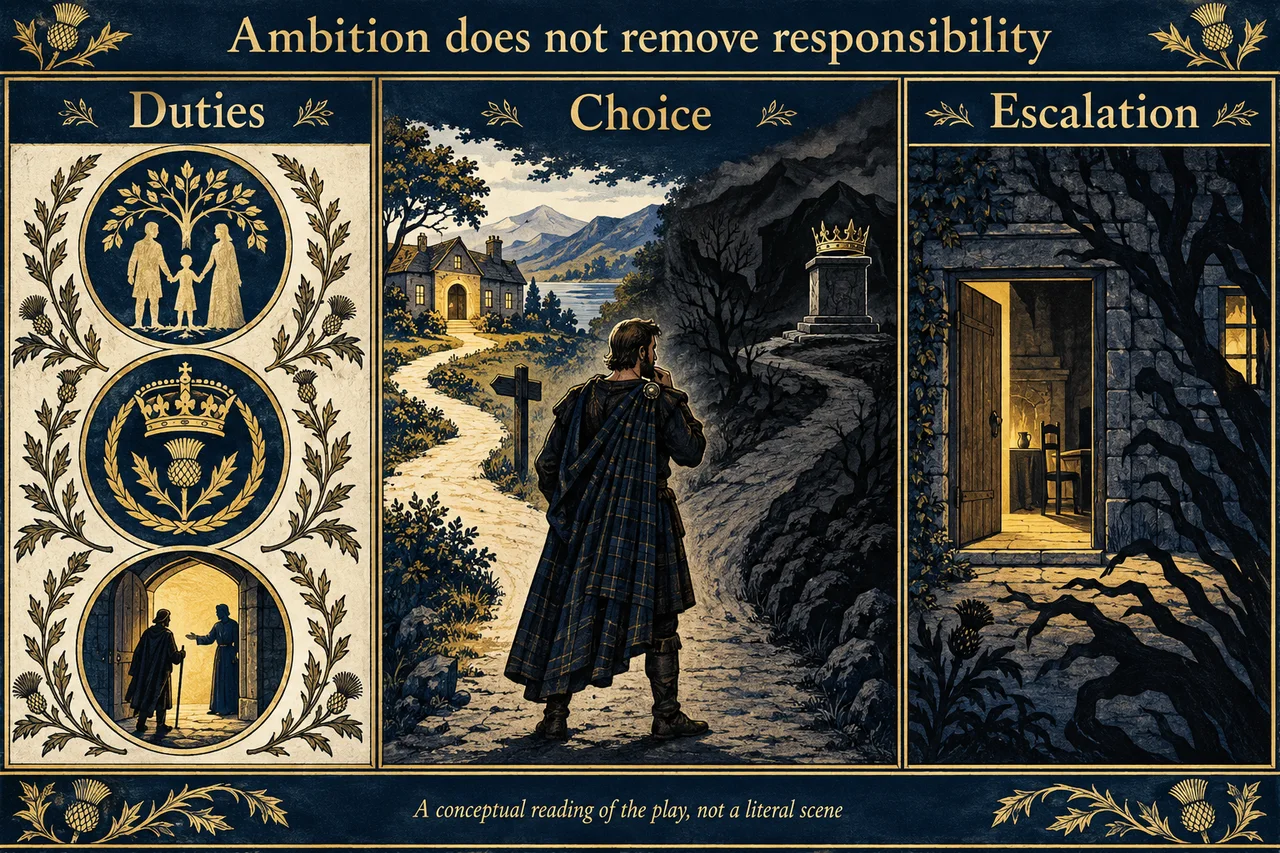
Image: illustration, not a documentary photograph. · Original generated educational illustration; pending editorial acceptance.
Macbeth: conditional thought, ambition and responsibility
Read 1.7 aloud before assigning names to its techniques. A soliloquy is a sustained speech conventionally exposing a character's thoughts when no other character is understood to hear them. It gives the audience access, but not a guarantee that the speaker understands himself accurately. An aside is usually briefer and set apart from conversation; neither device makes the speaker the author's spokesperson. In 1.7 Macbeth tests the murder through conditional reasoning, moral obligations and anticipated consequences. His hesitation is intellectually active. The question is not simply whether he feels afraid, but what his fear recognises and what he eventually chooses to suppress.
Verse also organises the thought. Blank verse is unrhymed verse using an iambic pentameter framework: conventionally five feet, each moving from a lighter to a stronger syllable. As an original demonstration, “the quiet road will lead us home at dawn” can be marked the QUI | et ROAD | will LEAD | us HOME | at DAWN. With quiet spoken as two syllables, there are ten syllables and five rising feet; a foot boundary can divide a word. This is a model, not a quotation from Shakespeare. Actual delivery can vary stress, pace and pause, so do not claim that every line has mechanically identical beats or that a variation proves one emotion. A caesura is a pause within a verse line; enjambment carries syntax across its end. In 1.7, follow how the conditional sentence moves beyond the first printed line rather than stopping thought at every line ending. That continuing syntax makes completed action difficult to isolate from consequences. The method is to read sentence and verse line together, then test a proposed performance effect.
The opening “If it were done when 'tis done” repeats “done” while making completion uncertain. A conditional clause makes an action depend on an imagined condition. Macbeth wishes that the murder could finish its consequences at the moment of execution. Yet the verbal repetition cannot settle what “done” includes: bodily death, political success, punishment or moral reckoning. The syntax enacts an attempted separation between an act and its aftermath. We infer evasion because the subsequent reasoning restores consequences that the wish tried to remove. A technique matters when its grammatical work helps explain a character's argument, not because its label sounds sophisticated.
Macbeth then identifies duties as kinsman, subject and host. These are distinct relationships, so the proposed murder violates several forms of trust at once. Hospitality matters concretely because Duncan is inside Macbeth's home and dependent on his protection. Regicide means killing a monarch, but using that noun alone does not explain this scene. Duncan's mild exercise of power further weakens Macbeth's excuse: the speaker supplies reasons against himself. This is strong evidence for responsibility. The witches have introduced a future possibility, yet Macbeth's own account shows that he can understand reasons to refuse the means he is considering.
The horse-riding metaphor of “vaulting ambition” imagines desire as a force that overreaches its intended landing. Ambition is not automatically immoral: it can mean striving towards a valued goal. Here the metaphor condemns disproportion and lack of a justified motive. It also anticipates a structural problem: securing the crown creates further insecurity, so the leap does not deliver stable arrival. Resist turning a metaphor into a precise prediction of every later scene. Its force lies in a relation between means, desire and control, which the later action can develop differently from the speaker's present understanding.
The strongest competing reading notices self-interest in the hesitation. Macbeth worries about earthly retaliation and his own afterlife as well as Duncan's virtues. His thought may therefore reveal moral insight without selfless commitment. Do not force a false choice between conscience and fear: mixed motives are possible. An argument can state that his capacity to articulate duty intensifies his guilt even if fear dominates his practical decision. Context makes the political stakes legible, but “Jacobeans believed in divine right” cannot replace the textual fact that he describes specific personal obligations. Avoid claiming a single universal political doctrine for an entire audience.
For transfer, compare the pause before Duncan's murder with Macbeth's later speed in ordering the attack on Macduff's family in 4.1. The contrast is a change in deliberation, not proof that he has ceased to think altogether. One reading sees moral resistance eroded by habitual violence; another sees rapid action as an anxious attempt to prevent thought from undermining authority. Correct the misconception that fate cancels choice: a prediction does not itself command a method, and Macbeth supplies both the plan and reasons against it. Your argument should evaluate the pressures acting on him while preserving the causal role of his decisions.
The duties panel groups kinship, lawful service and hospitality as distinct obligations rather than one vague fear. The branching path makes refusal imaginable: ambition does not mechanically determine murder. The threatened household panel asks how later haste differs from the earlier deliberation. These are invented concept symbols, not a reconstruction of a performed scene or proof of Shakespeare’s single intended meaning. Reading anchors: 1.7; 4.1. Read the complete lawful chosen text alongside this lesson. The commentary and answers are arguable original interpretations, not an official mark scheme.
Worked example: Original task: Analyse whether Macbeth’s hesitation in 1.7 reduces or intensifies his responsibility. Write a qualified model paragraph.
Separate pressure from compulsion: the prophecy does not specify murder.
Use conditional syntax as evidence of attempted consequence-free action.
Link the named duties to the situation of Duncan as guest.
Weigh the self-interested counterreading before reaching a judgement.
Answer: Macbeth’s hesitation intensifies rather than removes his responsibility because it shows that he can formulate the case against his own desire. The conditional opening, “If it were done when ’tis done”, tries to imagine a murder whose consequences end with its execution. Repetition gives the wish an apparent closure, but the surrounding speech repeatedly reopens what the act would entail. His duties as subject and host make Duncan’s vulnerability a reason for protection, not an opportunity for advancement. Admittedly, fear of punishment also shapes the hesitation, so the speech need not establish wholly disinterested goodness. Even that limitation matters: Macbeth recognises moral and practical barriers, then accepts their violation. Shakespeare makes the eventual decision disturbing through demonstrated understanding rather than through an absence of alternatives.
Check your understanding: 1. Define a conditional clause using Macbeth’s opening. 2. Explain why “the witches made him do it” is too strong. 3. Transfer: develop a two-stage argument comparing 1.7 with 4.1. Does faster action mean greater certainty or greater fear?
Answer: 1. An if-clause sets a condition under which another proposition would hold; here Macbeth imagines completion without continuing consequences. 2. The witches predict kingship but do not instruct him to kill Duncan. His deliberation and plan supply intervening choices. 3. Start with the extended testing of duties in 1.7, then contrast the decision to attack Macduff’s household in 4.1. Argue that speed can perform certainty while revealing insecurity: Macbeth acts to forestall threats he cannot fully know. Qualify this by noting the apparent hardening of resolve. The change is not simply courage gained; it is deliberation displaced by preventative violence.
Why: A complete answer derives its conclusion from grammar, situation and sequence. “Fear” and “certainty” are competing explanations to test, not mutually exclusive labels that must be chosen without evidence. The transferable skill is to analyse the reasoning performed by a speech before using it as character evidence. Do not treat responsibility as a numerical share or the prophecy as a causal law.