Macbeth: gender, persuasion and the gap between appearance and intent
By UK GCSE English Literature · independent study · myAudience
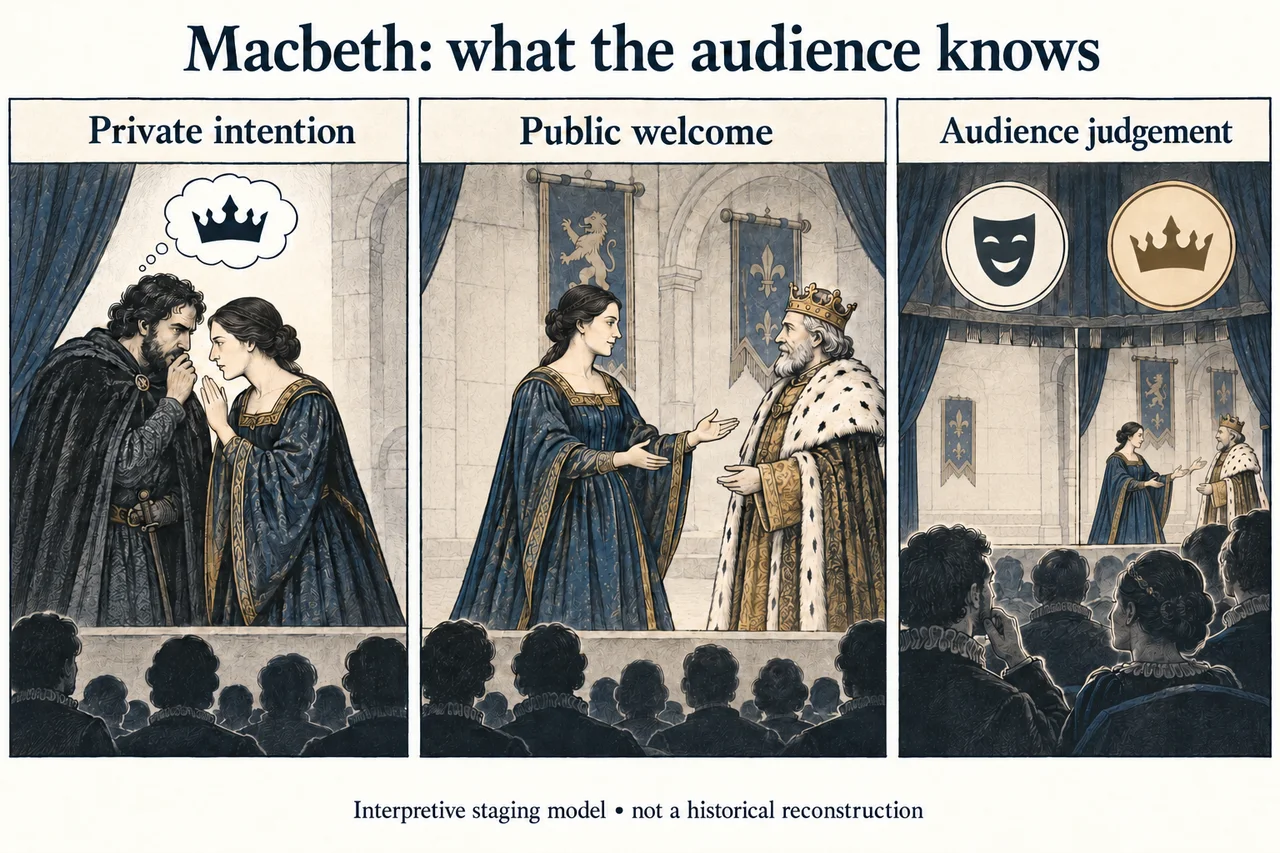
Image: illustration, not a documentary photograph. · Original generated educational illustration; pending editorial acceptance.
Macbeth: gender, persuasion and the gap between appearance and intent
In 1.5 and 1.7, Lady Macbeth uses language to alter what her husband regards as possible and honourable. Persuasion attempts to change another person's judgement or action; manipulation more specifically exploits vulnerabilities while concealing or distorting relevant considerations. Calling all persuasion manipulation can flatten the scene. Identify the mechanism: she reframes reluctance as a failure of manhood, makes courage depend on the proposed crime and presents practical preparation as reassurance. Her rhetoric is powerful partly because it redirects values Macbeth already recognises. He is not an empty vessel into which she places an entirely new ambition.
The imperative is a grammatical form used for commands or requests, often with an understood “you”. In “unsex me here”, Lady Macbeth addresses spirits and asks for qualities she associates with effective cruelty. It is an invocation, not proof that a physical transformation occurs. Her speech links gender to compassion, nurture and bodily imagery, then attempts to sever those connections. One reading exposes restrictive expectations that make ruthless action seem unavailable to a woman. Another sees her accepting the same hierarchy she appears to resist: strength still means renouncing qualities coded as feminine. The contradiction produces a stronger argument than “she wants to be a man”.
In 1.7 she makes manhood conditional on action. Macbeth initially distinguishes courage from immoral excess, so the dialogue stages a dispute about the definition of masculinity. Do not assume that one character's definition is the play's final judgement. Macduff's insistence in 4.3 that he must feel grief as a man later supplies an important counterexample. Feeling and action need not be opposites. Read the two exchanges together to trace an argument conducted across the drama: violent self-proving can be challenged by a model of masculine responsibility that includes sorrow and care. This is interpretation supported by contrasting speeches, not a claim that Shakespeare offers a single modern gender manifesto.
Lady Macbeth's flower-and-serpent comparison in 1.5 instructs Macbeth to manage visible surfaces. A simile states a likeness, while imagery gathers concrete sensory associations; the relevant issue here is how harmless appearance conceals danger. Dramatic irony arises when the audience knows something a character does not, so that speech or action acquires an additional significance. In 1.6 Duncan reads the welcome without knowing the intended murder. The audience can compare the private preparation with the public performance. His courtesy is therefore exposed to a hostile reinterpretation unavailable to him. Dramatic irony is not merely “something unexpected happens”.
Plate ELIT-A01 shows private plotting beside public hospitality, then spectators comparing those scenes. The crown in the thought bubble represents desired power, not a crown already won; Duncan alone wears a royal crown in the corrected version. The concealed crown motif is a visual metaphor for ambition rather than a stage direction. No character in the public panel can see the private conversation, but the theatre audience has experienced both. The plate compresses scenes and uses imagined costumes, so it cannot establish what an original performance looked like. Its useful claim concerns the distribution of knowledge, which you should verify against 1.5–1.6.
The marriage also changes structurally. Macbeth later conceals the plan against Banquo from Lady Macbeth in 3.2, reducing the partnership that seemed decisive in Act 1. This counterevidence prevents the claim that she controls every crime. She helps make the first decision workable, but Macbeth extends violence through his own initiative. Correct the misconception that power in a dialogue equals permanent power throughout the play. Track who proposes, knows, orders and performs each action. A nuanced response can recognise her coercive rhetoric while arguing that the drama distributes responsibility and exposes the limits of her apparent command.
Compare what the conspirators know with what Duncan hears in the welcome. Macbeth does not enter in Act 1 Scene 6: the public-welcome panel therefore shows Lady Macbeth and Duncan without him. The adjacent private scene is a conceptual juxtaposition, not simultaneous action. Costumes, audience, thought-crown and mask symbols are imagined; only the textual gap between intention and welcome supports dramatic-irony analysis. Reading anchors: 1.5; 1.6; 1.7; 3.2; 4.3. Read the complete lawful chosen text alongside this lesson. The commentary and answers are arguable original interpretations, not an official mark scheme.
Worked example: Original task: Write an annotated paragraph explaining how the play challenges a violent definition of manhood. Use the argument in 1.7 and the grief in 4.3.
Opening claim concerns a contested definition, not a general verdict on women or men.
First evidence: Lady Macbeth makes murder a test of masculine status.
Counterevidence: Macduff associates manhood with the capacity to feel grief.
Judgement: the later scene challenges the earlier rhetoric without absolving either conspirator.
Answer: Shakespeare presents violent manhood as an argument characters use, rather than an uncontested truth. In 1.7 Lady Macbeth makes Macbeth’s identity depend on committing murder, redirecting a soldier’s investment in courage towards the violation of a sleeping guest. Her persuasion is effective because it attacks a reputation he values. Yet Macduff’s response to his family’s deaths in 4.3 insists that he must “feel it as a man”. The later formulation includes grief within masculinity instead of treating feeling as weakness. That contrast exposes the narrowness of the earlier test: suppressing compassion can make violence possible, but does not make it honourable. The play consequently allows masculine responsibility to include emotional recognition, while leaving Macbeth accountable for accepting a definition he had initially resisted.
Check your understanding: 1. Distinguish invocation from achieved transformation in 1.5. 2. Explain the dramatic irony of Duncan’s welcome. 3. Transfer: evaluate “Lady Macbeth governs all Macbeth’s violence” using 1.7, 3.2 and 4.3. Specify what each scene can and cannot prove.
Answer: 1. “Unsex me” is a request to spirits; it does not show that the request is granted. 2. Duncan lacks the audience’s knowledge of the plot, so sincere hospitality language acquires a concealed threat. 3. In 1.7 Lady Macbeth substantially pressures the decision and supplies a plan. In 3.2 Macbeth withholds the next murder plan, so her control is not continuous. In 4.3 an alternative account of manhood challenges the value that enabled her persuasion; it does not describe her direct action. Conclude that she influences the first regicide while Macbeth later expands violence independently. This accounts for agency and changing knowledge instead of assigning a single permanent controller.
Why: An interpretation must distinguish rhetorical influence, practical planning and authorial evaluation. The plate is an aid to the second task, not evidence for historical dress or the actual blocking of a performance. Better answers also acknowledge that a director can alter our impression through tone and proximity, while the sequence of private preparation and public welcome remains textual evidence.