Macbeth: guilt, theatrical uncertainty and the limits of cleansing
By UK GCSE English Literature · independent study · myAudience
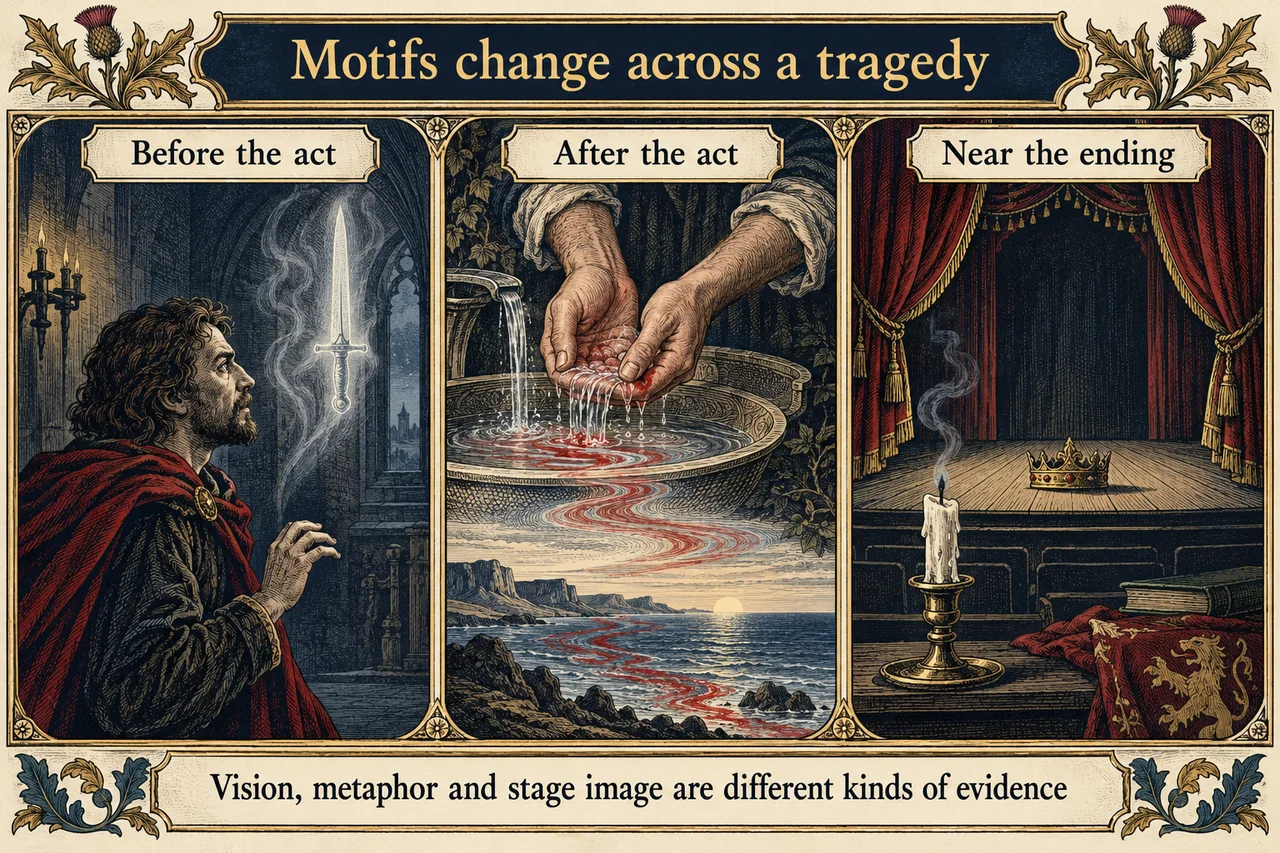
Image: illustration, not a documentary photograph. · Original generated educational illustration; pending editorial acceptance.
Macbeth: guilt, theatrical uncertainty and the limits of cleansing
In 2.1 and 2.2, the murder itself occurs offstage while the audience watches anticipation and aftermath. This is a structural choice: attention falls on perception, hesitation, sound and response rather than on a spectacle of the killing. Offstage action is not unimportant action; it can intensify imaginative participation because the audience must construct what the characters cannot undo. When you discuss an effect, name the evidence for it. The bell, Macbeth's exit and his return connect inward debate to a completed act, while knocking introduces pressure from a world outside the conspirators' private space.
The dagger speech tests sight against touch. A rhetorical question need not seek an answer from another speaker; here the questions dramatise uncertainty about an image's status. Macbeth attempts to grasp what he sees and cannot. This supports a reading of the dagger as an externalised mental image, but the play's supernatural framework makes a purely psychological explanation contestable. A director could show a dagger, leave Macbeth looking at empty space or use light to suggest uncertainty. Those are proposed performance choices, not evidence that one production is required. Explain which interpretation a choice would strengthen and what uncertainty it would reduce.
Macbeth's post-murder speech moves from the visible blood on his hands to a disproportionate imagined cleansing. Invoking Neptune's ocean gives the question a scale no ordinary washing can meet. Hyperbole is deliberate exaggeration; here it reveals the mismatch between a physical stain and moral injury. The alternative image reverses cleansing: the hands would colour the water instead. This reversal makes guilt seem contaminating rather than removable. Do not claim that red always symbolises guilt in every work. Its meaning here arises from recently committed murder, blood on the hands and the contrast with impossible purification.
Lady Macbeth's immediate confidence in water offers a practical counterposition. Yet in 5.1 her compulsive imagined washing undermines it. A motif is a recurring element whose repetitions and variations develop meaning. The blood-and-washing motif matters because its ownership and function change: the first act's practical organiser later cannot obtain the assurance she once offered. Structural comparison adds more than repeating a quotation. Note the changed situation, audience knowledge and status of the stain. In 2.2 blood is materially present; in 5.1 the cleaning responds to an imagined spot. The second scene is witnessed and reported by others, exposing private suffering.
Guilt is a sense of responsibility for wrongdoing; remorse includes regret about the wrong or its consequences. Neither term requires a medical diagnosis. Macbeth's distress is evidence of disturbed consciousness, but it does not prove a settled intention to repair harm. His later murders are an important objection to a reading that equates suffering with redemption. Lady Macbeth's sleepwalking likewise invites pity without restoring Duncan or the other victims. Tragedy can place sympathy and judgement together. A reader may recognise suffering while refusing to treat the sufferer's pain as equivalent to the pain imposed on others.
Correct the misconception that identifying a hallucination completes analysis. Even if you choose that interpretation, you must show why perception is unstable at this point, how the speech is staged and how the image participates in the play's larger pattern. Equally, “the dagger is definitely a witch's spell” outruns the evidence. Write calibrated claims: the failed attempt to grasp it supports a mental-image reading; the supernatural atmosphere leaves another possibility available. Your conclusion should explain why uncertainty is productive: the audience observes Macbeth seeking external confirmation for an act whose moral implications he already understands.
The dagger is drawn translucent to keep its status uncertain, rather than certify a supernatural cause. The centre panel turns Macbeth’s imagined ocean of cleansing into an illustration of hyperbole: water does not literally carry the murder to the sea. The final candle anticipates the later speech, not this night’s stage directions. Following the motif across separate scenes explains how guilt and meaning change; it does not establish a medical diagnosis. Reading anchors: 2.1; 2.2; 5.1. Read the complete lawful chosen text alongside this lesson. The commentary and answers are arguable original interpretations, not an official mark scheme.
Worked example: Original task: Analyse how the changing washing motif challenges the idea that consequences can be controlled. Use 2.2 and 5.1.
Select the material blood in 2.2 and the imagined stain in 5.1 as a precise contrast.
Analyse scale in Macbeth’s ocean image rather than simply naming hyperbole.
Show how Lady Macbeth’s later action reverses her earlier confidence.
Qualify: suffering makes control fail; it does not by itself establish repentance or repair.
Answer: The washing motif turns practical confidence into evidence of failed control. In 2.2 Macbeth imagines blood overwhelming Neptune’s ocean, making the stain proportionately larger than any available remedy. The hyperbole separates moral consequence from physical cleaning. Lady Macbeth initially treats water as sufficient, but her repeated washing in 5.1 returns to a spot that no longer needs to be materially present. Shakespeare transfers the problem from Macbeth’s immediate terror to her later involuntary behaviour, so an attempted solution becomes a sign of continuing injury. This reversal can invite sympathy for her suffering without proving redemption: the victims remain dead and no repair follows. The pattern therefore challenges the conspirators’ belief that managing appearances or removing evidence can end what their action has begun.
Check your understanding: 1. Explain why the dagger’s status is uncertain. 2. Distinguish a physical stain from the later imagined stain. 3. Transfer: propose two stage treatments for 2.1 and evaluate how each alters the balance between external temptation and Macbeth’s imagination.
Answer: 1. Macbeth sees the dagger but cannot grasp it; the play also includes supernatural agents, so sight and context support different explanations. 2. The early blood follows a real murder, whereas Lady Macbeth’s later action responds to a perceived spot during sleepwalking. 3. A visible suspended dagger can make temptation seem external and shared with the audience, though it risks closing uncertainty. An empty stage directs attention to Macbeth’s speech and reaching hand, strengthening a mental-image reading while withholding visual confirmation. Neither treatment proves an objective cause within the story. Compare how each invites the audience to judge Macbeth’s search for permission and preserve the text’s questions.
Why: The transfer requires an interpretation of form as performed drama. A stage proposal should specify a visible or audible choice, derive its effect and acknowledge the evidence it suppresses. No medical label is necessary. A strong response treats guilt as a moral and theatrical problem rather than assuming that pain automatically pays for a crime.