Macbeth: insecure kingship, equivocation and the widening circle of harm
By UK GCSE English Literature · independent study · myAudience
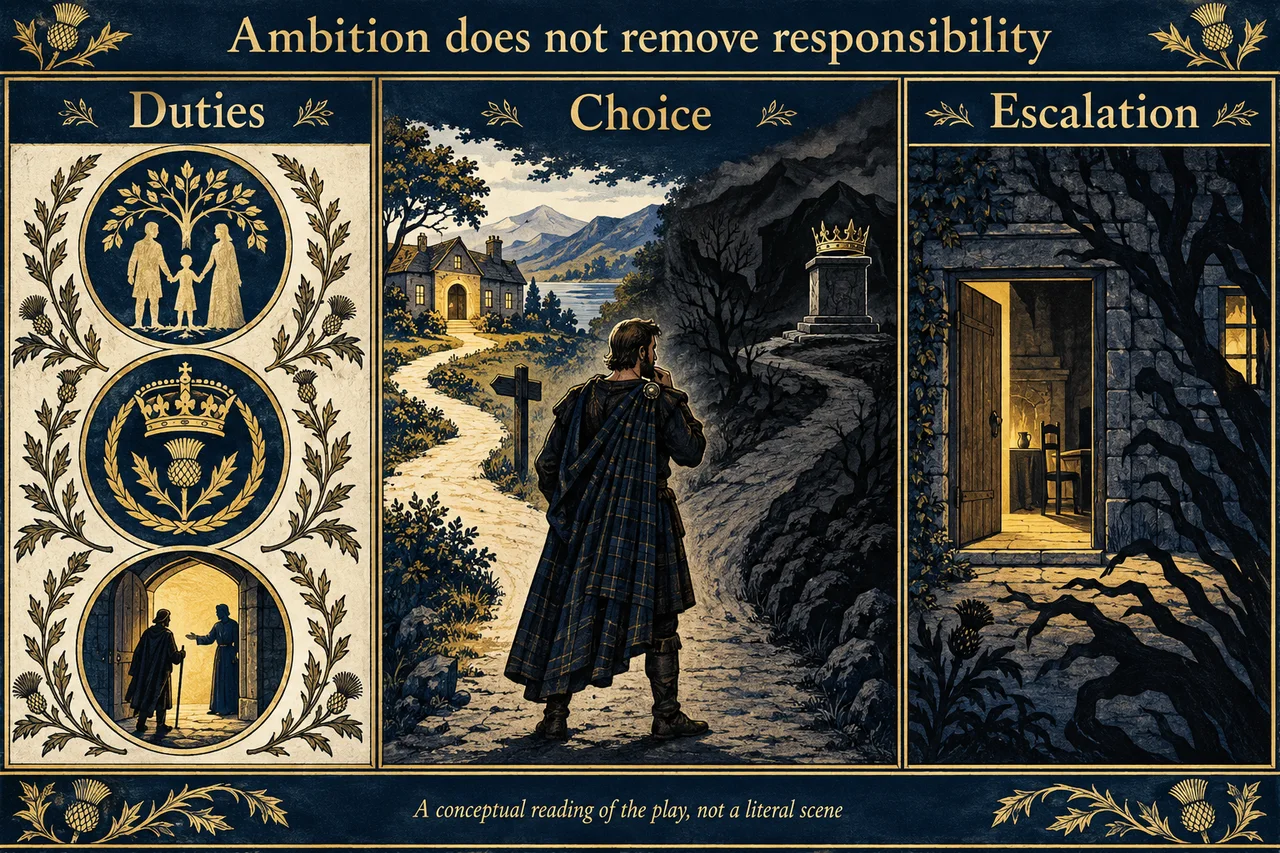
Image: illustration, not a documentary photograph. · Original generated educational illustration; pending editorial acceptance.
Macbeth: insecure kingship, equivocation and the widening circle of harm
Acts 3 and 4 test the assumption that possessing power will satisfy the desire that produced the first crime. Macbeth's fear of Banquo's descendants shifts attention from gaining kingship to controlling succession. A distinction between possession and security is essential: he has the title, but cannot guarantee its future. The metaphor of a fruitless crown makes rule seem barren because it will not produce the desired line. The crown is not literally unable to bear fruit; the figurative language imports reproduction and inheritance into the political object. Explain the relationship before naming the metaphor.
The banquet in 3.4 is both a public ceremony and a private crisis. A banquet displays order, hospitality and royal authority, yet Macbeth's reaction to the ghost interrupts that performance. Dramatic form allows the audience to watch a social script break down in real time. Other guests cannot straightforwardly share his perception; their responses give the audience a second view of his behaviour. The contrast does not require a narrator to call him unstable. A director's choice to show or withhold the ghost changes the audience's sensory alignment, but the interruption and Lady Macbeth's attempts to manage it remain central.
Banquo and Fleance must be distinguished: Banquo is killed, while Fleance escapes. Macbeth can order violence but cannot reliably command its results. This matters to the argument about insecurity, because the feared future is not eliminated. Banquo's own earlier uncertainty also complicates his status as an entirely uncomplicated moral opposite. A foil is a character whose similarities or differences illuminate another character. A foil need not be perfect. Compare their responses to prophecy, their attitudes to honour and their actions; do not convert contrast into an unsupported claim that one has no ambition at all.
Equivocation uses wording that allows different senses, often enabling a listener to infer a reassuring meaning that the speaker need not straightforwardly state. In 4.1 the assurance concerning birth encourages Macbeth to turn a qualified proposition into universal invulnerability. Later Macduff's account exposes the gap between Macbeth's inference and the prediction's wording. This is not a mathematical paradox or a medical definition of birth: it is a dramatic exploitation of ordinary expectations. Similarly, the movement of Birnam Wood depends on a concealed practical possibility. Shakespeare makes misplaced confidence depend on the receiver's active interpretation, so deception and self-deception work together.
The attack on Macduff's family widens violence beyond opponents who threaten Macbeth directly. The domestic scene in 4.2 gives the audience access to vulnerable people rather than only to the ruler's fear. Its position before Macduff learns the news creates a painful knowledge gap: spectators already know what he is about to discover. Political harm thereby acquires personal relationships and voices. Calling this merely “another murder” misses the change in dramatic scale. The sequence asks whether Macbeth's private insecurity has become a principle of government, producing suffering for people whose lives do not revolve around his ambitions.
Context can sharpen the stakes of succession and treason without dictating a single answer. The RSC relates the play's equivocation references to the aftermath of the Gunpowder Plot trials; that is a historically grounded interpretive connection, not proof that every ambiguous line encodes a named conspirator. Correct the misconception that contextual knowledge is a detachable paragraph of facts. Attach a relevant fact to a textual problem, then evaluate its limit. For example, the possibility of political deception can make the prophecy's language culturally resonant, while the play also makes that deception intelligible to audiences who do not know the trial history.
Read the same duty-and-choice plate against the widening harm in Acts 3 and 4. The empty household and dark branches symbolise threatened people; they do not reproduce a murder or show an inevitable prophecy. Contrast the time Macbeth gives to duties in 1.7 with the declared haste in 4.1. A crown on a pedestal visualises desire, without presenting accession as deserved or depicting an actual stage prop. Reading anchors: 3.1; 3.3; 3.4; 4.1; 4.2; 4.3; 5.8. Read the complete lawful chosen text alongside this lesson. The commentary and answers are arguable original interpretations, not an official mark scheme.
Worked example: Original task: Write a paragraph explaining why Macbeth’s increasing violence fails to secure his position. Use the banquet and the escaped Fleance.
State the difference between the title he possesses and the future he wants to guarantee.
Use Fleance’s escape as an outcome outside his control, not a completed overthrow.
Analyse the banquet’s public form and interruption by private terror.
Connect unsuccessful security to further violence without excusing the decision.
Answer: Macbeth’s violence fails because it cannot turn present possession into guaranteed succession. Banquo’s death removes one person, but Fleance’s escape preserves the future Macbeth fears; the result therefore contradicts the total control imagined in his plan. At the banquet in 3.4, royal ceremony should display settled authority, yet the ghost converts the occasion into a visible struggle to maintain appearances. The guests witness disruption even when they do not share Macbeth’s vision. Shakespeare makes insecurity public through the failure of a social form designed to conceal it. Further violence becomes an attempt to answer a problem violence has intensified. This does not make tyranny inevitable or absolve its author: Macbeth repeatedly chooses to treat uncertainty as permission to attack others.
Check your understanding: 1. Explain why Fleance’s escape matters without claiming he becomes king in the play. 2. Identify the inference Macbeth wrongly treats as certainty after the birth prophecy. 3. Transfer: evaluate whether 4.2 changes the scale of the tragedy, using its placement before Macduff receives the news.
Answer: 1. Escape leaves the predicted lineage possible; the play does not stage Fleance’s accession. 2. Macbeth assumes the ordinary sense of being born exhausts every possible case and therefore that no human opponent can harm him. 3. The household scene grants threatened civilians speech and relationships, moving beyond the ruler’s self-focused fear. Its placement means the audience knows the loss before Macduff, so his discovery is not just information but an encounter with an already witnessed catastrophe. Argue that the tragedy expands from personal ambition to the social costs of rule. Qualify that public political disorder was present earlier; this scene concentrates it in domestic experience.
Why: The model keeps prediction, inference and observed outcome separate. It corrects both the invented ending in which Fleance takes the crown and the idea that a prophecy is transparently understood on first hearing. The transfer answer uses sequence and access to knowledge to explain scale, rather than claiming that the presence of children automatically produces one universal emotional response.