Macbeth: time, tragic endings and a judgement that remains contested
By UK GCSE English Literature · independent study · myAudience
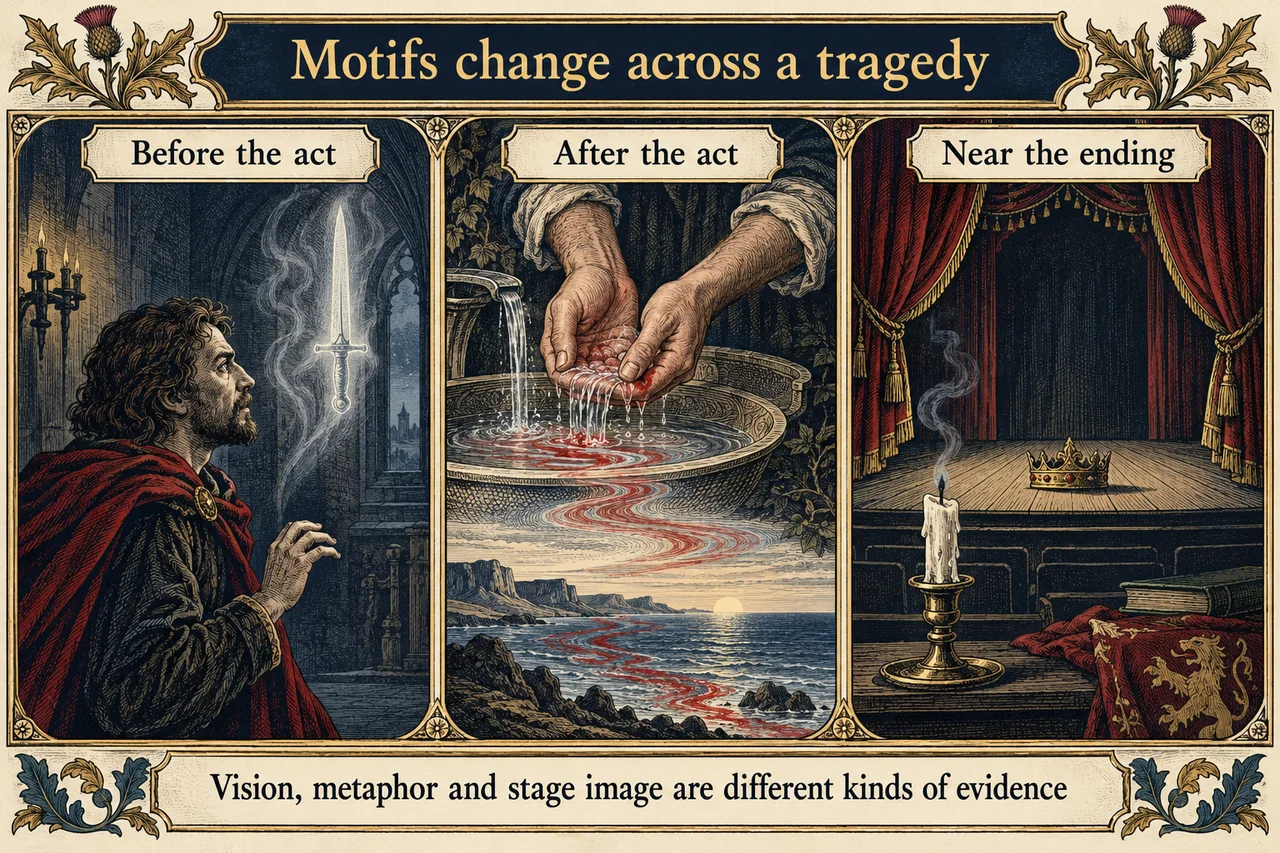
Image: illustration, not a documentary photograph. · Original generated educational illustration; pending editorial acceptance.
Macbeth: time, tragic endings and a judgement that remains contested
The final act changes the play's handling of time and language. In 5.5 Macbeth responds to the announcement of his wife's death with a speech about life's progression towards emptiness. A nihilistic view denies or radically doubts value or meaning; using the term does not establish that the whole play endorses that view. The speech belongs to a character whose choices have destroyed relationships and trust. Its dramatic situation both gives it emotional force and limits its authority. An audience may find its account of mortality compelling while recognising that Macbeth's own conduct has helped produce the isolation from which he speaks.
The repetition of “tomorrow” turns future time into successive units that seem to offer no renewal. Repetition can create emphasis, rhythm or attrition; here its effect depends on the surrounding images of small movement and extinction. The candle metaphor makes life vulnerable and brief. The subsequent theatrical image presents a person as a performer with temporary noise and motion. Because the speech occurs inside a play, this metaphor also invites reflection on performance itself. Do not call it metatheatrical merely because you have learned the word: explain that a drama uses acting as an image of human life, creating a relation between the audience's present experience and the speaker's claim.
Earlier Macbeth wants to control the future promised by prophecy; now future time seems empty. That reversal links ambition to disillusionment. Yet the final fighting complicates a reading of total passive surrender. Macbeth continues to resist even after reassurance fails. One interpretation sees remnants of the soldier's courage, another sees stubborn refusal to face responsibility, and a third sees courage detached from a defensible cause. These are competing accounts of the same action, not mutually exclusive plot summaries. A persuasive judgement specifies which account best explains his words, opponent and situation, while acknowledging the residue explained by the alternatives.
Macduff's encounter supplies the limit to Macbeth's interpretation of the birth prophecy. Recognition here means coming to understand a previously misunderstood situation; it need not produce moral conversion. Macbeth recognises deception, but that recognition does not entail restoring his victims or accepting justice. Avoid treating every last-act discovery as a redemptive moment. The audience can distinguish intellectual correction from ethical change. His response to the failure of prophecy therefore matters as much as the revelation itself: the drama asks what a person does when the story supporting his invulnerability collapses.
Malcolm's closing movement offers political restoration, but a restored ruler cannot reverse the dead. Closure is the degree to which an ending resolves a work's conflicts; it can be strong in one dimension and incomplete in another. The throne changes hands and supporters are rewarded, while grief and damage survive. A reading that calls the ending simply “happy” ignores the tragic losses, but a reading that sees nothing except endless chaos ignores the public settlement. You can argue that the play restores legitimate rule while making that restoration costly and ethically demanding. The word “legitimate” here describes the drama's presentation of rightful succession, not a timeless endorsement of every monarchy.
A whole-play essay should test its thesis against the ending, not save it as a compulsory final quotation. If the thesis is that ambition produces emptiness, the final fighting is necessary counterevidence. If the thesis is that bravery is restored, the absence of reparative action is necessary counterevidence. Correct the misconception that a personal response is an unsupported feeling. It is a judgement you can defend through precise reference, method and qualification. A demanding response can find Macbeth impressive at a moment without endorsing his cause, and can find the ending restorative without pretending the social and personal harms have disappeared.
The final panel’s extinguishing candle and empty crown are conceptual partners for the time speech and failing rule. They do not quote the play or prescribe a production’s closing image. Compare that despair with Malcolm’s final settlement, rather than making Macbeth’s voice stand for every character. The earlier dagger and washing panels provide a route back through his choices, showing that recognition at the ending does not undo earlier harm. Reading anchors: 1.2; 5.5; 5.8 combat and closing settlement (5.9 in some editions). Read the complete lawful chosen text alongside this lesson. The commentary and answers are arguable original interpretations, not an official mark scheme.
Extended argument to develop: Macbeth’s ending changes what he knows more clearly than what he does. The birth prophecy’s fulfilment exposes a mistaken interpretation; it does not teach him to repair the injuries of his rule. His refusal to yield can therefore be recognised as courage without being accepted as moral recovery. Earlier courage protected Duncan’s kingdom, whereas final resistance defends a position created through regicide and further violence. This contrast tests the easy claim that an admirable quality remains admirable regardless of its purpose. The time speech adds a difficulty: its weary compression of repeated days can evoke sympathy for a speaker who finds achievement empty. Sympathy for that suffering, however, need not excuse the actions which produced it. The audience hears a personal account of meaninglessness rather than an uncontested final truth. Malcolm’s settlement offers a political countervoice, promising a different future even though succession cannot bring back the dead. A response could conclude that tragedy makes judgement uncomfortable by preserving recognisable human capacities within a destructive course of action. A defensible alternative might give greater weight to Macbeth’s final defiance, but it must explain why defiance should count as redemption when no reparative choice follows. Now turn this linked argument into your own response to a specified extract, choosing and analysing short, accurate evidence at each step; it is a reasoned model of connections, not a complete timed examination answer.
Worked example: Original task: Write a qualified paragraph on whether Macbeth’s final resistance restores his heroic identity. Bring the opening soldier and the final act into relation.
State a judgement that distinguishes capacity from moral cause.
Compare military courage in 1.2 with resistance after reassurance fails in 5.8.
Use the speech about time as a complication, not the author’s final philosophy.
Close by explaining what is recovered and what remains unrepaired.
Answer: Macbeth’s final resistance recovers something of the opening soldier’s capacity without restoring the moral value of his cause. The courage admired in 1.2 reappears when he continues to fight after the prophecy’s reassurance collapses, so the ending resists a simple portrait of cowardice. Yet the same willingness to confront danger now serves the rule sustained by his crimes. His speech about empty time in 5.5 makes the persistence especially troubling: action continues after the future has lost its promised fulfilment. We may admire endurance while judging its object destructive. Shakespeare consequently separates a heroic quality from a heroic identity. Macbeth can retain courage without repairing the trust, relationships and lives his pursuit of power has destroyed.
Check your understanding: 1. Explain why Macbeth’s account of life cannot automatically be called Shakespeare’s belief. 2. Distinguish recognition from repentance in the final encounter. 3. Transfer: plan an essay arguing that the ending is both restorative and unresolved, selecting three moments and one counterreading.
Answer: 1. It is situated speech by an isolated character; other action and voices can contest it. 2. Recognising the prophecy’s deception corrects understanding but does not establish remorse or repair. 3. Use the failure of reassurance in 5.8, Macduff’s victory and Malcolm’s closing settlement in Folger’s 5.8 (5.9 in some editions). Trace movement from deceptive private certainty to public succession, then qualify restoration through deaths that the settlement cannot reverse. Counterreading: the final rewards and invitation strongly organise political closure. Answer it by distinguishing resolved succession from surviving human loss, rather than denying the force of the ceremonial ending.
Why: This is an original essay problem, not a reproduced question or a promised grade. A good plan develops relations between scenes and includes relevant contrary evidence. Accurate scene numbering should follow the learner’s edition: some editions arrange the final scenes differently, so the speech or event anchor takes precedence over an unverified line number. A coherent thesis need not claim that every conflict is resolved in the same way.